Derris elliptica
(Roxb.) Benth.
Derris Root
iNaturalist· cc-by-nc
(c) JODY HSIEH, some rights reserved (CC BY-NC), uploaded by JODY HSIEH
iNaturalist· cc-by-nc
(c) JODY HSIEH, some rights reserved (CC BY-NC)
iNaturalist· cc-by-nc
(c) JODY HSIEH, some rights reserved (CC BY-NC)
Summary
Source: WikipediaDerris eliptica is a species of leguminous plant from Southeast Asia and the southwest Pacific islands, including New Guinea. The roots of D. elliptica contain rotenone, a strong insecticide and fish poison. Also known as derris powder and tuba root (in Indonesia), it was formerly used as an organic insecticide used to control pests on crops such as peas. However, due to the high acute toxicity of rotenone to which the powder is often refined, it is unsafe: in spite of its popularity with organic growers., Derris root, when crushed, releases rotenone. Some native residents of Fiji and New Guinea practice a form of fishing in which they crush the roots and throw them into the water. The stunned or killed fish float to the surface where they can be easily reached. Despite its toxicity, Derris is used as a food plant by Lepidopteran larvae including Batrachedra amydraula.
Description
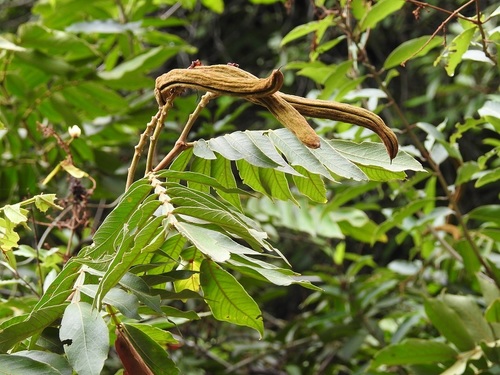
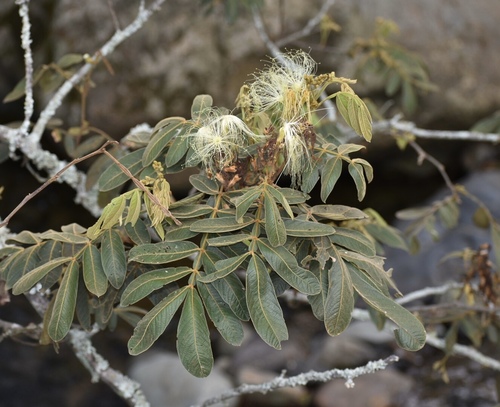
An evergreen vine. The stem is sturdy and climbing. It can be 5-12 m long. The older stems can be 3-4 cm thick. The young shoots can grow for several metres without producing leaves. The leaves are divided and have a silky surface underneath. There are 7-15 leaflets. These are oblong and 2-42 cm long by 2-8 cm wide. They are widest near the tip before tapering to a point. The flowers are bright red and pea shaped. They occur in clusters. The clusters are 11-26 cm long. They have rusty hairs. The fruit is an oblong pod 4-8 cm long and 2-2.5 cm wide. There are 1-3 seeds inside.
Edible Uses
The leaves have been recorded as eaten in Thailand, though this should be treated with caution. The bark is chewed with betel leaf.
Traditional Uses
CAUTION: The roots are poisonous. The leaves have been recorded as eaten in Thailand but this should be treated with caution. The bark is chewed with betel leaf.
Known Hazards
The roots are poisonous and should not be consumed.
Distribution
It is a tropical plant. It prefers humid well drained soil. It needs a protected sunny position. It is drought and frost tender. In Papua New Guinea it grows from sea level to 70 m altitude.
Where It Grows
Asia, Australia, China, East Timor, Fiji, India, Indochina, Indonesia, Malaysia, Micronesia, Myanmar, Northeastern India, Pacific, Palau, Papua New Guinea, PNG, Rotuma, SE Asia, Thailand, Timor-Leste, Vietnam,
Cultivation
Plants can be grown from seed. The seed needs to be treated to break the hard seed coat before planting.
Other Information
It is cultivated.
Notes
The insecticide derris dust comes from this plant. The root is also pounded and used to stun fish. There are about 80 Derris species.
Synonyms
Also Known As
Bakal bih, Co-rua, Etam chali, Hiru alu, Hon, Makoi sopa, Myin-gaung-nwe
References (11)
- Ambasta, S.P. (Ed.), 2000, The Useful Plants of India. CSIR India. p 167
- Bodkin, F., 1991, Encyclopedia Botanica. Cornstalk publishing, p 335
- J. Proc. Linn. Soc., Bot. 4(suppl.):111. 1860
- Martin, F.W. & Ruberte, R.M., 1979, Edible Leaves of the Tropics. Antillian College Press, Mayaguez, Puerto Rico. p 199
- Patiri, B. & Borah, A., 2007, Wild Edible Plants of Assam. Geethaki Publishers. p 38
Show all 11 references Hide references
- Purseglove, J.W., 1968, Tropical Crops Dicotyledons, Longmans. p 256
- Smith, P.M., 1979, Derris, in Simmonds, N.W., (ed), Crop Plant Evolution. Longmans. London. p 311
- Sukarya, D. G., (Ed.) 2013, 3,500 Plant Species of the Botanic Gardens of Indonesia. LIPI p 918
- Sutjaritjai, N., et al, 2019, Traditional Uses of Leguminosae among the Karen in Thailand. Plants 2019, 8, 600 p 7 (As Paraderris elliptica)
- Verdcourt, B., 1979, Manual of New Guinea Legumes. Botany Bulletin No 11, Division of Botany, Lae, Papua New Guinea. p 320
- Zeven, A. C. & de West, J. M. J., 1982, Dictionary of cultivated plants and their regions of diversity. Wageningen. p 57