Dendrocalamus latiflorus
Munro
Sweet bamboo shoot, Taiwan giant bamboo, Dried bamboo shoot
iNaturalist· cc-by-nc
(c) Hugo Sun, some rights reserved (CC BY-NC)
iNaturalist· cc-by-nc
(c) Hugo Sun, some rights reserved (CC BY-NC)
iNaturalist· cc-by-nc
(c) 張子見, some rights reserved (CC BY-NC)
Summary
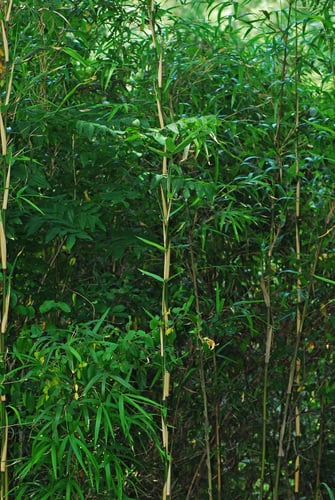
An evergreen bamboo reaching 20 m tall with a 10 m spread, growing at a fast rate. Hardy to UK zone 10, flowers are wind-pollinated. Adapts to light sandy, medium loamy, and heavy clay soils with good drainage across mildly acidic to mildly alkaline pH ranges. Requires full sun and prefers moist soil. Mature culms are erect with pendulous tips, 14–25 m tall, 8–20 cm diameter at base, with walls 5–30 mm thick and internodes 20–70 cm long.
Description
A tufted bamboo plant. It grows 20-50 m tall. The stems are long and bend. They are 10-30 cm across. The segments are 45-60 cm apart. The leaves are 6-15 cm long and 3-5 cm wide. The flowers are small. They are 12-15 mm across. They are feathery and red or purple in colour.
Edible Uses
The young stems of this bamboo are eaten raw or cooked and are notably free of any unpleasant taste even when eaten raw — a quality considered unusual among bamboo shoots. They are regarded as delicious and are also shredded and dried for use in Chinese-style snacks in Japan. Stems can reach 15–30 cm in diameter. Young shoots are harvested 7–25 days after emergence, when they are 35–60 cm tall, and harvesting can begin from the 2nd year of growth of a clump. Before eating or canning, harvested shoots are steamed, cut lengthwise, cleaned, and sterilized for 15 minutes in pure or salted boiling water. When boiled in pure water, a white compound containing 90% tyrosine typically precipitates; this can be removed by boiling for 1.5 hours in a 0.06–0.07% citric acid solution followed by 12 hours of washing. For fermented dry shoots, the middle portions are boiled, left to ferment for 2–4 weeks, then sliced into pieces of 4–5 cm × 2.8 mm. In the Philippines, harvested culms are either dried directly in sun or shade, or first kept in running water for several weeks before being air dried.
Traditional Uses
The shoots are eaten cooked or canned. They are also shredded and dried. They are also fermented. The shoots are eaten raw. They are also shredded and dried and used in snacks.
Medicinal Uses
None known
Distribution
It is cultivated. It occurs in subtropical conditions. It grows up to 1,000 m altitude in Taiwan. It can tolerate temperatures to -4°C. It can also grow in the lowland tropics. It does best on moist fertile soil. Alkaline or acid soils are not suitable for shoots. Melbourne Botanical Gardens. In XTBG Yunnan. In Sichuan.
Where It Grows
Asia, Australia, China, India, Indochina, Indonesia, Japan, Laos, Malaysia, Myanmar, Northeastern India, Pacific, Philippines, SE Asia, Taiwan, Thailand, USA, Vietnam,
Cultivation
Succeeds in subtropical conditions, as well as in lowland to moderate elevations in the tropics. It is found at elevations up to 1,000 metres in Taiwan, where it can tolerate temperatures as low as -4°c. It prefers areas of high rainfall. Grows best in moist, fertile soils. Heavy clay, gravel alkaline or acidic soils are not suitable for the production of edible shoots. Vegetatively propagated plants can develop within 3 years into clumps with 20 - 25 culms, on average 5 - 6 metres tall and 3 - 4cm in diameter. Five year old plants can have a culm height in the region of 15 metres with a diameter of 7cm. A 1 - 2 year-old culm can produce 5 - 10 shoots weighing 3 - 5 kg. Average young shoot production per clump increases in the first 5 years after planting from 30 kg in the 2nd year to 60 kg in the 3rd year to 80 kg in the 4th year, to a maximum of about 100 kg in the 5th year. Bamboos have an interesting method of growth. Each plant produces a number of new stems annually - these stems grow to their maximum height in their first year of growth, subsequent growth in the stem being limited to the production of new side branches and leaves. In the case of some mature tropical species the new stem could be as much as 30 metres tall, with daily increases in height of 30cm or more during their peak growth time. This makes them some of the fastest-growing species in the world. The plant is used in breeding programmes to develop hybrid cultivars that grow fast and provide quality construction material with wide adaptability and high economic value, or to provide better tasting shoots. Bamboos in general are usually monocarpic, living for many years before flowering, then flowering and seeding profusely for a period of 1 - 3 years before usually dying. Flowering is rare in Taiwan; though sporadic flowering and fruiting is a normal occurrence in the Philippines, Indonesia and China.
Propagation
Sow seed in containers, barely covering them. Germination is generally reliable, with around 90% germination within 2 weeks. Prick seedlings out into individual pots as soon as they are large enough to handle, and plant out into permanent positions when 20 cm tall. Plants may remain in a low-growing juvenile state for several years — cutting culms to ground level can encourage taller adult growth. Seed loses viability quickly. Because seed is often scarce, vegetative propagation is the standard method. Preferred cuttings are taken from 2-year-old culms, are 50 cm long with 2 nodes, and planted horizontally 6–10 cm deep. Rooted cuttings are best transplanted during the rainy season when 2 years old.
Other Uses
The leaves are used for making hats and boat roofs, and as packing material. The culm grows erect with a pendulous tip, reaching 14–25 metres tall, 8–20 cm in diameter at the base, with walls 5–30 mm thick and internodes 20–70 cm long. Mature culms serve as water pipes, small fishing rafts for use in streams, woven baskets, and are used in house construction and paper pulp production. Culm harvesting may begin when clumps are 3–7 years old. To maintain sustainable yields, only over-mature culms and a limited number of mature ones should be taken at any one time, and the total harvested should not exceed 60% of standing mature culms.
Production
A 1-2 year old culm can produce 5-10 shoots. These weigh 3-5 kg.
Other Information
It is a commercially cultivated vegetable. The shoots are an important vegetable. It is grown in large quantities in Taiwan and China. They are canned and exported.
Notes
It is also used in medicine. There are about 29 Dendrocalamus species.
Synonyms
Also Known As
Bambu taiwan, Big jute bamboo, Gomi, Hava, Kaha, Ma bamboo, Machiku, Ma-chu, Maribob, Wa-bo, Wa-ni
References (25)
- Altschul, S.V.R., 1973, Drugs and Foods from Little-known Plants. Notes in Harvard University Herbaria. Harvard Univ. Press. Massachusetts. no. 46 (As Sinocalamus latiflorus)
- Anderson, E. F., 1993, Plants and people of the Golden Triangle. Dioscorides Press. p 209
- Arora, R. K., 2014, Diversity in Underutilized Plant Species - An Asia-Pacific Perspective. Bioversity International. p 40
- Dransfield, S. & Widjaja, EA., 1995, Plant Resources of South East Asia. PROSEA No. 7 Bamboos. Leiden. p 21
- Facciola, S., 1998, Cornucopia 2: a Source Book of Edible Plants. Kampong Publications, p 46 (As Sinocalamus latiflorus)
Show all 25 references Hide references
- Guite, C., 2016, A study of wild edible plants associated with the Paite tribe of Manipur, India, International Journal of Current Research. Vol. 8, Issue, 11, pp. 40927-40932
- Hani Medicine of Xishuangbanna, 1999, p 787
- Herklots, (As Sinocalamus latiflorus)
- Hibbert, M., 2002, The Aussie Plant Finder 2002, Florilegium. p 84
- http://www.plantnames.unimelb.edu.au/sorting/Bamboos_Edible.html
- Hu, Shiu-ying, 2005, Food Plants of China. The Chinese University Press. p 288
- Kays, S. J., and Dias, J. C. S., 1995, Common Names of Commercially Cultivated Vegetables of the World in 15 languages. Economic Botany, Vol. 49, No. 2, pp. 115-152
- Lu, B., et al, 2009, Effects of genetic variability, parts and seasons on the sterol content and composition in bamboo shoots. Food Chemistry 112: 1016-1021
- Premlata, T., et al, 2020, Edible bamboo resources of Manipur: consumption pattern of young shoots, processing techniques and their commercial status in the local market. Indian Journal of Traditional Knowledge Vol. 19(1) pp 73-82
- Sukarya, D. G., (Ed.) 2013, 3,500 Plant Species of the Botanic Gardens of Indonesia. LIPI p 841
- Tanaka, (As Sinocalamus latiflorus)
- Trans. Linn. Soc. London 26:152, t. 6. 1868
- USDA, ARS, National Genetic Resources Program. Germplasm Resources Information Network - (GRIN). [Online Database] National Germplasm Resources Laboratory, Beltsville, Maryland. Available: www.ars-grin.gov/cgi-bin/npgs/html/econ.pl (10 April 2000)
- van Wyk, B., 2005, Food Plants of the World. An illustrated guide. Timber press. p 174 (As Dendrocalamus latifolius ?)
- Wiersema, J. H. & Leon, B., 2013, World Economic Plants. A Standard Reference CRC Press. 2nd Ed. p 238
- World Checklist of Useful Plant Species 2020. Royal Botanic Gardens, Kew
- Yang, R., et al, 2008, Content and distribution of flavonoids among 91 edible plant species. Asia Pac. J. Clin. Nutru. 17(S1): 275-279
- Yang Yuming, Wang Kanglin, Pei Shengji, and Hao Jiming, 2004, Bamboo Diversity and Traditional Uses in Yunnan, China Mountain Research and Development, 24(2):157-165. 2004.
- Yang, Y., et al, A review of bamboo resources in Yunnan, China www.bioversityinternational.org
- Zeven, A. C. & de West, J. M. J., 1982, Dictionary of cultivated plants and their regions of diversity. Wageningen. p 55