Dendrobium speciosum
Smith
King orchid, Rock Lily, Rock Orchid
iNaturalist· cc-by-nc
(c) jacintafrancesca, some rights reserved (CC BY-NC)
iNaturalist· cc-by-nc
(c) jacintafrancesca, some rights reserved (CC BY-NC)
iNaturalist· cc-by-nc
(c) jacintafrancesca, some rights reserved (CC BY-NC)
Summary
Source: WikipediaDendrobium speciosum, commonly known as rock orchid or cane orchid, is a species of highly variable Australian orchid. Its varieties can be found in a range of habitats as epiphytes (on branches or trunks of trees) or lithophytes. It has a continuous distribution along the east coast of Australia and in distinct populations along the Tropic of Capricorn. As a lithophyte, it forms gigantic spreading colonies on rocks and cliff faces, often exposed to full sun, with its roots forming dense, matted beds across the rock that anchor the plant. It can be found at altitudes from sea level to 900 metres (3,000 ft).
Description
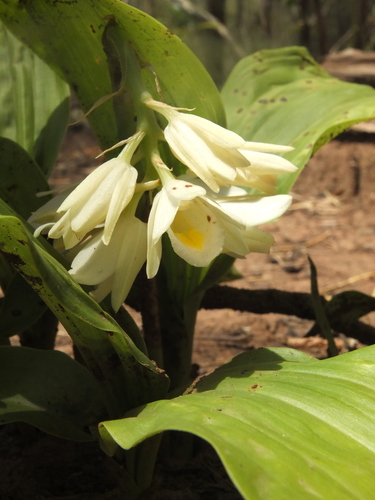
A large clump forming orchid. Clumps can be 2 m across. The false bulbs are about 40 cm long. They are swollen at the base and taper to the tip. The leaves are 25 cm long and 8 cm wide. They are oval and about 5 occur together. They are produced near the top of the false stem. The flowers occur in masses. They are creamy-white or yellow and 3.5 cm across. They are in clusters along a stalk which can be 70 cm along.
Edible Uses
The false bulbs are cooked by roasting and eaten. The stems are grated, dried, and stored for later use. The flowers are also edible.
Traditional Uses
The false bulbs are cooked by roasting and eaten. The stems are grated and dried and stored for later use.
This uses section is brief — help expand it
Distribution
It grows in tropical and subtropical places. It grows in coastal areas. It grows on rock faces and sandstone cliffs. It suits hardiness zones 9-11. It suits Mediterranean climates.
Where It Grows
Australia*,
Cultivation
Plants can be grown by dividing large clumps. They can also be grown from aerial growth. It is possible to grow plants from seed.
Notes
There are about 900-1200 Dendrobium species orchids.
Nutrition
| Part | Moisture | kJ | kcal | Protein | Vit A | Vit C | Iron | Zinc |
|---|---|---|---|---|---|---|---|---|
| Stem | 13.9 | 1376 | 329 | 3.4 | — | — | — | — |
Synonyms
References (25)
- Bodkin, F., 1991, Encyclopedia Botanica. Cornstalk publishing, p 334
- Brickell, C. (Ed.), 1999, The Royal Horticultural Society A-Z Encyclopedia of Garden Plants. Convent Garden Books. p 354
- Caton, J.M. & Hardwick, R. J., 2016, Field Guide to Useful Native Plants from Temperate Australia. Harbour Publishing House. p 280
- Cherikoff V. & Isaacs, J., The Bush Food Handbook. How to gather, grow, process and cook Australian Wild Foods. Ti Tree Press, Australia p 194
- Cribb, A.B. & J.W., 1976, Wild Food in Australia, Fontana. p 119
Show all 25 references Hide references
- Cronin, L., 1989, The Concise Australian Flora. Reed. p 75
- Cundall, P., (ed.), 2004, Gardening Australia: flora: the gardener's bible. ABC Books. p 483
- Elliot, R., 2003, Australian Plants for Mediterranean Climate gardens. Rosenberg. p 49
- Elliot, W.R., & Jones, D.L., 1984, Encyclopedia of Australian Plants suitable for cultivation. Vol 3. Lothian. p 233
- Exot. bot. 1:17, t. 10. 1804-1805
- Greig, D., 1996, Flowering Natives for Home Gardens. Angus & Robertson. p 140
- Grieg, D., 2002, A photographic guide to Wildflowers of South-eastern Australia. New Holland. p 97
- Hardwick, R.J., 2000, Nature's Larder. A Field Guide to the Native Food Plants of the NSW South Coast. Homosapien Books. p 58
- Hedrick, U.P., 1919, (Ed.), Sturtevant's edible plants of the world. p 269
- Hibbert, M., 2002, The Aussie Plant Finder 2002, Florilegium. p 84
- Hinton, B & B., 1982, A Wilderness in Bloom. Wildflowers of tropical Australia. p 53
- Holliman, J., (Ed.), 2002, Orchids. Botanica's Pocket. Random House, Australia. p 214
- Jones D, L, 1986, Ornamental Rainforest Plants in Australia, Reed Books, p 320
- Low, T., 1991, Wild Food Plants of Australia. Australian Nature FieldGuide, Angus & Robertson. p 108
- Low, T., 1992, Bush Tucker. Australia’s Wild Food Harvest. Angus & Robertson. p 125
- Melzer, R. & Plumb, J., 2011, Plants of Capricornia. Belgamba, Rockhampton. p 498
- Nicholson, N & H., 1996, Australian Rainforest Plants 2, Terania Rainforest Publishing. NSW. p 24
- Pearson, S. & A., 1992, Rainforest Plants of Eastern Australia. Kangaroo Press p 84
- Ratcliffe D & P., 1987, Australian Native Plants for Indoors. Little Hills press. p 81
- Young, P.A.R., 1991, Rainforest Guide. Brisbane Forest Park. p 27