Geodorum densiflorum
(Lam.) Schltr.
Pink nodding orchid, Pink shepherd's crook
iNaturalist· cc-by
(c) Siddarth Machado, some rights reserved (CC BY)
iNaturalist· cc-by
(c) Siddarth Machado, some rights reserved (CC BY)
iNaturalist· cc-by
(c) Siddarth Machado, some rights reserved (CC BY)
Summary
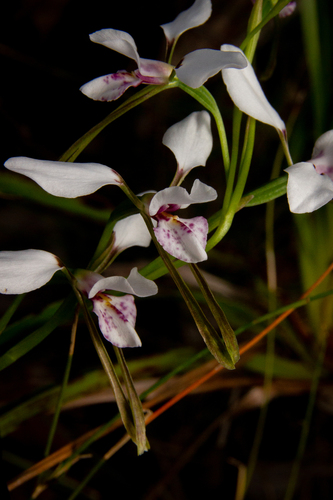
Source: WikipediaGeodorum densiflorum, commonly known as pink nodding orchid or 地宝兰 (di bao lan), is a plant in the orchid family and is native to areas from tropical Asia to eastern Australia and some Pacific Islands. It is a terrestrial orchid with broad, pleated, dark green to yellowish leaves and up to and twenty pale pink flowers with dark red veins on the labellum. It grows in wetter habitats including rainforest, woodlands, grasslands and swamps.
Description
An orchid that has a fleshy rhizome. It has round false bulbs and several broad leaves. There are 3-5 leaves at the top of a short stem, the top leaf is the largest. The leaves are oval and 10-35 cm by 3-9 cm wide. They are pleated along their length. The leaf stalk is 15 cm long. The flowering stalk has 8-10 pink flowers. It becomes bent over by the time the flowers are mature. The fruit are capsules 2-5 cm long. They are oval and have ribs along them.
Edible Uses
The tuberous roots yield a gum, though no edible uses are recorded.
Medicinal Uses
The tuberous base is regarded as emollient and can be applied as a poultice to the skin.
Distribution
It is a tropical plant. It grows on lighter soils including sand. In southern China it grows along stream sides and on grassy slopes between 300-2,400 m above sea level.
Where It Grows
Asia, Australia, Cambodia, China, India, Indochina, Indonesia, Japan, Laos, Malaysia, Myanmar, New Guinea, SE Asia, Sri Lanka, Thailand, Vietnam,
Cultivation
Plants are grown from seeds.
Propagation
Plants are grown from seeds.
Other Uses
A powerful glue-like substance is extracted from the tuberous roots. It is used to cement parts of musical instruments such as guitars and mandolins. The simplest preparation method is to split the rhizomes and rub the raw pulp directly onto the surfaces to be joined. Alternatively, cooking the rhizomes first and then finely grating them is said to produce exceptional tenacity. A gum can also be obtained by water extraction of the plant, then separated by precipitation with alcohol; this gum has exceptional strength and lasting power.
Synonyms
References (2)
- Melzer, R. & Plumb, J., 2011, Plants of Capricornia. Belgamba, Rockhampton. p 503
- Pearson, S. & A., 1992, Rainforest Plants of Eastern Australia. Kangaroo Press p 114