Daphniphyllum macropodum
Miq.
Yuzuri-Ha
iNaturalist· cc-by-nc
(c) onidiras-iNaturalist, some rights reserved (CC BY-NC), uploaded by onidiras-iNaturalist
Summary
Source: WikipediaDaphniphyllum macropodum is a shrub or small tree found in China, Japan and Korea. Small populations are also located in the southern Kuril Islands. Like all species in the genus Daphniphyllum, D. macropodum is dioecious, that is male and female flowers are borne on different plants. The timber is used in China in construction and furniture making. It is grown as an ornamental plant, chiefly for its foliage.
Description
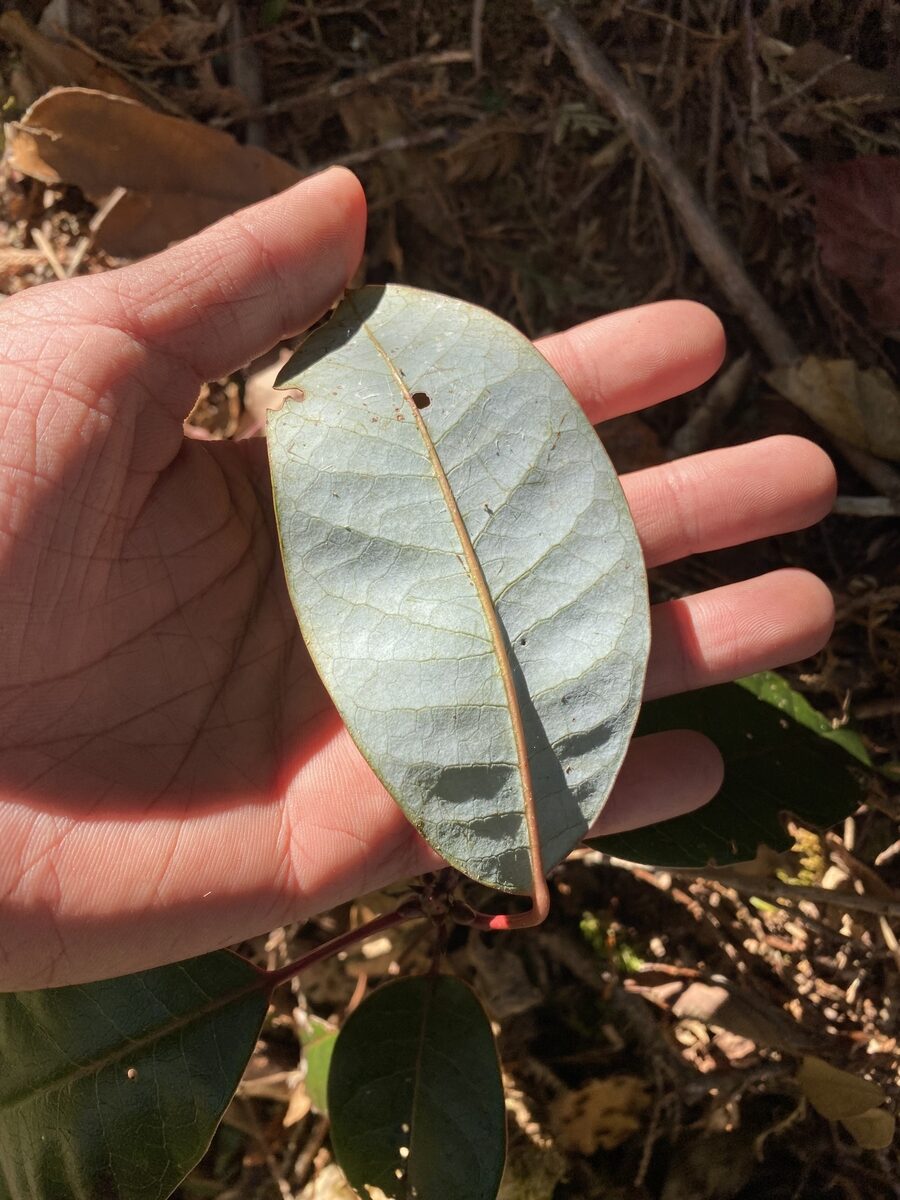
A small evergreen tree. It grows about 3 m high. It can be 15 m high. The trunk is thick. The bark is grey brown. Branching starts low down. The leaves are oblong and leathery. The leaves can be 20 cm long. The stalks are red and 5 cm long. Both male and female flowers are in racemes in the axils of leaves. They are very small. The fruit are fleshy and have one seed inside.
Edible Uses
The leaves are cooked and eaten, traditionally as a 'New Year's green' — a reference that likely relates to Chinese New Year, which falls in February.
Medicinal Uses
None known
Distribution
It is a temperate plant. It can tolerate lime in the soil. It is somewhat hardy to frosts. It can tolerate shade. In China it grows in forests between 600-1,900 m above sea level. It suits hardiness zones 6-8. In Sichuan and Yunnan.
Where It Grows
Asia, Australia, China, Japan*, Korea, North America, Taiwan, USA,
Cultivation
Succeeds in any good soil, tolerating lime but perhaps not suitable for very chalky soils. A useful plant for moist shady positions. Dislikes cold drying winds. A very ornamental plant, it is hardy to about -20°c. Plants have withstood 30° of frost at Kew Gardens, but prefer shelter. Very closely related to D. himalense and possibly no more than a sub-species of that species. The flowers have a pungent aroma. They are produced in racemes on the previous year's wood. Dioecious, male and female plants must be grown if seed is required.
Propagation
Sow seed in spring in a cold frame. Once seedlings are large enough to handle, prick them out into individual pots and grow on in the greenhouse for at least their first winter, then plant out in late spring or early summer after the last expected frosts. Cuttings of moderately ripened wood, 7–10cm taken with a heel or at a junction with old wood, can be rooted in July in individual pots in a frame with brisk bottom heat — they are slow to root but succeed at a fair percentage. Layers of current season's growth, 12cm long, taken in August/September will root in 12–18 months at a high success rate.
Other Uses
The wood is soft, close-grained, and even-textured with a very handsome appearance, used for turnery and carving. The wood of the roots is particularly striking, being deep red in colour.
Production
It grows slowly.
Notes
There is only one genus in the Daphniphyllaceae and 10 species.
Synonyms
References (7)
- Cundall, P., (ed.), 2004, Gardening Australia: flora: the gardener's bible. ABC Books. p 474 (As Daphniphyllum himalense subsp. macropodum)
- Etherington, K., & Imwold, D., (Eds), 2001, Botanica's Trees & Shrubs. The illustrated A-Z of over 8500 trees and shrubs. Random House, Australia. p 256 (As Daphniphyllum himalense subsp. macropodum)
- Hibbert, M., 2002, The Aussie Plant Finder 2002, Florilegium. p 83 (As Daphniphyllum himalense subsp. macropodum)
- Plants for a Future database, The Field, Penpol, Lostwithiel, Cornwall, PL22 0NG, UK. http://www.scs.leeds.ac.uk/pfaf/ (As Daphniphyllum himalense subsp. macropodum)
- Ryan, S., 2008, Dicksonia. Rare Plants Manual. Hyland House. p 20 (As Daphniphyllum himalense subsp. macropodum)
Show all 7 references Hide references
- Schuler, S., (Ed.), 1977, Simon & Schuster's Guide to Trees. Simon & Schuster. No. 102 (As Daphniphyllum himalense subsp. macropodum)
- Taiwania 12:212. 1966 (As Daphniphyllum himalense subsp. macropodum)