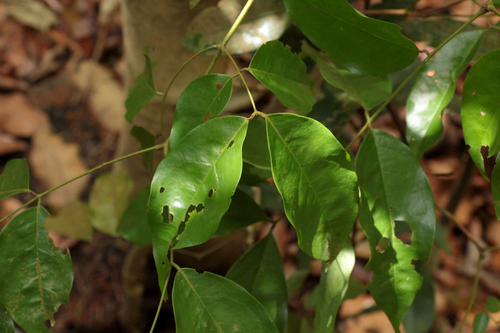
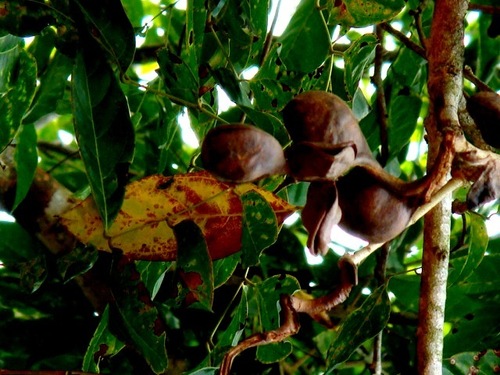
Acacia brachystachya
Benth.
Umbrella mulga, Turpentine Mulga
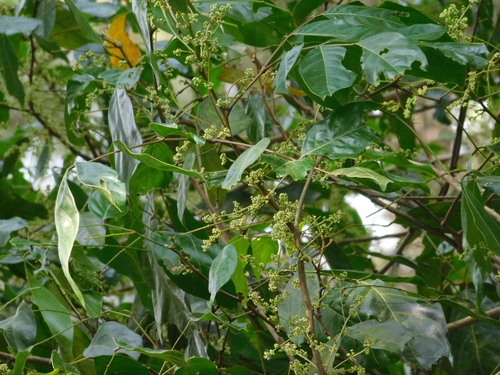
iNaturalist· cc-by
(c) Kym Nicolson, some rights reserved (CC BY), uploaded by Kym Nicolson
iNaturalist· cc-by-nc
(c) Bruce McLennan, some rights reserved (CC BY-NC), uploaded by Bruce McLennan
iNaturalist· cc-by-nc
(c) Bruce McLennan, some rights reserved (CC BY-NC), uploaded by Bruce McLennan
Summary
Source: WikipediaAcacia brachystachya commonly known as umbrella mulga, umbrella wattle, turpentine mulga, grey mulga or false bowgada, is a species of flowering plant in the family Fabaceae and is endemic to Australia. It is a erect or spreading, bushy shrub or tree with grey bark, straight linear or slightly curved phyllodes, cylindrical heads of bright yellow flowers, and straight pods. It is native to all mainland Australian states except Victoria, and also occurs in the Northern Territory.
Description
A shrub or small tree. It grows 5 m tall. There are prickles along the stem. The leaves are twice divided and there are 8-18 pairs of pinnae. There are up to 50 pairs of pinnules on each pinnae. The flowers are yellow. They are in large clusters at the ends of branches. The pods are flattened.
Edible Uses
The seeds are eaten.
Traditional Uses
The seed are eaten.
This uses section is brief — help expand it
Distribution
It is a subtropical plant. It prefers dry stony well drained soils. It is native to central Australia. It needs an open sunny position. It is drought and frost resistant.
Where It Grows
Australia*,
Cultivation
It is grown from seed. The seed needs treatment to break the hard seed coat. Normally this is by putting the seeds in very hot water and letting the water cool down overnight then planting the seeds immediately. It can be grown from cuttings.
Notes
There are about 1,350 Acacia species. Over 1,000 occur in Australia. Also as Mimosaceae.
Synonyms
Also Known As
Wonuy
References (10)
- Bodkin, F., 1991, Encyclopedia Botanica. Cornstalk publishing, p 11
- Cherikoff V. & Isaacs, J., The Bush Food Handbook. How to gather, grow, process and cook Australian Wild Foods. Ti Tree Press, Australia p 188
- Elliot, W.R., & Jones, D.L., 1982, Encyclopedia of Australian Plants suitable for cultivation. Vol 2. Lothian. p 25
- Hall, N. et al, 1972, The Use of Trees and Shrubs in the Dry Country of Australia, AGPS, Canberra. p 344
- Hunter, J.T., 2017, Is there a relationship between contemporary high Aboriginal plant resource locations and mapped vegetation communities? Cunninghamia 17:27-34. The Royal Botanic Garden Sydney. ISSN 2200 - 405X
Show all 10 references Hide references
- Lazarides, M. & Hince, B., 1993, Handbook of Economic Plants of Australia, CSIRO. p 2
- Maiden, J. H., 1889, The Useful Native Plants of Australia (including Tasmania). The Technology Museum of NSW, Sydney. p 3 (As Acacia cibaria)
- Paczkowska, G . & Chapman, A.R., 2000, The Western Australian Flora. A Descriptive Catalogue. Western Australian Herbarium. p 301
- Usher, G., 1974, A Dictionary of Plants Used by Man. Constable. p 11 (As Acacia cibaria)
- World Checklist of Useful Plant Species 2020. Royal Botanic Gardens, Kew