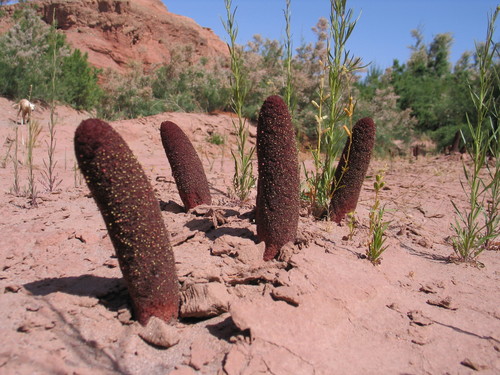
Cynomorium coccineum
L. ? Descourt
Red thumb, Desert thumb
iNaturalist· cc-by-nc
(c) Clara de Vega, some rights reserved (CC BY-NC)
iNaturalist· cc-by-nc
(c) Clara de Vega, some rights reserved (CC BY-NC)
iNaturalist· cc-by-nc
(c) Li Jianong, some rights reserved (CC BY-NC), uploaded by Li Jianong
Description
The parasitic scarlet herb that attaches itself to the roots of saltwort (Atriplex sp.) and other plants. It can be dark red or purplish-black, The stem is fleshy and unbranched. It grows 10-20 cm high. The leaves are scale like. The flowers are very small and massed in clusters. They form a club shaped structure which sticks upwards.
Edible Uses
The flower stalk is bitter-sweet and regarded as a delicacy. The leaves are eaten. The root is dried, crushed, and used as a condiment or flavouring. The heart of the plant is peeled or dried and processed into flour to make porridge.
Traditional Uses
The flower stalk is bitter-sweet and is regarded as a delicacy. The leaves are eaten. The root is dried and crushed and used as a condiment or flavouring. The heart of the plant is peeled or dried and processed into flour to make porridge.
Distribution
It grows on rocky and sandy ground. It is on salt marshes and often close to the coast. It is highly salt tolerant. The host plants - probably Atriplex dimorphostegia Kar. & Kir.; Atriplex halimus L.; Atriplex rosea L.; and Atriplex tatarica L. - were also gathered and eaten for their soft, mucilaginous leaves. In Bahrain it grows on Zygophyllum qatarensis. It can grow in arid places.
Where It Grows
Afghanistan, Africa, Algeria, Arabia, Bahrain, Egypt, Europe, Iran, Iraq, Israel, Italy, Jordan, Kuwait, Libya, Malta, Mauritania, Mediterranean, Middle East, Mongolia, Morocco, North Africa, Oman, Pakistan, Portugal, Qatar, Saudi Arabia, Spain, Syria, Tunisia, United Arab Emirates, UAE, West Africa, Western Sahara,
Other Information
The plant is eaten by children.
Notes
There are one or two Cynomorium species. These are sometimes placed in the family Balanophoraceae. An emergency food mentioned in the Bible (Job 30:4).
Also Known As
Cynomorium, Malta mushroom, Tartuth, Tarthooth, Tartooth, Tarthuth, Tertout, Zibb al-ard
References (17)
- Blamey, M and Grey-Wilson, C., 2005, Wild flowers of the Mediterranean. A & C Black London. p 33
- Flora of Pakistan. www.eFloras.org
- Heywood, V.H., Brummitt, R.K., Culham, A., and Seberg, O. 2007, Flowering Plant Families of the World. Royal Botanical Gardens, Kew. p 120
- Jardin, C., 1970, List of Foods Used In Africa, FAO Nutrition Information Document Series No 2.p 73
- Karim, F. M. & Dakheel, A, J., 2006, Salt-tolerant plants of the United Arab Emirates. 2006. International Center for Biosaline Agriculture, Dubai, UAE. p 86
Show all 17 references Hide references
- Mandaville, J. P., 2004, Bedouin ethnobotany: Plant concepts and plant use in a desert pastoral world. PhD thesis University of Arizona. p 156
- Middleditch, B. S., 1991, Kuwaiti Plants: Distribution, Traditional Medicine, Phytochemistry, Pharmacology and Economic Value. Studies in Plant Science, 2. Elsevier p 27
- MOLDENKE,
- Monod, T., (On wild edible plants of Mauritania)
- Nassif, F., & Tanji, A., 2013, Gathered food plants in Morocco: The long forgotten species in Ethnobotanical Research. Life Science Leaflets 3:17-54
- Norton, J., et al, 2009, An Illustrated Checklist of the Flora of Qatar. UNESCO Office in Doha.
- Phillips, D.C., 1988, Wild Flowers of Bahrain. A Field Guide to Herbs, Shrubs, and Trees. Privately published. p 65
- Rivera, D. et al, 2006, Gathered Mediterranean Food Plants - Ethnobotanical Investigations and Historical Development, in Heinrich M, Müller WE, Galli C (eds): Local Mediterranean Food Plants and Nutraceuticals. Forum Nutr. Basel, Karger, 2006, vol 59, pp 18–74
- Royal Botanic Gardens, Kew (1999). Survey of Economic Plants for Arid and Semi-Arid Lands (SEPASAL) database. Published on the Internet; http://www.rbgkew.org.uk/ceb/sepasal/internet [Accessed 16th April 2011]
- Seidemann J., 2005, World Spice Plants. Economic Usage, Botany, Taxonomy. Springer. p 132
- Uphof, 1968,
- World Checklist of Useful Plant Species 2020. Royal Botanic Gardens, Kew