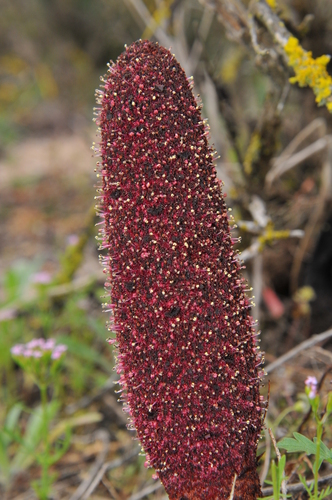
Cynomorium coccineum subsp. songaricum
(Ruprecht) J. Leonard
Suo yang, Lock-up yang
iNaturalist· cc-by-nc-sa
(c) Juan José Sánchez, some rights reserved (CC BY-NC-SA)
iNaturalist· cc-by-nc
(c) Li Jianong, some rights reserved (CC BY-NC), uploaded by Li Jianong
iNaturalist· cc-by-nc
(c) Clara de Vega, some rights reserved (CC BY-NC)
Description
A root parasite. It grows on Nitraria, Reaumaria, Salsola and Tamarix shrubs. It has an underground stem 15-50 cm long and 1-2 cm wide. The aerial portion is 15-40 cm high and 3-6 cm wide. The leaves are like scales. They are 1-2 cm long and wide. They are arranged in spirals. The flowers are small and dark purple. Male and female flowers are separate.
Edible Uses
Starch extracted from the stems is used in pastries.
Traditional Uses
Starch extracted from the stems is used in pastries.
This uses section is brief — help expand it
Medicinal Uses
Used in traditional Chinese medicine and is noted to be a powerful antioxidant.
Distribution
It is a temperate plant. It grows near lakes and streams. In China it grows between 500-700 m altitude in northern provinces. It grows on desert shrubs. It grows in desert areas in Inner Mongolia. It can grow in arid places.
Where It Grows
Afghanistan, Asia, Central Asia, China, Iran, Middle East, Mongolia, Tajikistan,
Notes
There are 2 Cynomorium species. This one is used in Chinese medicine. It is a powerful antioxidant.
Synonyms
References (6)
- "Chinese Nutrition Journal", 2002, Vol 23(8) p 298
- Fan H. & Chen, G., 2017, Novel Cynomorium songaricum polysaccharides with enhancement of T cell immune response. China Botanical Congress.
- Flora of China.
- F. Osten-Saken & F. J. Ruprecht, Mem. Acad. Imp. Sci. Saint Petersbourg 14(4):73. 1869 (Sert. tianschan.)
- Hu, Shiu-ying, 2005, Food Plants of China. The Chinese University Press. p 584
Show all 6 references Hide references
- https://en.wikipedia.org/wiki/List of wild edible plants in Mongolian cuisine (As Sinomorium songaricum)