Ficus petiolaris
Kunth
The rock fig
iNaturalist· cc-by-nc-sa
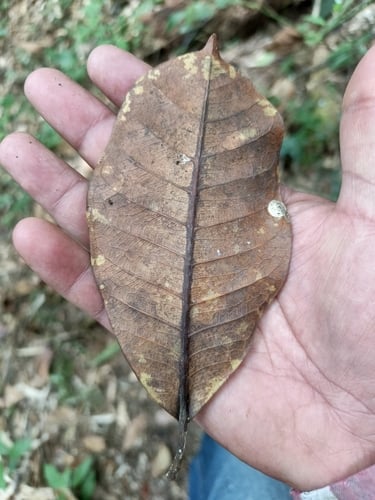
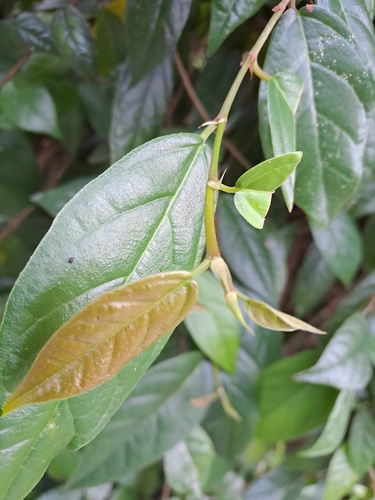
(c) Emmanuel Guevara Lazcano, some rights reserved (CC BY-NC-SA)
iNaturalist· cc-by-nc-sa
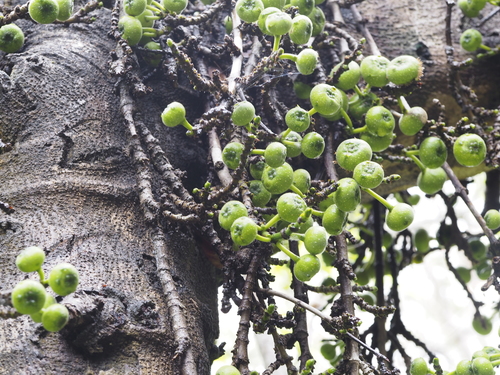
(c) Emmanuel Guevara Lazcano, some rights reserved (CC BY-NC-SA)
iNaturalist· cc-by-nc
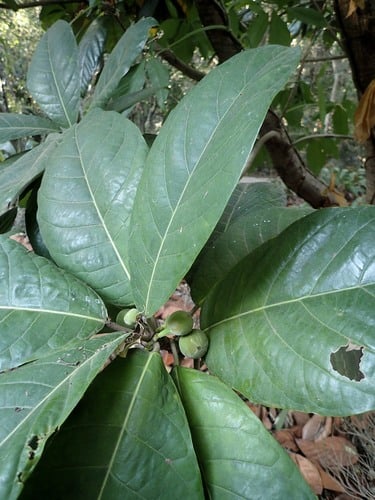
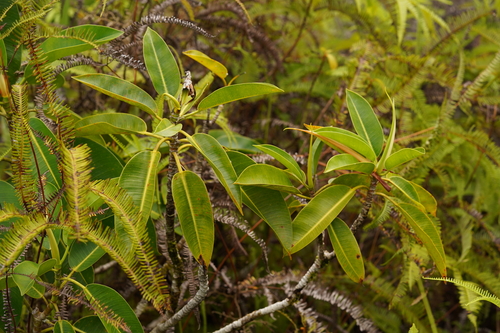
(c) Diego Cordero, some rights reserved (CC BY-NC)
Summary
Source: WikipediaFicus petiolaris, commonly known as the petiolate fig and rock fig, is a fig that is endemic to Mexico from Baja California and Sonora south to Oaxaca. It grows from 10 to 20 feet high. It grows best with moderate water and partial shade. A unique feature is white hairs on the vein axils. Other common names include the Baja California rock fig, Palmer wild fig, and Brandegee wild fig.
Description
A tree. It grows 30 m tall. The roots grow over rocky areas. The leaves are 4-15 cm long by 3-13 cm wide. They can be heart shaped at the base.
This description is brief — help expand it
Edible Uses
The semi-dried fruit are eaten.
Traditional Uses
The semi-dried fruit are eaten.
This uses section is brief — help expand it
Medicinal Uses
The bark was traditionally used by the Aztecs to make paper, known as amate. Many of the remaining Aztec codices were written on amate. In the 16th century, Francisco Hernández de Toledo relates: "the cooking of the roots and bark moisten the tongue of those who have a fever, relieves the pains of the chest and if they are not removed milk evacuates bile and phlegmatic humors by the Upper or lower duct. Cure inveterate ulcers of the lips or any other. " In the 20th century, Maximino Martinez, referred to as astringent, to heal fractures, cracks in gums, herpes and pectoral. In Mexico, this species is recommended against intestinal parasites, herpes, cough, spleen stones, to regulate menstruation and heal fractures. In Sonora it is advised in cases of goiter, chest pains, phlegm, wounds and ulcers. In Morelos it is used to attenuate the fever. The treatment includes latex, juice or resin. In Michoacán, against the hepatitis the macerated bark is prepared and put to soak one day to apply baths, in addition to taking it fasting for nine days.
Distribution
It is a tropical plant.
Where It Grows
Central America, Mexico,
Cultivation
Succeeds in full sun or partial shade. Fig trees have a unique form of fertilization, each species relying on a single, highly specialized species of wasp that is itself totaly dependant upon that fig species in order to breed. The trees produce three types of flower; male, a long-styled female and a short-styled female flower, often called the gall flower. All three types of flower are contained within the structure we usually think of as the fruit. The female fig wasp enters a fig and lays its eggs on the short styled female flowers while pollinating the long styled female flowers. Wingless male fig wasps emerge first, inseminate the emerging females and then bore exit tunnels out of the fig for the winged females. Females emerge, collect pollen from the male flowers and fly off in search of figs whose female flowers are receptive. In order to support a population of its pollinator, individuals of a Ficus spp. must flower asynchronously. A population must exceed a critical minimum size to ensure that at any time of the year at least some plants have overlap of emmission and reception of fig wasps. Without this temporal overlap the short-lived pollinator wasps will go locally extinct.
Propagation
Seed - germinates best at a temperature around 20°c. Air layering. Tip cuttings around 4 - 12cm long, taken from lateral branches.
Other Uses
The bark has been used as a source of fibre for the manufacture of paper. A latex containing rubber is obtained from the plant. This substance is elastic and adhesive and very ductile, gray in colour, and capable of being formed into membranes as delicate as soap bubbles, being in this state white and transparent ; exposed to the air it hardens and assumes a yellow tint, for which reason it should be kept in vessels full of water. In boiling water it softens and becomes more sticky. Its density is greater than that of water ; its odour is urine-like, and it has scarcely any taste. The latex contains 15% caoutchouc, 55% of a resin soluble in alcohol, and 5% of a resin soluble in ether. This gum is used by surgeons and others in Mexico for treating broken bones, hernia, etc. The strong, elastic, aerial roots have been used by native people in making suspension bridges.
Synonyms
Also Known As
Zalate
References (2)
- Pio-Leon, J. F., et al, 2017, Prioritizing Wild Edible Plants of potential new crops based on Deciduous Forest traditional knowledge by a Rancher community. Botanical Sciences 95(1): 47-59
- World Checklist of Useful Plant Species 2020. Royal Botanic Gardens, Kew