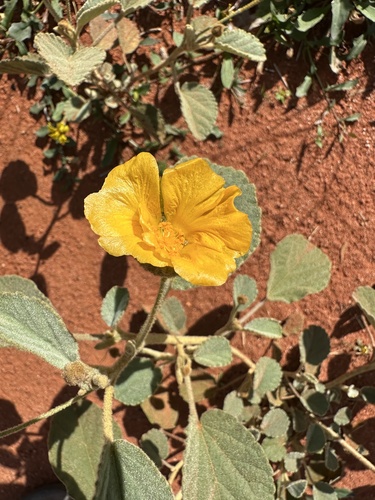
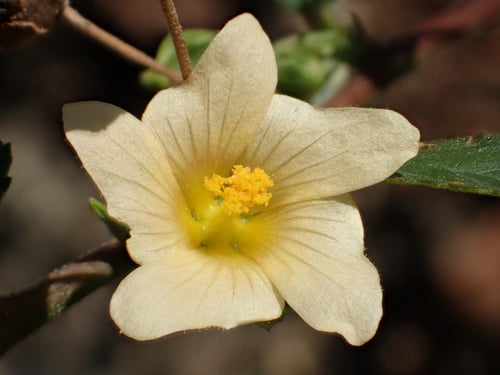
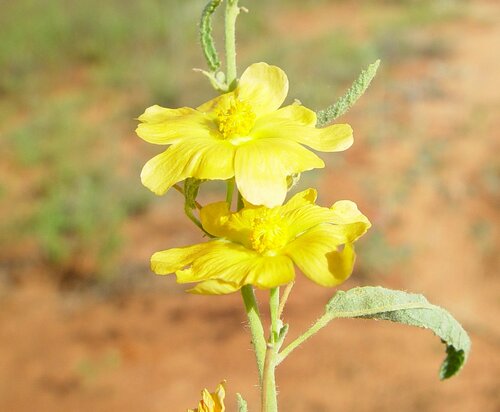
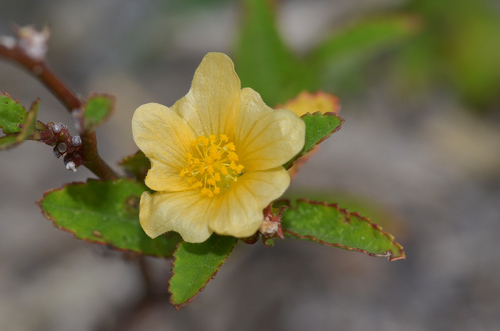
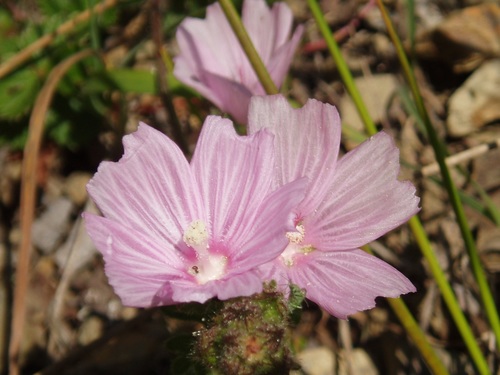
Commersonia bartramia
(L.) Merr.
iNaturalist· cc-by-nc
(c) ndionson, some rights reserved (CC BY-NC), uploaded by ndionson
iNaturalist· cc-by-sa
(c) Greg Tasney, some rights reserved (CC BY-SA)
Summary
Source: WikipediaCommersonia bartramia, commonly known as brown kurrajong, is a species of flowering plant in the family Malvaceae and is native to Southeast Asia, the Northern Territory, Queensland and New South Wales. It is a tree or shrub with heart-shaped to egg-shaped leaves much paler on the lower surface, and sometimes with fine, irregular teeth on the edges.
Description
A tree. It grows 15 m tall. The small branches have yellow hairs. The leaves are broadly oval and 9-24 cm long by 5-14 cm wide. The fruit capsule is round and 2 cm across and have 5 valves. The seeds are narrowly oval and black.
Medicinal Uses
The roots are used medicinally.
Distribution
It is a tropical plant.
Where It Grows
Asia, Australia, Cambodia, Caroline Islands, China, Fiji, Indonesia, Laos, Malaysia, Myanmar, New Caledonia, Pacific, Papua New Guinea, PNG, Philippines, Samoa, SE Asia, Solomon Islands, Thailand, Vanuatu, Vietnam, Wallis-Futuna Islands,
Cultivation
Commersonia bartramia is a plant of the subtropics to the tropics, where it can be found at elevations up to 800 metres. Trees are rather frost-sensitive. Often found in the wild in both in brown clay-loams or white sand soils. A fast-growing tree. Plants can flower all year round in some parts of its range.
Propagation
Seed - tiny and long-lived. Best sown as soon as it is ripe, it can be germinated by blending the whole capsules, then covering the mix with almost boiling water (making sure it cools down quickly enough not to cook and kill the seed) and then sowing the resulting fibrous mass. Cuttings strike quickly and easily.
Other Uses
The fibrous bark has many applications. The fibre is used as cordage for fishing lines, nets, baskets, belts, girdles, headbands etc. A great deal of crushing is necessary to extract the fibre because the bark contains a very large quantity of mucilaginous matter, which is exceedingly difficult to remove either by hot or cold water, but which, however, can be removed by alkalis. The fibre is very long, and not interlaced; it is very strong when moist, but becomes hard and breaks more readily when dry; this is owing to the glutinous matter, which remains in it and dries hard, A thorough and complete crushing seems absolutely necessary before it can be cleaned. The bark is used to make bark cloth in Melanesia. Strips of the bark are used as a crude rope to carry produce and firewood, and for lashing in construction. The light wood is used to start fire by friction in the Solomon Islands. The white wood is light in weight, soft and close-grained. It is used in light construction, for fishing floats etc. Small poles and sticks from the tree are used to stake yams. The wood is a fast-burning firewood and makes a useful fuel. A fast-growing, natural pioneer species in its native range, often appearing along the sides of roads. It regenerates quickly, and is often found in abundance after disturbance such as a forest fire or road building
Synonyms
References (1)
- World Checklist of Useful Plant Species 2020. Royal Botanic Gardens, Kew