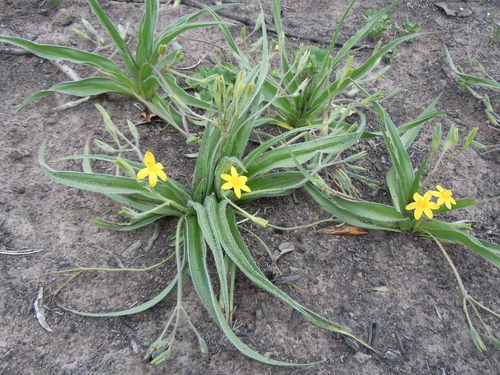
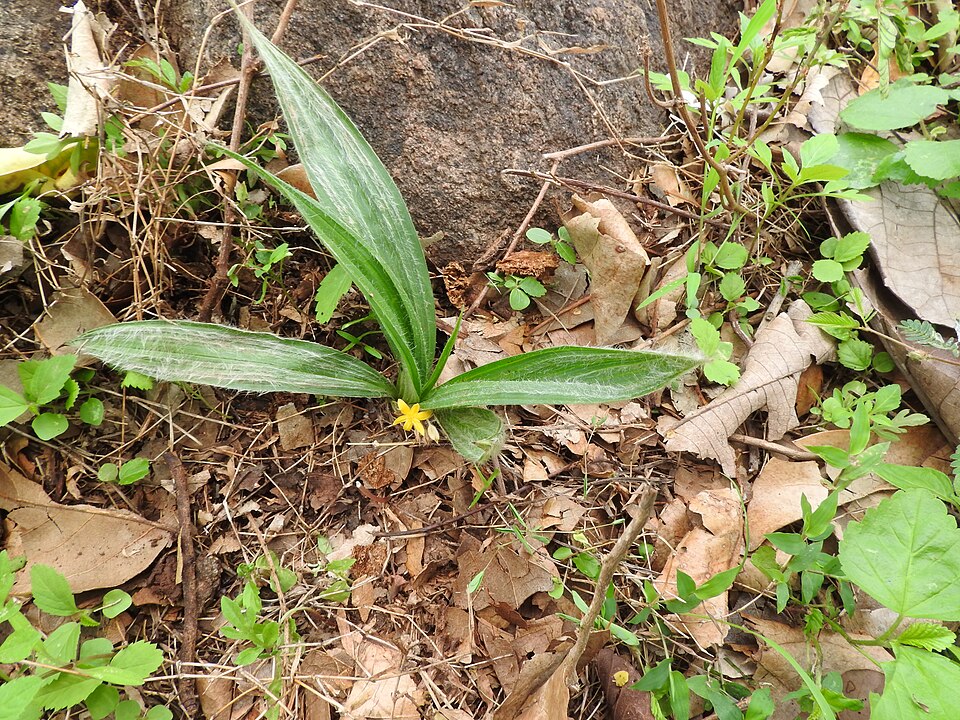
Curculigo orchioides
Gaertn.
Star grass, Golden-eyed grass
iNaturalist· cc0
no rights reserved, uploaded by 葉子
iNaturalist· cc-by-nc
(c) Yuwaraj Gurjar, some rights reserved (CC BY-NC), uploaded by Yuwaraj Gurjar
iNaturalist· cc-by-nc
(c) Basu Dev Poudel, some rights reserved (CC BY-NC), uploaded by Basu Dev Poudel
Summary
Source: WikipediaCurculigo orchioides (commonly called golden eye-grass, xian mao, weevil-wort, कालो मुस्ली (in Nepal) black musli, Kali musli, or Kali Musali) is a flowering plant species in the genus Curculigo. It is native to Nepal, China, Japan, the Indian subcontinent, Papuasia, and Micronesia. The species has been reported also from islands such as Guam and New Caledonia.
Description
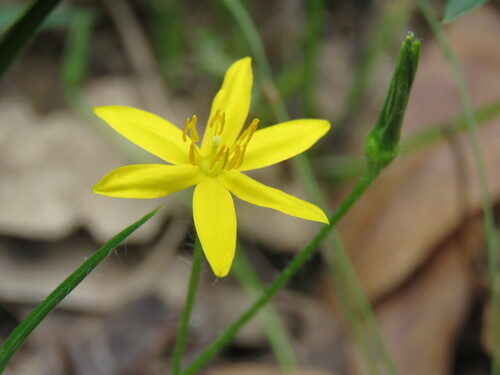
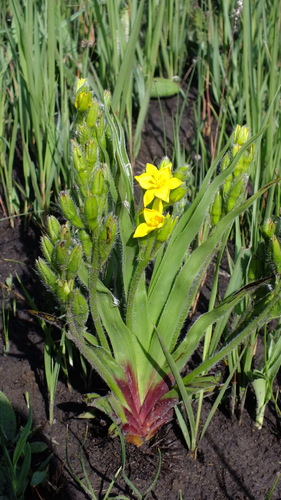
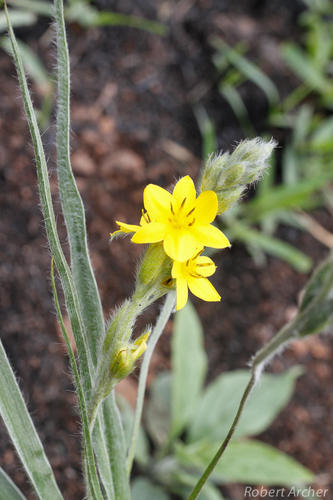
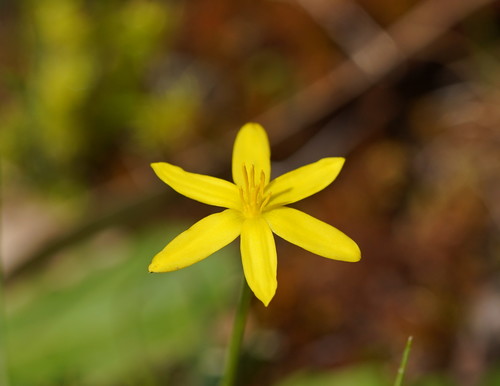
A small herb with grass like leaves. It grows from a tuber or corm. The leaves are large and sword shaped. They are folded like a fan. The flowers are yellow and small. They are star like. They are produced just near the ground. The fruit is a pale green berry.
Edible Uses
The tubers are cooked and eaten.
Traditional Uses
The root tubers are cooked and eaten. They are also used for the preparation of drinks.
This uses section is brief — help expand it
Medicinal Uses
The rhizome is used in traditional medicine throughout the plant's range and is especially valued in Chinese medicine as a general tonic and restorative, particularly for the decline of physical strength. It is described as a bitter-tasting, mucilaginous herb with adaptogenic, analeptic, androgenic, anticonvulsive, anti-inflammatory, aphrodisiac, diuretic, emmenagogue, sedative, tonic, and uterine tonic properties, and it also stimulates the immune system. Pharmacological studies have identified medically active compounds including saponins and glycosides. Curculigosaponins C and F significantly promote the proliferation of spleen lymphocytes; saponins F and G increase the weight of the thymus; and curculigoside exerts immunological and protective effects. Internally, the rhizome is used to treat peptic ulcers, piles, gonorrhoea, leucorrhoea, asthma, jaundice, chronic nephritis, diarrhoea, lumbago, and headache. Externally, it is applied to skin diseases. The rhizomes are washed, freed from roots, sliced, and dried in the shade. The dried slices are typically powdered and a small amount mixed into a glass of milk with sugar, or used to prepare a decoction for drinking. Swelling of the tongue has been reported as a side effect after drinking a decoction; the recommended antidote in China is a decoction of Rheum tanguticum with sodium sulphate.
Distribution
A tropical plant. In Papua New Guinea it grows mostly below 1,000 m altitude. It occurs in open grassland at low and medium altitudes in the Philippines. In southern China it grows on open grassy slopes from near sea level to 1,600 m above sea level.
Where It Grows
Asia, Bangladesh, Cambodia, China, Guam, India, Indochina, Indonesia, Japan, Laos, Marianas, Myanmar, Northeastern India, Pacific, Pakistan, Papua New Guinea, PNG, Philippines, SE Asia, Thailand, Vietnam,
Cultivation
Succeeds in humid tropical and subtropical areas and can be cultivated outdoors in warm, essentially frost-free temperate areas. Prefers a humus-rich, fertile, well-drained soil and a position in dappled shade. The rhizomes may reach 30 cm x 11.5 cm. Only 3 - 5 leaves are found on the plant at a given time. The flowers and fruits are inconspicuous because they are close to the ground and partially covered by the bracts and leaves.
Propagation
Seed is best sown as soon as it is ripe. The rootstock can also be divided, and offsets can be used.
Other Uses
None known Special Uses
Notes
There are 10 Curculigo species. It is used in medicine.
Nutrition
| Part | Moisture | kJ | kcal | Protein | Vit A | Vit C | Iron | Zinc |
|---|---|---|---|---|---|---|---|---|
| Roots | 67.4 | 1534 | — | 9.6 | — | — | 124.4 | 2.5 |
Synonyms
Also Known As
Black musale, Kaki musli, Kali musli, Kanyut-net, Kenda, Kuluthupokie, Mushali, Mutha-li, Nelatati-gadde, Nelatatygadda, Nela tengu, Nilappanai, Sha-wel, Sukui kita, Tala nuli, Toloangi, Wan prao
References (22)
- Ambasta, S.P. (Ed.), 2000, The Useful Plants of India. CSIR India. p 151
- Arinathan, V., et al, 2007, Wild edibles used by Palliyars of the western Ghats, Tamil Nadu. Indian Journal of Traditional Knowledge. 6(1) pp 163-168
- Aryal, K., Moe, A.T., Hein, P.P., Bay, Y.H.S., Htay, T., Aung, H.W., Shakya, B., Xuefei, Y., Shaoliang, Y. , 2020, Wild and non- cultivated edible plants and their contribution to local livelihoods in Putao, Myanmar. ICIMOD.
- Burkill, I.H., 1966, A Dictionary of the Economic Products of the Malay Peninsula. Ministry of Agriculture and Cooperatives, Kuala Lumpur, Malaysia. Vol 1 (A-H) p 713
- Chandrakumar, P., et al, 2015, Ethnobotanical studies of wild edible plants of Gond, Halba and Kawar tribes of Salekasa Taluka, Gondia District, Maharashtra State, India. International Research Journal of Pharmacy 6(8)
Show all 22 references Hide references
- Fruct. sem. pl. 1:63, t. 16, fig. 11. 1788
- Hedrick, U.P., 1919, (Ed.), Sturtevant's edible plants of the world. p 254
- Jadhav, V. D. et al, 2011, Documentation and ethnobotanical survey of wild edible plants from Kolhapur district. Recent Research in Science and Technology. 3(12): 58-63
- Johns, R.J. & Hay, A., 1976, Monocotyledons of Papua New Guinea. Part 1 , Forestry College Bulolo, PNG p 86
- Kiran, K. C., et al, 2019, Diversity and Seasonal Availability of Potential Wild Edible Plants from Vidarbha Region of Maharashtra State, India. Int.J.Curr.Microbiol.App.Sci (2019) 8(2): 1434-1446
- Kumar, G.M., & Shiddamallayya, N., 2014, Documentation of Wild Plant Tubers as Food Resources in Hassan District, Karnataka, International Journal of Applied Biology and Pharmaceutical Technology. 5(2) p 90
- Kumar, R. & Saikia, P., 2020, Wild edible plants of Jharkhand and their utilitarian perspectives. Indian Journal of Traditional Knowledge Vol 19 (2), April 2020, pp 237-250
- McMakin, P.D., 2000, Flowering Plants of Thailand. A Field Guide. White Lotus. p 50
- Misra, R. C., et al, 2013, Genetic resources of wild tuberous food plants traditionally used in Similipal Biosphere Reserve, Odisha, India. Genetic Resources and Crop Evolution. Vol. 60 No. 2. Springer
- Monsalud, M.R., Tongacan, A.L., Lopez, F.R., & Lagrimas, M.Q., 1966, Edible Wild Plants in Philippine Forests. Philippine Journal of Science. p 437
- Pandy, R. K. & Saini, S. K., 2007, Edible plants of tropical forests among tribal communities of Madhya Pradesh. Indian Journal of Traditional Knowledge. 6(1), pp 185-190
- Sarma, H., et al, 2010, Updated Estimates of Wild Edible and Threatened Plants of Assam: A Meta-analysis. International Journal of Botany 6(4): 414-423
- Samydurai, P., et al, 2012, Wild habits of Kolli Hills being staple food of inhabitant tribes of eastern Ghats, Tamil Nadu, India. Indian Journal of Natural Products and Resources. 3(3) September 2012 pp 432-437
- Sivakumar, A. & Murugesan, M., 2005, Ethnobotanical Studies of the wild edible plants used by the tribals of the Anaimalai Hills, the Western Ghats. Ancient Science of Life. XXV(2) Oct-Dec.
- Toppo, P. et al, 2016, Wild edible plants of Dhamtari district of Chhattisgarh, India. Van Sangyan Vol. 3, No. 4
- Tutul, E et al, 2009, Angiospermic Flora of Runctia Sal Forest, Bangladesh. Bangladesh J. Plant Taxon. 16(1): 83-90. p 88
- Wild edible plants of Himachal Pradesh