Vepris simplicifolia
(Engl.) Mziray
iNaturalist· cc-by-sa
(c) Greg Tasney, some rights reserved (CC BY-SA)
iNaturalist· cc-by-sa
(c) Greg Tasney, some rights reserved (CC BY-SA)
iNaturalist· cc-by-sa
(c) Greg Tasney, some rights reserved (CC BY-SA)
Description
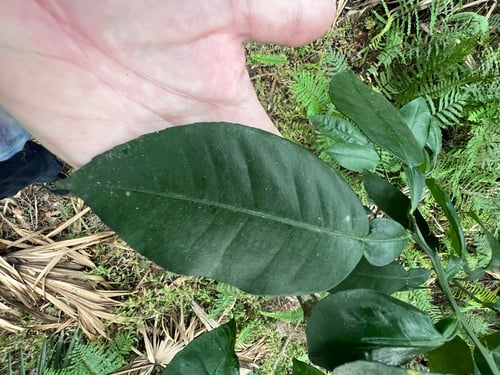
A tree. It can grow 4-10 m tall. The leaves have one leaflet. The leaves are 3-15 cm long by 1.8-5.6 cm wide. The flowers are in groups in the axils of leaves. They are yellow-green. The fruit is round and 6-10 mm across. They are green but turn orange to red when ripe. There is usually one seed but there can be 2 lobes amd 2 seeds.
Edible Uses
The fruit are eaten.
Medicinal Uses
A leaf decoction is taken in the treatment of pneumonia. The leaves and twigs are used in the treatment of pleurisy. The leaf ash is applied externally as a treatment against leprosy. A bark decoction is drunk to treat chest complaints. A root decoction is used to treat stomach-ache, backache, leprosy, gonorrhoea and brucellosis. The fruits are chewed to relieve toothache.
Distribution
It is a tropical plant.
Where It Grows
Africa, East Africa, Kenya, Tanzania,
Other Uses
The twigs are used as toothbrushes. The wood is used for timber, tool handles, spoons, bows, walking sticks and poles. The wood is used for fuel.
Synonyms
Also Known As
Mutuyu, Olgilai
References (3)
- Mbuvi, M. T. E., et al, 2019, Annonated checklist of plant species of Loita Forest Narok County, Kenya. Int. J. Adv. Res. Biol. Sci. (2019). 6(3): 54-110
- Mutie, F. G., 2020, Conservation of Wild Food Plants and Their Potential for Combatting Food Insecurity in Kenya as Exemplified by the Drylands of Kitui County. Plants 2020, 9, 1017
- World Checklist of Useful Plant Species 2020. Royal Botanic Gardens, Kew (As Toddalia simplicifolia)