Lessertia frutescens
(L.) Goldblatt & J. C. Manning
iNaturalist· cc-by-sa
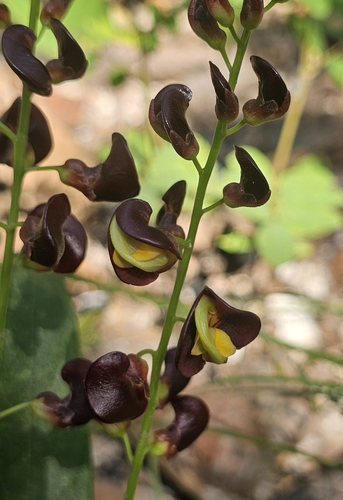
(c) magriet b, some rights reserved (CC BY-SA), uploaded by magriet b
iNaturalist· cc-by-nc
(c) Lindokuhle Mgwaba, some rights reserved (CC BY-NC)
Summary
Source: WikipediaLessertia frutescens (syn. Sutherlandia frutescens (L.) R.Br.; Colutea frutescens L.) is a southern African legume in the family Fabaceae. It is also known as cancer bush, balloon pea, Cape bladder pea, sutherlandia; and phetola ("it changes") in seTswana, and insiswa ("the one that drives away the darkness") in isiZulu. It is a shrub with bitter, aromatic leaves, with red-orange flowers appearing in spring to mid-summer. These are followed by inflated, air-filled pods containing the seeds.
Description
A sprawling small shrub. It can grow 1 m tall. The leaves have 13-21 leaflet stalks. The leaves are oblong. The flowers are 50 mm long and bright red. The pods are large and inflated.
Edible Uses
The leaves are brewed as tea, and the seeds are eaten as a snack.
Traditional Uses
The leaves are used for tea drinks. The seeds are eaten as a snack.
This uses section is brief — help expand it
Medicinal Uses
Lessertia frutescens has a long history of herbal use in S. Africa. It is said to be a good general medicine and a useful bitter tonic, and that a little taken before meals will aid digestion and improve the appetite. It has become one of the most talked about medicinal herbs in the ethnobotanical world because of its strong reputation as a cure for cancer and increasingly as an immune system booster in the treatment of HIV/AIDS. Research on its properties is ongoing. The leaves and stems have a very bitter flavour. They are anticancer, antiseptic, bitter tonic, blood purifier. They are used mainly as an aqueous infusion or decoction, either internally or externally as an antiseptic wash, eye lotion or douche. With its strong tonic effect upon the body, the plant is a useful aid in the treatment of a wide range of conditions. An infusion or decoction is taken internally in the treatment of conditions as diverse as cancer, gastric ailments, diarrhoea and dysentery, chicken pox. gynaecological problems, backache, rheumatism, oedema and fevers. It is also used to treat colds, 'flu, asthma, TB, bronchitis, liver problems, haemorrhoids, diabetes, varicose veins and inflammation. It is also used in the treatment of mental and emotional stress, including irritability, anxiety and depression and is used as a gentle tranquillizer. Externally, it is used in the treatment of eye infections, as a wash for wounds; and as a douche for prolapse of the uterus. Whole fruits may be chewed for the relief of stomach pains. Investigations of different collections of this herb suggests that it is biochemically variable and that distinct chemical races of the species may exist in different parts of its distribution range. These may vary in potency and bioactivity.
Distribution
It is a subtropical plant.
Where It Grows
Africa, South Africa*, Southern Africa,
Cultivation
Lessertia frutescens is a plant of the warm temperate to tropical regions of southern Africa, growing mainly in semi-arid regions. It is not very cold hardy, able to tolerate short periods with temperatures falling to around -5°c, so long as it is growing in a freely draining soil and summers have been sufficiently warm to fully ripen the wood. It usually grows where there is a distinct dry season, butis found inboth summer rainfall and winter rainfall regions. A tough plant that does well in full sun and tolerates all soil types. Established plants are very drought tolerant. A fast-growing, but short-lived species. Plants seed themselves readily, so that as the older plants start to look past their best they can be removed The fruit is a large, bladder-like, papery inflated pod and is almost transparent. It can be used in dry flower arrangements as it dries well, maintaining its colour and form. The plant is quite pest resistant. This species has a symbiotic relationship with certain soil bacteria; these bacteria form nodules on the roots and fix atmospheric nitrogen. Some of this nitrogen is utilized by the growing plant but some can also be used by other plants growing nearby.
Propagation
Seed - sow in a well-drained soil in a seedtray. Germination is improved if seeds are left to soak for about 4 hours or overnight in water hot enough for you to put your hand in. Keep the seed trays warm (not hot) and damp but not wet. Germination should occur in 2 - 3 weeks and seedlings can be transplanted as soon as they are large enough to handle Cuttings of half-ripe wood in a frame.
Other Uses
An extract of the leaves is used as an ingredient in commercial cosmetic preparations as an antimicrobial. Because they are fast and tough, they also work quite well as pioneers in a new garden, where they give cover and colour while the slower growing perennials get going
Synonyms
References (3)
- Ruiters-Welcome, A. K., 2019, Food plants of southern Africa. Ph.D. thesis. Univ. of Johannesburg p 58
- Welcome, A. K. & Van Wyk, B.-E., 2019, An inventory and analysis of the food plants of southern Africa. South African Journal of Botany 122 (2019) 136–179
- World Checklist of Useful Plant Species 2020. Royal Botanic Gardens, Kew