Cubilia cubili
(Blanco) Adelbert
Kubili nut
wikimedia· cc0
Wikimedia Commons - Pomophagist44
wikimedia· cc0
Pomophagist44 (via Wikimedia Commons)
wikimedia· cc0
Pomophagist44 (via Wikimedia Commons)
Summary
Source: WikipediaCubilia cubili is a species of flowering plant in the family Sapindaceae. It is a tree native to northeastern Malesia, ranging from eastern Borneo to Sulawesi, the Philippines, and western Maluku. It is the sole species in genus Cubilia.
Description
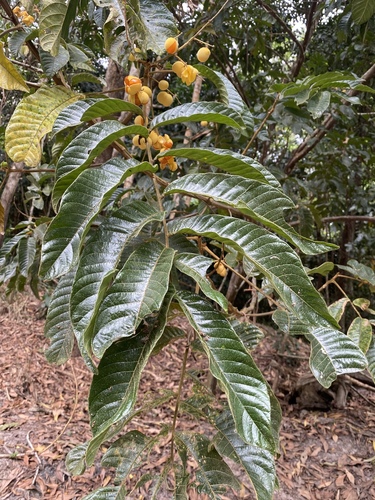
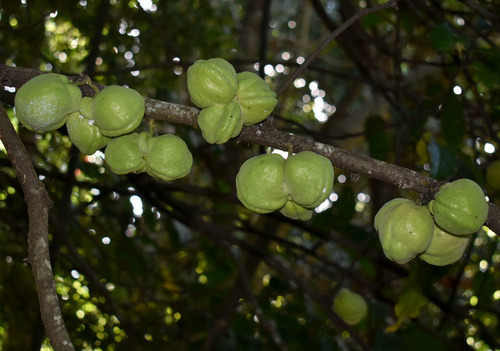
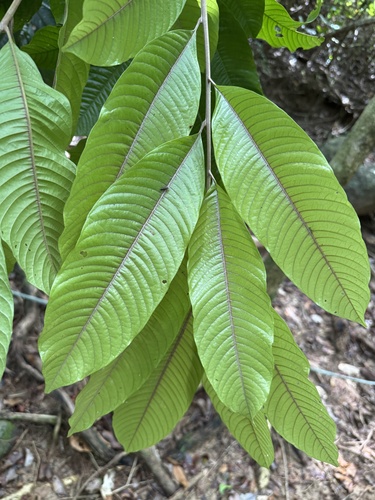
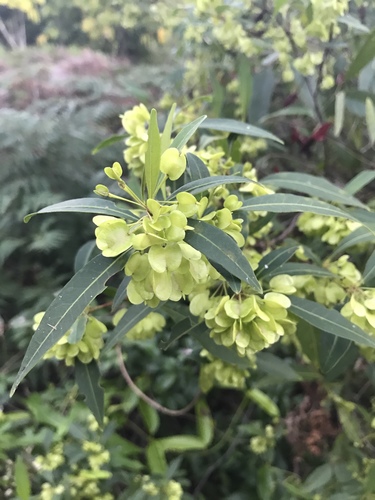
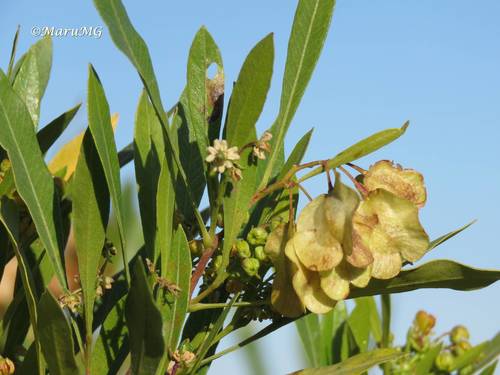
A large tree. It grows up to 25-50 m high. The trunk is 75 cm across. There are buttresses 6 m high. The bark is smooth and reddish-brown. The leaves are compound with large leaflets which are smooth and pointed at both ends. There are 3-5 pairs of leaflets. The leaflets taper to the tip and are rounded at the base. They are 10-15 cm long by 3-5 cm wide. They can be both larger and smaller. The flowers are small and borne on rather large flower arrangements. These are 30 cm long. The flowers are orange-brown. The fruit are oval and about 5 cm long. The fruit have lobes. These are 3-4 cm long by 2-2.5 cm wide. They are covered with very many pointed projections giving a warty appearance.
Edible Uses
The seeds or nuts are eaten raw, boiled, or roasted. The false aril (seed layer) is also eaten, and the leaves are used as a vegetable.
Traditional Uses
The seeds or nuts are eaten raw or cooked. They are boiled or roasted. The false aril or seed layer is eaten. The leaves are used as a vegetable.
This uses section is brief — help expand it
Medicinal Uses
The seeds contain 5.2% protein, 1.92% fat, 23.13% starch, and 18.83% carbohydrates.
Distribution
A tropical plant. They occur from Luzon to Mindanao in primary forests at low altitudes in the Philippines. In Indonesia it grows up to 600 m altitude.
Where It Grows
Asia, Indonesia, Malaysia, Pacific, Philippines, SE Asia,
Cultivation
Plants can be grown from seeds.
Other Uses
The timber is useful.
Notes
There is only one Cubilia species. The seeds are 5.2% protein, 1.92% fat, 23.13% starch, and 18.83% carbohydrates.
Nutrition
| Part | Moisture | kJ | kcal | Protein | Vit A | Vit C | Iron | Zinc |
|---|---|---|---|---|---|---|---|---|
| Fruit | 48.3 | 861 | — | 5.2 | — | — | — | — |
Synonyms
Also Known As
Amasi, Bak-sian, Kamesi raindang, Pohon saninten sabrang
References (16)
- Altschul, S.V.R., 1973, Drugs and Foods from Little-known Plants. Notes in Harvard University Herbaria. Harvard Univ. Press. Massachusetts. no. 2608 (As Cubilia blancoi)
- Brown, W.H., 1920, Wild Food Plants of the Philippines. Bureau of Forestry Bulletin No. 21 Manila. p 100 (As Cubilia blancoi)
- Coronel, R.E., 1982, Fruit Collections in the Philippines. IBPGR Newsletter p 6 (As Cubilia blancoi)
- Facciola, S., 1998, Cornucopia 2: a Source Book of Edible Plants. Kampong Publications, p 224 (As Cubilia blancoi)
- Leenhouts, P. W., 1994, Cubilia, Flora Malesiana Ser 1 Vol 11 p 491
Show all 16 references Hide references
- Martin, F.W. & Ruberte, R.M., 1979, Edible Leaves of the Tropics. Antillian College Press, Mayaguez, Puerto Rico. p 218 (As Cubilia blancoi)
- Menninger, E.A., 1977, Edible Nuts of the World. Horticultural Books. Florida p 70 (As Cubilia blancoi)
- Monsalud, M.R., Tongacan, A.L., Lopez, F.R., & Lagrimas, M.Q., 1966, Edible Wild Plants in Philippine Forests. Philippine Journal of Science. p 542
- Rumphia 3:101. 1847 (As Cubilia blancoi)
- Soepadmo, E. and Wong, K. M. and Saw, L. G., 1996, Tree Flora of Sabah and Sarawak. Forestry Malaysia. Volume Two. p 279
- Sosef, M. S. M., Hong, L. T., & Prawirohatmodjo, S., (Eds.), 1998, Timber tree: Lesser-known timbers. Plant Resources of South-East Asia, 5(3), p 174
- Sukarya, D. G., (Ed.) 2013, 3,500 Plant Species of the Botanic Gardens of Indonesia. LIPI p 218
- Terra, G.J.A., 1973, Tropical Vegetables. Communication 54e Royal Tropical Institute, Amsterdam, p 41 (As Cubilia blancoi)
- Uphof, (As Cubilia blancoi)
- Wickens, G.E., 1995, Edible Nuts. FAO Non-wood forest products. FAO, Rome. p150
- World Checklist of Useful Plant Species 2020. Royal Botanic Gardens, Kew