Cryptostylis subulata
(Labill.) Richb.f.,
Large tongue orchid
iNaturalist· cc-by-nc
(c) Cynthia Chan, some rights reserved (CC BY-NC), uploaded by Cynthia Chan
iNaturalist· cc-by-nc
(c) Andrew Dilley, some rights reserved (CC BY-NC), uploaded by Andrew Dilley
iNaturalist· cc-by-nc-sa
(c) Michael Keogh, some rights reserved (CC BY-NC-SA), uploaded by Michael Keogh
Summary
Source: WikipediaCryptostylis subulata, commonly known as large tongue orchid, duckbill orchid or cow orchid, is a common and widespread orchid in south eastern Australia and New Zealand. It has relatively large, leathery, dark green to yellowish-green leaves and up to twenty yellowish flowers with a reddish-brown and dark purple labellum. It is often found in damp or swampy situations but also occurs in drier places.
Description
An robust orchid. It has thick fleshy roots. The leaves are held erect and are leathery. They are up to 15 cm long by 3 cm wide. They are yellowish-green. The flower stalk is 80 cm long and has 3-20 flowers. Each flower is about 2.5 cm long. The flowers are green with brownish or reddish tinges. The tongue (labellum) is folded and reddish-purple.
Edible Uses
The tubers and roots are edible.
Known Hazards
It is a protected species.
Distribution
It is a temperate plant. It usually grows in swamps and near the edges of streams. It grow in moist positions in open forests. It needs a protected shaded position. It is damaged by frost and drought.
Where It Grows
Australia*, Tasmania*,
Cultivation
Plants can be grown from corms. A mixture of coarse sand and leaf litter from the original location is best. Plants do not respond well to root disturbance. Plants are pollinated by native wasps.
Notes
There are about 20 Cryptostylis species from Malaysia to Australia and the Pacific. It is a protected species.
Also Known As
Cow’s Horns, Duckbill Orchid, Tongue Orchid
References (12)
- Bodkin, F., 1991, Encyclopedia Botanica. Cornstalk publishing, p 305
- Cameron, M., (Ed.) 1981, A Guide to Flowers & Plants of Tasmania. Reed p 114
- Caton, J.M. & Hardwick, R. J., 2016, Field Guide to Useful Native Plants from Temperate Australia. Harbour Publishing House. p 132
- Cherikoff V. & Isaacs, J., The Bush Food Handbook. How to gather, grow, process and cook Australian Wild Foods. Ti Tree Press, Australia p 194
- Collier, P., 1993, Orchids of Tasmania. Plant Identikit. Society for growing Australian Plants. Tasmania. p 81
Show all 12 references Hide references
- Cronin, L., 1989, The Concise Australian Flora. Reed. p 70
- Elliot, W.R., & Jones, D.L., 1984, Encyclopedia of Australian Plants suitable for cultivation. Vol 3. Lothian. p 129
- Holliman, J., (Ed.), 2002, Orchids. Botanica's Pocket. Random House, Australia. p 163
- Jones, D., Wapstra, H., Tonelli, P., and Harris S., 1999, The Orchids of Tasmania. Miegunyah Press, MUP, Victoria, Australia. p 126
- Lim, T. K., 2015, Edible Medicinal and Non Medicinal Plants. Volume 9, Modified Stems, Roots, Bulbs. Springer p 29
- Tasmanian Herbarium Vascular Plants list p 73
- Woolmore, E et al, 2002, King Island Flora: A Field Guide. p 95
More from Orchidaceae
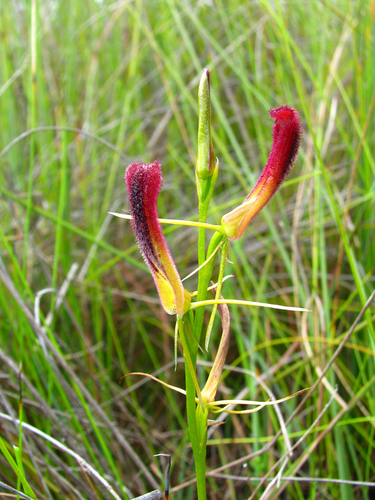
Cryptostylis hunteriana
Leafless tongue-orchid
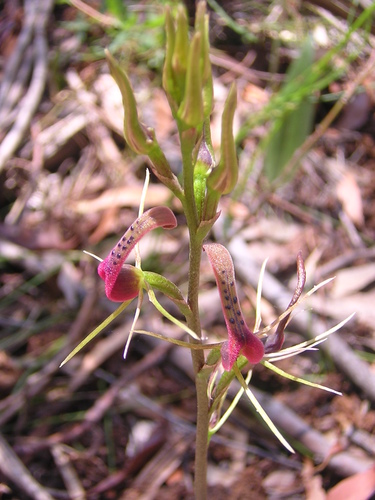
Cryptostylis leptochila
Small tongue-orchid, Red tongue-orchid
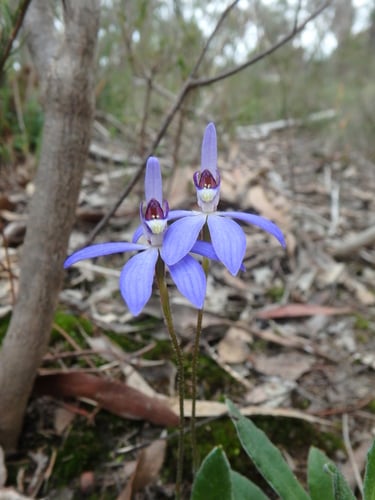
Cyanicula caerulea
Pink finger orchid
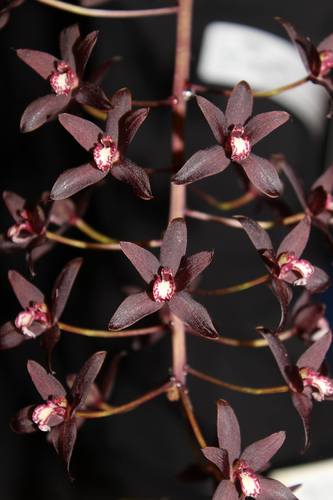
Cymbidium canaliculatum
Queensland tree orchid, Channel Leaf Cymbidium, Black Orchid, Cooktown Black Orchid
Cymbidium ensifolium
Sword cymbidium orchid
Cymbidium faberi