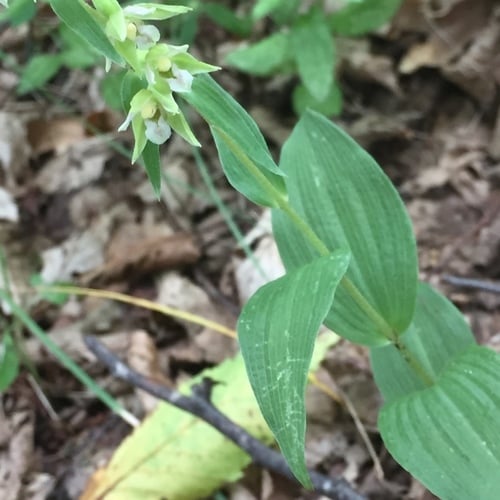
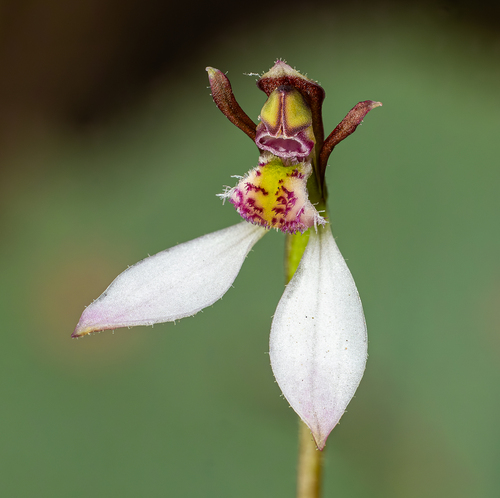
Ophrys fusca
Link.
Kedigozu
iNaturalist· cc-by-nc
(c) Marco Bonifacino, some rights reserved (CC BY-NC), uploaded by Marco Bonifacino
iNaturalist· cc-by-nc
(c) Nicolas Lagière, some rights reserved (CC BY-NC)
Summary
Source: WikipediaOphrys fusca, commonly known as the sombre bee-orchid or the dark bee-orchid, is a species of orchid native to the Mediterranean from southwestern Europe and northern Africa to western Asia. Most subspecies of the Ophrys fusca are pollinated by males Andrena bees.
Description
A perennial orchid reaching 0.4 m in height, hardy to UK zone 7. Flowering occurs May to June with insect pollination. The hermaphroditic plant grows in sandy, loamy, and clay soils across mildly acid to basic pH ranges, tolerates semi-shade to full sun, and prefers moist conditions.
Edible Uses
The root is the edible part, cooked and processed into salep — a fine white to yellowish-white powder made by drying and grinding the tuber. Salep has a starchy quality and is considered highly nutritious; one ounce is said to be enough to sustain a person for a day. It can be prepared as a drink or added to cereals and used in bread.
Traditional Uses
The bulb or tuber is used to produce salep - a hot drink with milk.
This uses section is brief — help expand it
Medicinal Uses
Salep is both nutritive and demulcent. It has been used as a specially valued food for children and convalescents, prepared by boiling with water and flavouring in the same manner as arrowroot. Its high mucilage content forms a soothing jelly used to treat irritations of the gastro-intestinal canal. A ratio of one part salep to fifty parts water is sufficient to produce this jelly. The tuber should be harvested as the plant dies down after flowering and setting seed.
Distribution
It is a temperate plant.
Where It Grows
Europe, Slovenia, Turkey
Cultivation
Plants can be grown in a lawn, but the lawn must not be cut until the plants have set seed. Plants are best grown in the shade. Orchids are, in general, shallow-rooting plants of well-drained low-fertility soils. Their symbiotic relationship with a fungus in the soil allows them to obtain sufficient nutrients and be able to compete successfully with other plants. They are very sensitive to the addition of fertilizers or fungicides since these can harm the symbiotic fungus and thus kill the orchid. This symbiotic relationship makes them very difficult to cultivate, though they will sometimes appear uninvited in a garden and will then thrive. Transplanting can damage the relationship and plants might also thrive for a few years and then disappear, suggesting that they might be short-lived perennials. The flowers resemble a female insect and also emit a scent similar to female pheremones, they are pollinated by a male insect of that species attempting to copulate with the flower. Tubers should be planted out whilst they are dormant, this is probably best done in the autumn. They should be planted at least 5cm below soil level.
Propagation
Sow seed on the surface of compost in a greenhouse, preferably as soon as it is ripe, keeping the compost consistently moist. The seed has a minute embryo surrounded by a single protective cell layer, with minimal food reserves, and depends on a symbiotic relationship with a soil-dwelling fungus. The fungal hyphae invade the embryo cells, and the orchid digests this fungal tissue as its primary food source until it can draw nutrients from soil organic matter. Introduce the appropriate fungus by incorporating soil taken from around established plants, or sow directly around an existing plant of the same species and allow seedlings to develop to a transplantable size. This species rarely produces offsets, but division can be attempted. When flowers begin to fade, the newly formed tuber can be removed — this stress may encourage the original plant to produce additional tubers. The removed tuber should be kept dormant while the parent plant is encouraged to keep growing and form replacements. Division can also be done once a full rosette has developed but before flowering begins: detach the entire new growth from the old tuber, pot it up with a cut near the base of the stem while leaving one or two roots on the old tuber, often without needing to dig up the plant. The old tuber should then generate one or two new growths, while the detached rosette continues to grow and flower normally.
Other Uses
No other uses are known. The plant is noted for its scent.