Crataegus tanacetifolia
(Poir.) Pers.
Tansy-leaved hawthorn, Syrian haw
iNaturalist· cc-by-nc
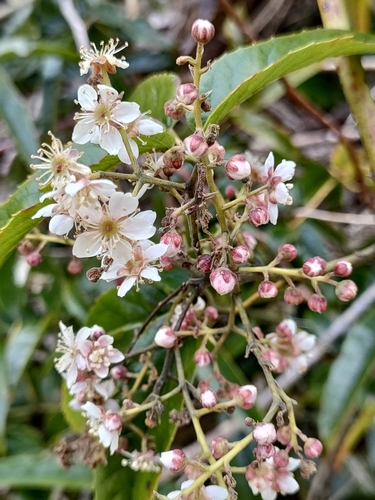
(c) Σάββας Ζαφειρίου (Savvas Zafeiriou), some rights reserved (CC BY-NC)
iNaturalist· cc-by-nc-sa
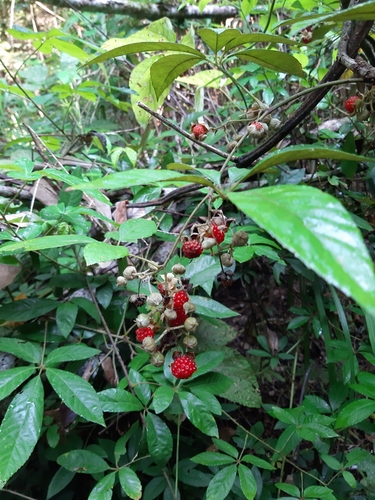
(c) Georgios Mesimeris, some rights reserved (CC BY-NC-SA)
iNaturalist· cc-by-nc-sa
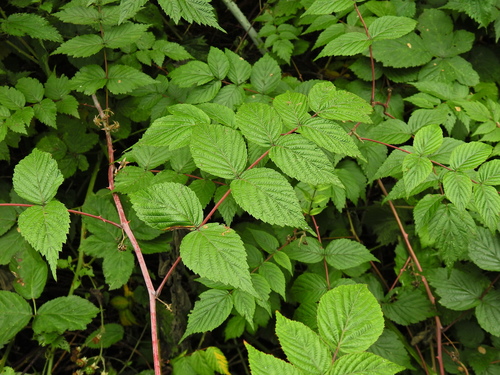
(c) Georgios Mesimeris, some rights reserved (CC BY-NC-SA)
Summary
Source: WikipediaCrataegus tanacetifolia, the tansy-leaved thorn, is a species of hawthorn. It is native to Turkey where it occurs on dry slopes or in rocky places, usually on calcareous rocks. It is a deciduous tree that grows up to 10 metres in height and 8 metres in width The fruit, is 10–14 mm or up to 25 mm in diameter, orange or rarely red in colour. It can be consumed fresh or cooked.
Description
A shrub or small tree. It grows 6-10 m high and spreads 8 m wide. The shoots usually do not have thorns. The leaves are dark green and egg shaped. They are 6 cm long and have fine lobes with teeth along the edge. The fruit are 2-3 cm across. They are orange-yellow. They have the scent and flavour of apples.
Edible Uses
The fruit is a good size at up to 25mm in diameter, with a soft, juicy texture and an acid-sweet, apple-like flavour that is very pleasant eaten raw when fully ripe. It can also be used in pies and preserves, or dried for later use. The centre holds up to five fairly large seeds that tend to stick together, giving the impression of eating a cherry-like fruit with a single stone.
Traditional Uses
The fruit are eaten.
This uses section is brief — help expand it
Medicinal Uses
No specific research has been recorded for this species, but the fruits and flowers of hawthorns in general are well established in herbal folk medicine as a heart tonic — a use that modern research has supported. Both fruits and flowers have a hypotensive effect and act as a mild, direct heart tonic. They are particularly indicated for a weak heart combined with high blood pressure. Prolonged use is needed for the treatment to be effective. It is typically taken as a tea or tincture.
Distribution
Temperate. It can grow on a range of soils and with various pH values. It can tolerate very wet soils as well as drought. Plants are cold hardy. It suits hardiness zones 6-9.
Where It Grows
Australia, Armenia, Asia, Caucasus, Europe, Mediterranean, Middle East, Syria, Turkey, Türkiye,
Cultivation
Plants can be grown from seed. The seed need cold treatment. Plants can also be grafted.
Propagation
Sow seed as soon as it is ripe in autumn in a cold frame. Some seed will germinate the following spring, but most will likely take another year. Stored seed can be very slow and erratic — warm stratify for 3 months at 15°c, then cold stratify for 3 months at 4°c, and even then germination may take a further 18 months. Scarifying before stratifying may reduce this time, and fermenting the seed for a few days in its own pulp may also help. Alternatively, harvest seed green (once the embryo is fully developed but before the seedcoat hardens) and sow immediately in a cold frame; if timed well, germination can occur in spring. For small quantities, pot seedlings as soon as they are large enough to handle and grow on in individual pots for the first year, planting out in late spring into nursery beds or final positions. For larger quantities, sow directly into an outdoor seedbed with protection from mice and other seed-eating animals, undercutting the roots if plants are to remain in the seedbed for more than two years.
Other Uses
The wood is heavy, hard, tough, and close-grained, making it useful for tool handles, mallets, and other small wooden items. The plant is also noted for its scent and its value in food forest settings.
Notes
There are 200 or more Crataegus species.
Also Known As
Kotan alici
References (12)
- Bodkin, F., 1991, Encyclopedia Botanica. Cornstalk publishing, p 296
- Dogan, Y., et al, 2004, The Use of Wild Edible Plants in Western and Central Anatolia (Turkey). Economic Botany 58(4) pp. 684-690
- Etherington, K., & Imwold, D., (Eds), 2001, Botanica's Trees & Shrubs. The illustrated A-Z of over 8500 trees and shrubs. Random House, Australia. p 241
- Facciola, S., 1998, Cornucopia 2: a Source Book of Edible Plants. Kampong Publications, p 197
- Flowerdew, B., 2000, Complete Fruit Book. Kyle Cathie Ltd., London. p 180
Show all 12 references Hide references
- Glowinski, L., 1999, The Complete Book of Fruit Growing in Australia. Lothian. p 44
- Hedrick, U.P., 1919, (Ed.), Sturtevant's edible plants of the world. p 226
- Hibbert, M., 2002, The Aussie Plant Finder 2002, Florilegium. p 76
- Lord, E.E., & Willis, J.H., 1999, Shrubs and Trees for Australian gardens. Lothian. p 53
- Lyle, S., 2006, Discovering fruit and nuts. Land Links. p 162
- Plants for a Future database, The Field, Penpol, Lostwithiel, Cornwall, PL22 0NG, UK. http://www.scs.leeds.ac.uk/pfaf/
- Syn. pl. 2(1):38. 1806