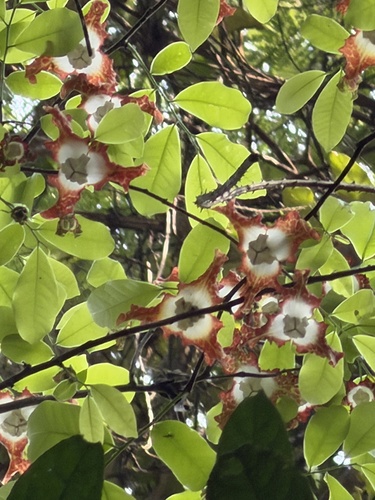
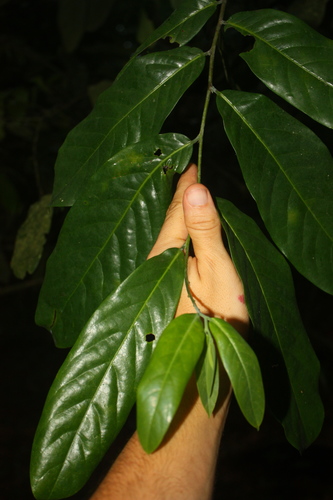
Goniothalamus macrophyllus
(Blume) Hook.f. & Thomson
iNaturalist· cc-by-nc
(c) kaigrr, some rights reserved (CC BY-NC)
iNaturalist· cc-by-nc
(c) kaigrr, some rights reserved (CC BY-NC)
iNaturalist· cc-by-nc
(c) kaigrr, some rights reserved (CC BY-NC)
Summary
Source: WikipediaGoniothalamus macrophyllus is a species of plant in the family Annonaceae. It is native to Borneo, Java, the Malay Peninsula, Sumatra and Thailand. Carl Ludwig Blume, the German-Dutch botanist who first formally described the species using the basionym Unona macrophylla, named it after its large leaves (Latinized forms of Greek μακρός, makrós and φύλλον, phúllon). It is commonly called Penawar Hitam in the Malaya Peninsula, Ki Cantung in Indonesia, Limpanas Putih in Brunei, and Chin Dok Diao in Thailand.
Description
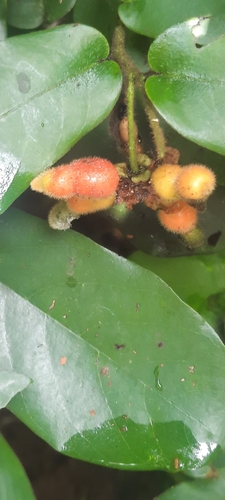
A shrub or small tree. It can grow 10 m tall. The trunk is 15 cm across. The leaves are alternate and simple. The flowers have petals 30 mm long. The flowers are creamish-white. The small fruit are 2 cm long.
Edible Uses
The fruit is edible.
Traditional Uses
Asia, India, Indonesia, Malaysia, Myanmar, SE Asia, Singapore, Thailand,
This uses section is brief — help expand it
Medicinal Uses
It has been reported to be used as a traditional medicine for a variety of ailments in the Malaya Peninsula, Indonesia, Brunei, and Thailand. However, bioactive compounds extracted from its roots have been reported to cytotoxic activity in tests with cultured human cancer cells.
Distribution
It is a tropical plant. It grows between 50-1,500 m above sea level.
Where It Grows
An understorey tree in humid forests at elevations from 50 - 1,500 metres.
Other Uses
The smoke produced by burning the root repels mosquitos, snakes and other wild animals.
Synonyms
References (1)
- Norfaizal, , M., et al, 2014, Flora Diversity of Sungai Teris, Karu Wildlife reserve, Pahang, Malaysia. Journal of Wildlife and Parks (2014) 28 : 81-91