Crataegus pinnatifida var. major
N.E. Br.
Mayhaw, Chinese haw, Chinese hawberry
gbif· cc-by
Kuzbass Botanical Garden (copyright is managed by Dr. Svetlana A. Sheremetova)
gbif· cc-by
Kuzbass Botanical Garden (copyright is managed by Dr. Svetlana A. Sheremetova)
Summary
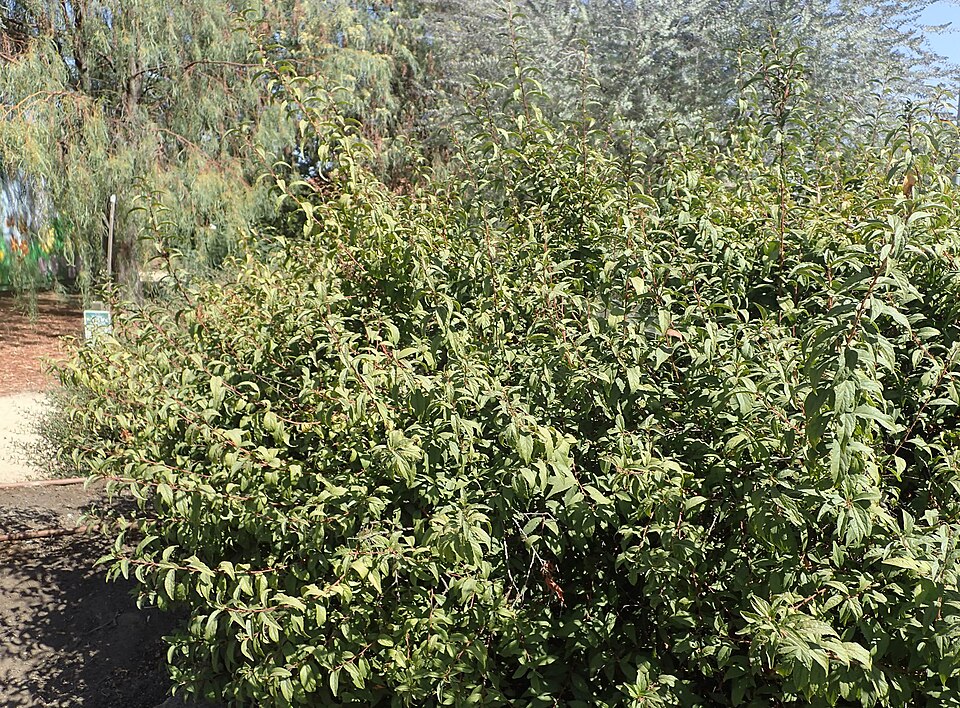
Source: WikipediaCrataegus pinnatifida, also known as mountain hawthorn, Chinese haw, Chinese hawthorn or Chinese hawberry, refers to a small to medium-sized tree, as well as the fruit of the tree. The fruit is bright red, 1.5 in (38 mm) in diameter.
Description
A small tree. It grows 7 m high. It usually has few thorns. It loses its leaves during the year. The flowers are white. The fruit are red with white dots. They are 2-3 cm across.
Edible Uses
In northern Chinese cuisine, ripe C. pinnatifida fruits are used in the desserts tanghulu and shanzhagao. It is also used to make the traditional candies haw flakes and haw rolls, as well as candied fruit slices, jam, jelly, and wine. It is also traditionally used as a finishing ingredient in Cantonese sweet and sour sauce, although it has since been partially supplanted by ketchup.
Traditional Uses
The fruit are eaten. They are also candied. They are also made into preserves and cooked or stewed.
This uses section is brief — help expand it
Medicinal Uses
In traditional Chinese medicine, the dried fruits of C. pinnatifida have been used as a digestive aid.
Distribution
Temperate.
Where It Grows
Asia, Australia, China*, Korea,
Cultivation
Plants can be grown from seed. The seed need cold treatment. Plants can also be grafted.
Other Information
It is an important cultivated fruit tree.
Notes
There are 200 or more Crataegus species.
Synonyms
Also Known As
Bei shanzha
References (10)
- Arora, R. K., 2014, Diversity in Underutilized Plant Species - An Asia-Pacific Perspective. Bioversity International. p 65
- Bodkin, F., 1991, Encyclopedia Botanica. Cornstalk publishing, p 297
- Flora of China. www.eFloras.org Volume 9
- Gard. Chron. ser. 2, 26:621, fig. 121. 1886
- Hibbert, M., 2002, The Aussie Plant Finder 2002, Florilegium. p 75
Show all 10 references Hide references
- Lyle, S., 2006, Discovering fruit and nuts. Land Links. p 161
- Plants for a Future database, The Field, Penpol, Lostwithiel, Cornwall, PL22 0NG, UK. http://www.scs.leeds.ac.uk/pfaf/
- Ryan, S., 2008, Dicksonia. Rare Plants Manual. Hyland House. p 20
- USDA, ARS, National Genetic Resources Program. Germplasm Resources Information Network - (GRIN). [Online Database] National Germplasm Resources Laboratory, Beltsville, Maryland. Available: www.ars-grin.gov/cgi-bin/npgs/html/econ.pl (10 April 2000)
- Wiersema, J. H. & Leon, B., 2013, World Economic Plants. A Standard Reference CRC Press. 2nd Ed. p 209