Crataegus coccinioides
Ashe
Columbian hawthorn, Kansas hawthorn, Mississippi hawthorn
iNaturalist· cc0
no rights reserved, uploaded by Étienne Lacroix-Carignan
iNaturalist· cc0
no rights reserved, uploaded by Étienne Lacroix-Carignan
iNaturalist· cc0
no rights reserved, uploaded by Étienne Lacroix-Carignan
Summary
Source: WikipediaCrataegus coccinioides is a species of hawthorn known by the common names Kansas hawthorn and large-flowered cockspurthorn. Crataegus coccinioides is native from Kansas, to New England, and the southernmost parts of Ontario and Quebec. It has large flowers and leaves and fruit that appear pinkish until polished to reveal the red colour underneath the wax bloom. Crataegus coccinioides (or its var. locuples) is a synonym of Crataegus dilatata.
Description
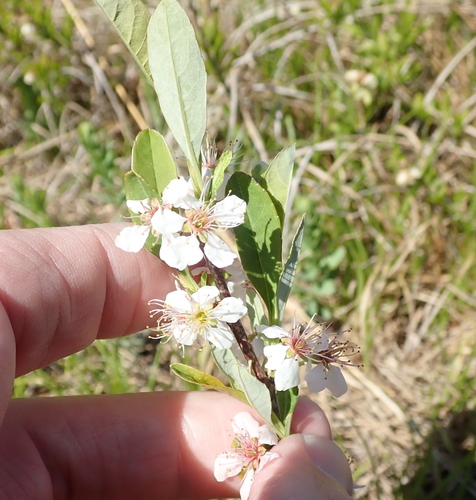
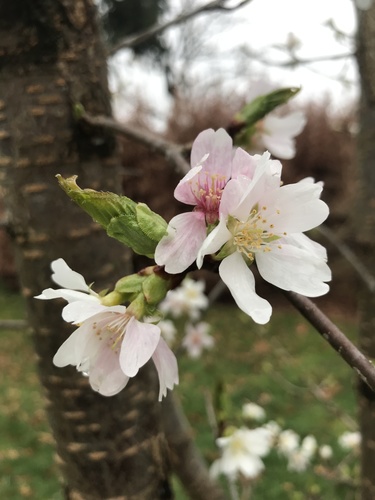
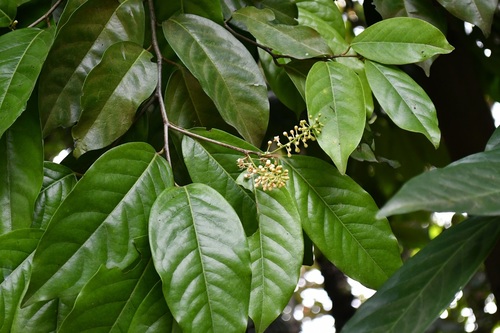
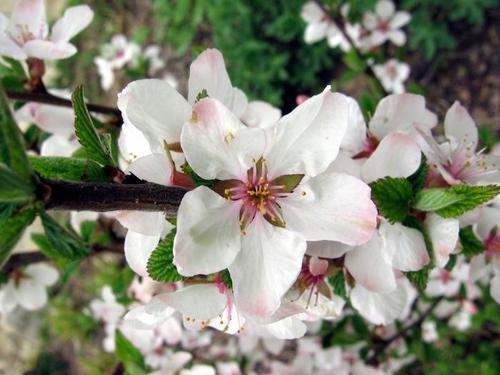
A small tree. It grows 6 m high. The trunk is 20 cm across. The crown is broad and round. It is dense with spreading branches. The leaves are 6-7.5 cm long and 5-6 cm wide. They are oval with a short-pointed tip. There are several shallow lobes and double teeth along the edge. They are reddish when young and become dark green above and paler underneath. They become orange or red in autumn. The flowers are large. They are 2-2.5 cm wide with 5 white petals. They occur as 4-7 flowers in clusters. The fruit are large and dark red. They are 19 mm across and round but flattened at the ends. They are shiny dark red with pale dots. There are 5 seeds inside.
Edible Uses
The fruit are edible.
Distribution
Temperate. It will grow in most soils. It is resistant to drought and frost.
Where It Grows
Australia, Canada, North America*, USA,
Cultivation
Plants can be grown from seed. The seed need cold treatment. Plants can also be grafted.
Notes
There are 200 or more Crataegus species.
Synonyms
References (6)
- Bodkin, F., 1991, Encyclopedia Botanica. Cornstalk publishing, p 295
- J. Elisha Mitchell Sci. Soc. 16(2):74. 1899
- Little, E.L., 1980, National Audubon Society Field Guide to North American Trees. Alfred A. Knopf. p 467
- Lord, E.E., & Willis, J.H., 1999, Shrubs and Trees for Australian gardens. Lothian. p 52
- Lyle, S., 2006, Discovering fruit and nuts. Land Links. p 164
Show all 6 references Hide references
- Plants for a Future database, The Field, Penpol, Lostwithiel, Cornwall, PL22 0NG, UK. http://www.scs.leeds.ac.uk/pfaf/