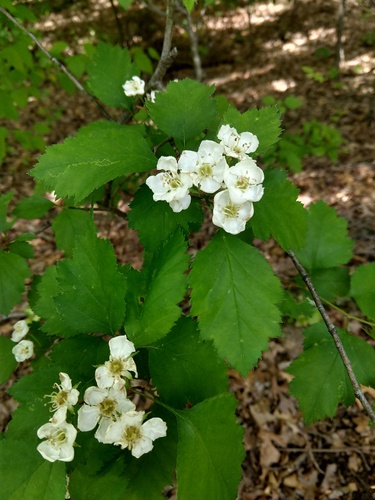
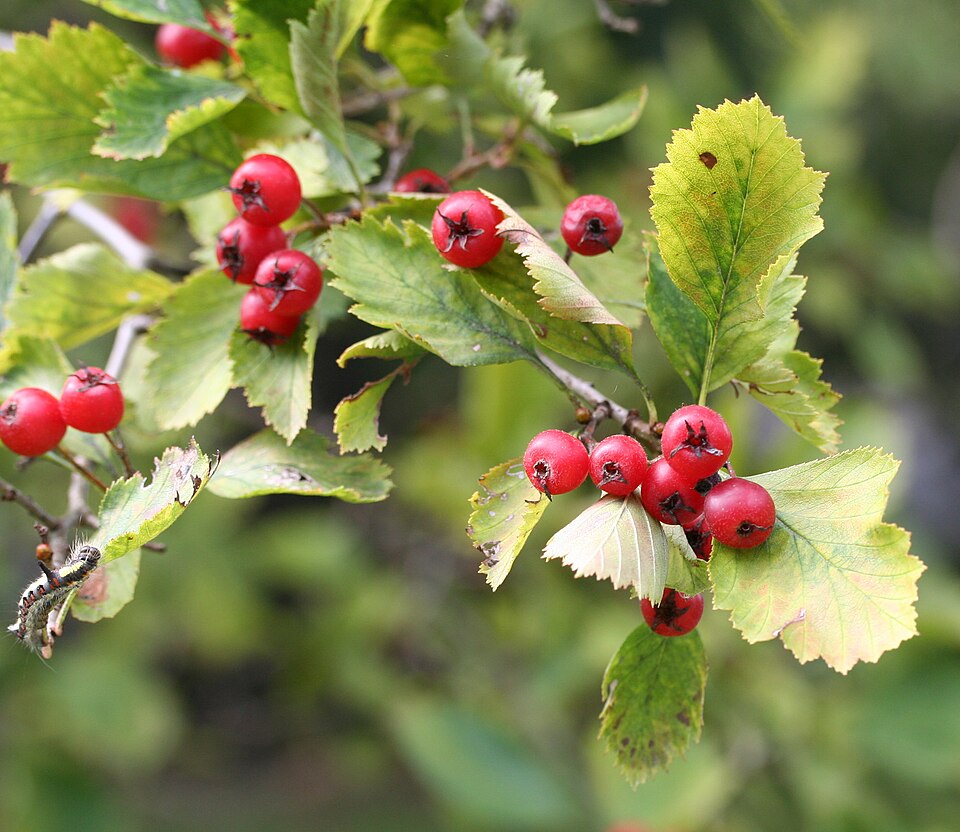
Crataegus acclivis
Sarg.
wikimedia· cc0
Wikimedia Commons - Britton, N.L., and A. Brown. 1913. An illustrated flora of the northern United States, Canada and the British Possessions. 3 vols. Charles Scribner's Sons, New York. Vol. 2: 317. Courtesy of Kentucky Native Plant Society. Scanned by Omnitek Inc.
wikimedia· cc-by-sa
Wikimedia Commons - VoDeTan2
Summary
Source: WikipediaA deciduous tree growing to 8 m tall by 7 m wide, hardy to UK zone 5. Flowers April to May with September seed ripening. Hermaphroditic and midge-pollinated. Adapts to light sandy, medium loamy, and heavy clay soils, including very alkaline conditions. Grows in semi-shade to full sun, preferring moist or wet soil but tolerating drought. Wind-tolerant but not salt-spray resistant; tolerates atmospheric pollution.
Description
A deciduous tree growing to 8 m tall by 7 m wide, hardy to UK zone 5. Flowers April to May with September seed ripening. Hermaphroditic and midge-pollinated. Adapts to light sandy, medium loamy, and heavy clay soils, including very alkaline conditions. Grows in semi-shade to full sun, preferring moist or wet soil but tolerating drought. Wind-tolerant but not salt-spray resistant; tolerates atmospheric pollution.
Edible Uses
The fruit ripens in early September, reaching about 18mm long, and can be eaten raw or cooked. It has a pleasantly sweet, juicy flesh that makes an excellent dessert fruit. Each fruit holds up to 5 seeds at its centre; these typically fuse together, giving the experience of eating a cherry with a single large stone.
Medicinal Uses
Though no specific research has been recorded for this species, the fruits and flowers of hawthorns broadly are well established in herbal folk medicine as a heart tonic, and modern research supports this. Both fruits and flowers exert a hypotensive effect and act as a gentle, direct heart tonic. They are particularly suited to treating a weak heart accompanied by high blood pressure. Prolonged use is required for effective results, and the plant is typically taken as a tea or tincture.
Distribution
It is a temperate plant.
Where It Grows
Canada, North America, USA,
Cultivation
A very easily grown plant, it prefers a well-drained moisture retentive loamy soil but is not at all fussy. Once established, it succeeds in excessively moist soils and also tolerates drought. It grows well on a chalk soil and also in heavy clay soils. A position in full sun is best when plants are being grown for their fruit, they also succeed in semi-shade though fruit yields and quality will be lower in such a position. Most members of this genus succeed in exposed positions, they also tolerate atmospheric pollution. Plants are hardy to at least -18°c. We have very little specific information on this plant, and it is regarded as no more than a form of C. pedicellata by most botanists. However, a tree seen at Kew in early September 1997 had a good crop of almost ripe fruit. This fruit was more elongated than C. pedicellata and was also ripe about 4 weeks before that species. Hybridizes freely with other members of this genus. Seedling trees take from 5 - 8 years before they start bearing fruit, though grafted trees will often flower heavily in their third year. The flowers have a foetid smell somewhat like decaying fish. This attracts midges which are the main means of fertilization. When freshly open, the flowers have more pleasant scent with balsamic undertones. Seedlings should not be left in a seedbed for more than 2 years without being transplanted.
Propagation
Seed is best sown fresh in autumn in a cold frame; some will germinate the following spring, though most will likely take a further year. Stored seed germinates slowly and erratically — warm stratify for 3 months at 15°C, then cold stratify for 3 months at 4°C, after which germination may still take another 18 months. Scarifying before stratification may shorten this period, and fermenting the seed for a few days in its own pulp may also help. Alternatively, harvest seed green — once the embryo is fully formed but before the seedcoat hardens — and sow immediately in a cold frame for possible spring germination. For small quantities, pot seedlings individually as soon as they are large enough to handle and grow on for the first year before planting out in late spring. For larger quantities, sow directly in a protected outdoor seedbed and undercut the roots if plants will remain there for more than two years.
Other Uses
No other uses are known.
Notes
There are about 280 (1,250) Crataegus species. Probably the fruit of most are edible.
References (1)
- Plants for a Future database, The Field, Penpol, Lostwithiel, Cornwall, PL22 0NG, UK. http://www.scs.leeds.ac.uk/pfaf/