Actinorhytis calapparia
(Blume) H. Wendl & Drude
Calappa palm
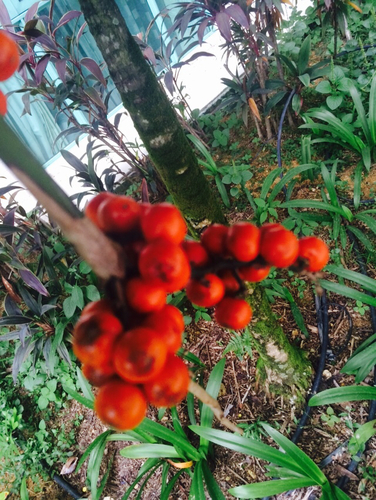
iNaturalist· cc-by
(c) scott.zona, some rights reserved (CC BY)
iNaturalist· cc-by-nc-sa
(c) Yanuar Ishaq Dc, some rights reserved (CC BY-NC-SA)
Description
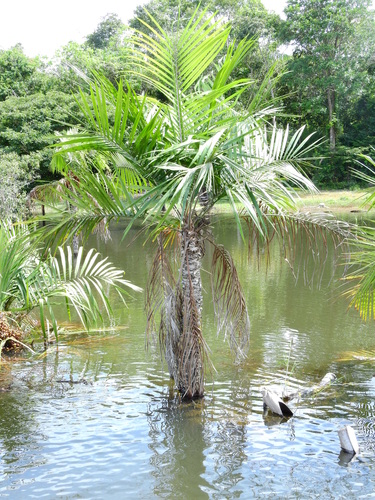
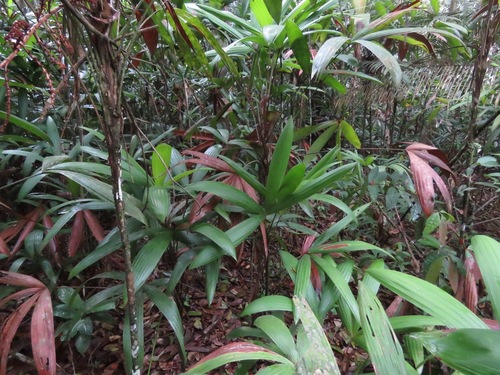
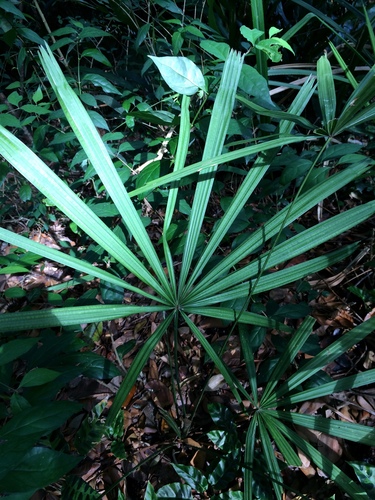
A tall palm with a narrow trunk. The trunk is grey-brown with a bright green crownshaft. It has an appearance a little like a coconut. It grows 20-30 m high. The fronds are divided along the leaf stalk into narrow leaflets. These have a sharp point. These leaflets (pinnae) have one strong mid-nerve and 4-5 parallel side veins. The leaf sheath is about 1-1.3 m long. The flowering stalk comes from below the crownshaft. It has one stiff main axis and 4-5 stiff side branches. Then there are many twigs which hang down. The whole flowering stalk is about 1 m long. There are 2 spathes or leaf like structures protecting the flowering palm stalk. These are about 1 m long. The flowers are of separate sexes both on the same tree. At the base of the flowering stalk there is one female flower to 2 male flowers but towards the tip the flowers are only male. Female flowers are larger than the male. The fruit are round and 4-5 cm across. The young nut has a juicy kernel. The nut has grooves spreading out like rays from the centre.
Edible Uses
The young nut kernel is chewed like betel nut, though it is reported to be very strong. The palm heart is also eaten.
Traditional Uses
The young nut is chewed like betel nut. It is very strong. The palm heart is eaten.
This uses section is brief — help expand it
Distribution
A tropical plant. It is widespread in Papua New Guinea. It grows in rainforest. It grows in well-drained rich soil with an abundance of moisture. It grows up to 1,000 m altitude. It grows in the Loyalty and Treasury Islands.
Where It Grows
Asia, Australia, India, Indonesia, Malaysia, Pacific, Papua New Guinea, PNG, SE Asia, Solomon Islands,
Cultivation
Plants can be grown from seeds.
Other Information
It is not known if it is used for food in Papua New Guinea.
Notes
There are 2 Actinorhytis species.
Synonyms
Also Known As
Boluru, Jawar, Jebug sari, Pinang hantu, Pinang kelapa, Pinang penawar, Pinang sendawa, Pomau, Vekaveke
References (19)
- Baker, W.J. and Dransfield, J., 2006, Field Guide to Palms of New Guinea. Kew p 48
- Balick, M.J. and Beck, H.T., (Ed.), 1990, Useful palms of the World. A Synoptic Bibliography. Colombia p 404,
- Barfod, A.S., Banka R., and Dowe, J. L., 2001, Field Guide to Palms in Papua New Guinea. AAU Reports 40 Department of Systematic Botany University of Aarhus. Denmark. p 62
- Burkill, I.H., 1966, A Dictionary of the Economic Products of the Malay Peninsula. Ministry of Agriculture and Cooperatives, Kuala Lumpur, Malaysia. Vol 1 (A-H) p
- Essig, F.B., 1977, The palm Flora of New Guinea. Botany Bulletin No 9. Papua New Guinea Division of Botany. Lae, Papua New Guinea. p 24 Plate 7 (Photo)
Show all 19 references Hide references
- Essig, F.B., 1995, A checklist and analysis of the palms of the Bismarck Archipelago. Principes 39(3):123-129
- French, B.R., 2010, Food Plants of Solomon Islands. A Compendium. Food Plants International Inc. p 283
- French, B.R., 2010, Food Plants of Solomon Islands. A Compendium. Food Plants International Inc. p 284 (As Actinorhytis poamau)
- Haynes, J., & McLaughlin, J., 2000, Edible palms and Their Uses. University of Florida Fact sheet MCDE-00-50-1 p 2
- Johnson, D.V., 1998, Tropical palms. Non-wood Forest products 10. FAO Rome. p 79
- Jones, D.L., 1994, Palms throughout the World. Smithtonian Institution, Washington. p 118
- Jones, D.L., 2000, Palms of Australia 3rd edition. Reed/New Holland. p 113
- Jones, D.L., 1994, Palms throughout the World. Smithtonian Institution, Washington. p 118 (As Actinorhytis poamau)
- Linnaea 39:184. 1875
- Menninger, E.A., 1977, Edible Nuts of the World. Horticultural Books. Florida p 124 (Incl. picture)
- Peekel, P.G., 1984, (Translation E.E.Henty), Flora of the Bismarck Archipelago for Naturalists, Division of Botany, Lae, PNG. p 58 (Drawing)
- Riffle, R.L. & Craft, P., 2003, An Encyclopedia of Cultivated Palms. Timber Press. p 23, 244
- Sukarya, D. G., (Ed.) 2013, 3,500 Plant Species of the Botanic Gardens of Indonesia. LIPI p 748
- World Checklist of Useful Plant Species 2020. Royal Botanic Gardens, Kew