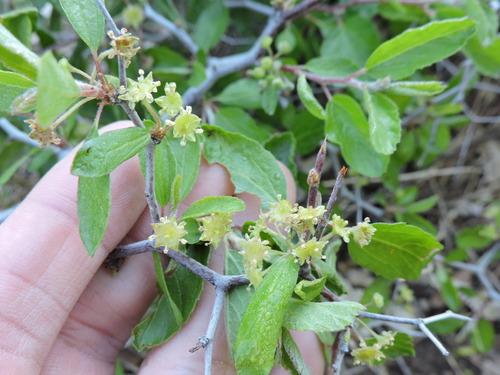
Frangula alnus
Mill.
Alder buckthorn
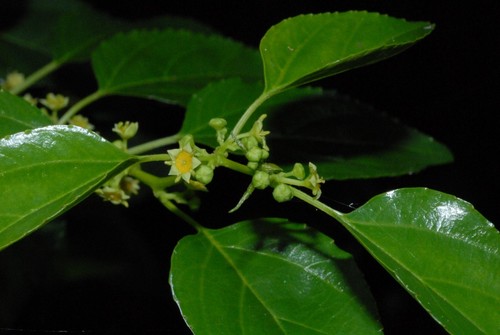
iNaturalist· cc-by-sa
(c) Sten Porse, some rights reserved (CC BY-SA)
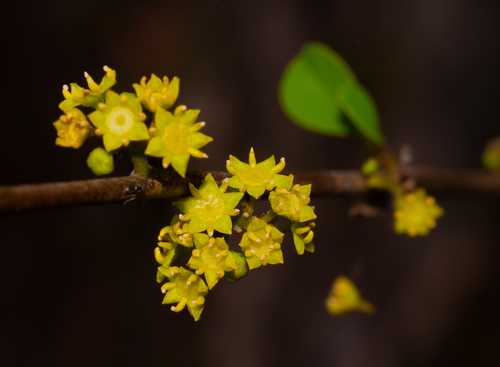
iNaturalist· cc-by
(c) Daniel Cahen, some rights reserved (CC BY), uploaded by Daniel Cahen
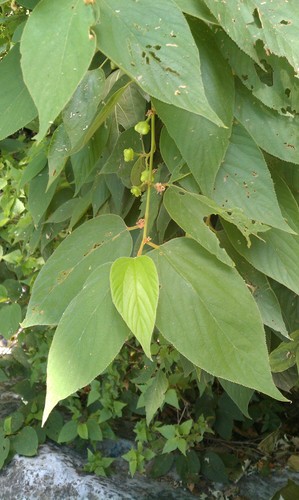
iNaturalist· cc-by-sa
(c) Douglas Goldman, some rights reserved (CC BY-SA), uploaded by Douglas Goldman
Summary
Source: WikipediaFrangula alnus, commonly known as alder buckthorn, glossy buckthorn, or breaking buckthorn, is a tall deciduous shrub in the family Rhamnaceae. Unlike other "buckthorns", alder buckthorn does not have thorns. It is native to Europe, northernmost Africa, and western Asia, from Ireland and Great Britain north to the 68th parallel in Scandinavia, east to central Siberia and Xinjiang in western China, and south to northern Morocco, Turkey, and the Alborz in Iran and the Caucasus Mountains; in the northwest of its range (Ireland, Scotland), it is rare and scattered. It is also introduced and naturalised in eastern North America.
Description
A shrub in the buckthorn family (Rhamnaceae) found in temperate regions. Both the fruit and bark are used as food and beverage, though caution is advised.
Edible Uses
The fruit is eaten fresh. The bark is used to make alcohol.
Traditional Uses
The fruit is eaten fresh. The bark is used to make alcohol. Caution.
This uses section is brief — help expand it
Medicinal Uses
Galen, a Greek physician of the 2nd century A.D., knew of alder buckthorn, although he did not distinguish clearly in his writings between it and other closely related species. All of these plants though, were credited with the power to protect against witchcraft, demons, poisons, and headaches. The bark (and to a lesser extent the fruit) has been used as a laxative, due to its 3–7% anthraquinone content. Bark for medicinal use is dried and stored for a year before use, as fresh bark is violently purgative; even dried bark can be dangerous if taken in excess.
Known Hazards
Caution advised with consumption.
Distribution
It is a temperate plant.
Where It Grows
Estonia, Europe, Latvia, Lithuania, Luxembourg, Slovenia, Sweden, Ukraine,
Synonyms
Also Known As
Kruklis, Navadna krhlika, Paa(k)spuu
References (3)
- Pieroni, A. & Soukand, R., 2018, Forest as Stronghold of Local Ecological Practice: Currently Used Wild Food Plants in Polesia, Northern Ukraine. Economic Botany, XX(X) pp. 1-21
- Pruse, B., et al, 2021, Active Wild Food Practices among Culturally Diverse Groups in the 21st Century across Latgale, Latvia. Biology 2021, 10, 551.
- Soukand, R. & Kalle, R., 2016, Perceiving the Biodiversity of Food at Chest-height: use of the Fleshy Fruits of Wild Trees and Shrubs in Saaremaa, Estonia. Hum Ecol 44:265–272