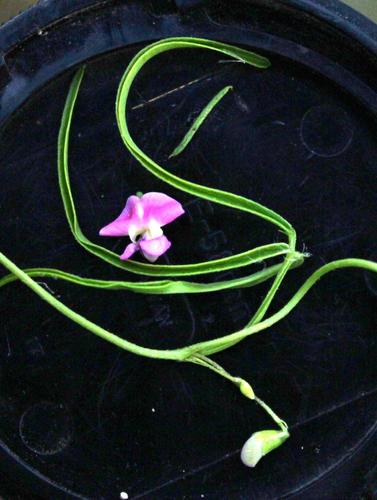
Cordyla densiflora
Milne-Redh.
iNaturalist· cc-by-nc
(c) frasergear, some rights reserved (CC BY-NC), uploaded by frasergear
iNaturalist· cc-by-nc
(c) frasergear, some rights reserved (CC BY-NC)
Description
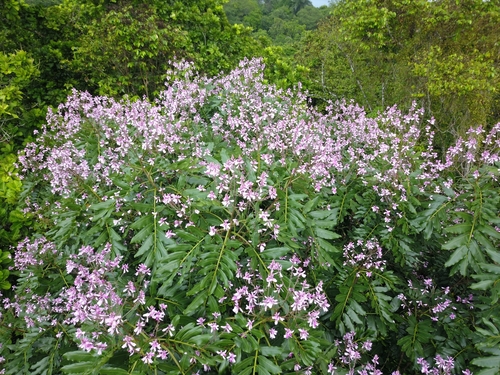
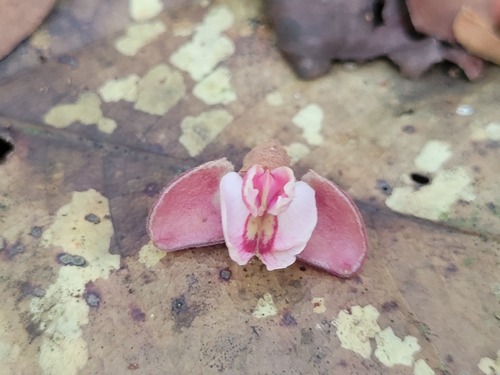
A tree. It loses its leaves during the year. It grows 4-10 m tall. The trunk is short and with many branches. The crown is bushy and rounded. The bark is smooth and pale grey to brown. The leaves are compound and there is an odd number of leaflets along the stalk. There are 5-9 pairs of leaflets and one at the end. They are 2-4 cm long. The tip is rounded. The flowers are small and appear on the tree when it has no leaves. They are in dense clusters near the ends of leafless branches. The fruit are green and rounded but flattened on one side. There is a beak at the tip. They are 6.5 cm long. They contain 1-6 seeds. The seeds are large and have a thin wall.
Edible Uses
The pulp of ripe fruit is eaten raw (though it has an unpleasant smell), and fruits are also collected, cooked, and eaten.
Traditional Uses
The pulp of the ripe fruit is eaten raw. It has an unpleasant smell. Fruit are collected and cooked then eaten.
This uses section is brief — help expand it
Medicinal Uses
A solution of pounded leaves, hot water and salt is allowed to cool until lukewarm. The solution is then used as an enema to treat severe constipation. To treat burns, ground charcoal made from the wood is mixed with sheep fat and smeared on the wound.
Distribution
A tropical plant. It grows in deciduous woodland and in savanna. In Tanzania it grows between 800-1,300 m above sea level.
Where It Grows
Africa, East Africa, Tanzania,
Cultivation
Plants can be grown by seeds or by cuttings. The tree is used as a living hedge.
Propagation
Seed - Cuttings
Other Uses
The wood is used to make beehives, drums, stools, grain mortars, poles and pestles. The wood is commonly harvested for fuel. We have no more specific information for this species, but the wood of Cordyla species is generally yellowish, durable and suitable for general carpentry, joinery and plywood. Trunks of large, old, hollow trees are prized for making drums and dug-out canoes. The tree is used as a live fence.
Production
In Tanzania ripe fruit are collected from October to February.
Also Known As
Mkwata
References (3)
- FAO. 1983, Food and fruit-bearing forest species 1: Examples from Eastern Africa. FAO Food and Forestry Paper 44/1 p 35
- Ruffo, C. K., Birnie, A. & Tengnas, B., 2002, Edible Wild Plants of Tanzania. RELMA p 236
- World Checklist of Useful Plant Species 2020. Royal Botanic Gardens, Kew