Cordeauxia edulis
Hemsley
Yeheb nut
wikimedia· cc-by
Wikimedia Commons - Hooker, W.J., Hooker, J.D., Icones Plantarum [Hooker’s] Icones plantarum], vol. 29: t. 2839 (1907) [M. Smith]
iNaturalist· cc-by-nc
(c) Ahmed Awale, some rights reserved (CC BY-NC), uploaded by Ahmed Awale
Summary
Source: WikipediaEvergreen shrub growing slowly to 4 m tall and wide, hardy to UK zone 10. Nitrogen-fixing species. Suits light sandy and medium loamy soils with good drainage; tolerates poor soil and drought. Requires full sun. Adapts to mildly acid to basic pH.
Description
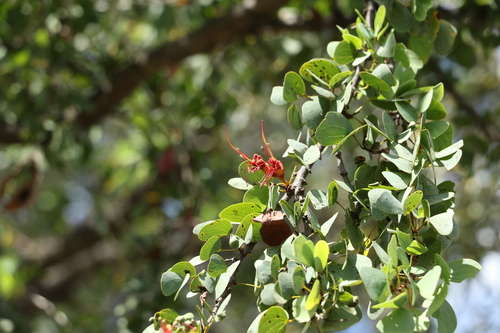
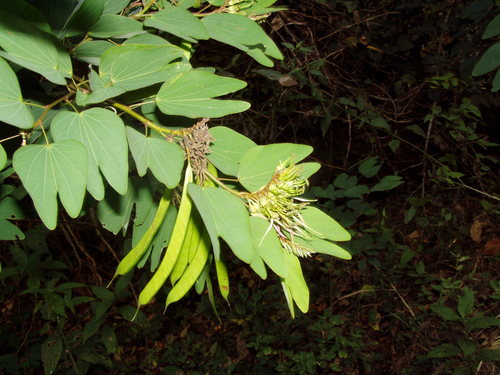
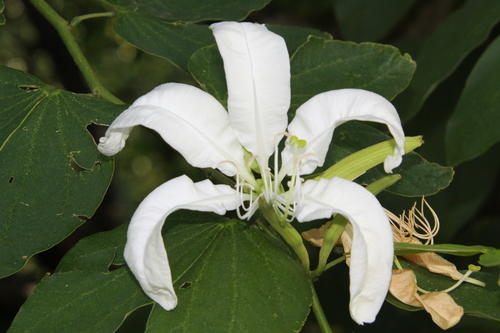
A small evergreen shrub. It has many stems. It grows to about 1.6 m tall but can grow to 2.5 m tall in good growing conditions. It has a long tap root. The leaves are 3-5 cm long. They are divided into 4 pairs of leaflets. The leaflets are oval and leathery. They are 1-2.5 cm long and 1-1.4 cm wide. The flowers have both sexes and are carried in clusters at the ends of branches. They are bright yellow and 2.5 cm across. The pods are 4-6 cm long and curved with a beak. The pods are leathery and slightly flattened. The pods contain 1-4 seeds. The seeds are round and about 12 mm across.
Edible Uses
The seeds can be eaten raw, roasted or boiled as a vegetable. Fresh or dried seeds have a sour flavour, but after roasting they develop a sweetish, agreeable, chestnut-like taste. The seeds may also be boiled to produce a sweet liquor. They are the size of a large filbert, with a smooth consistency and a thin, easily broken shell. The seeds are nutritious; their carbohydrate and protein content is lower than in pulses and other legumes, but they are richer in sugars and fats, providing a balanced diet and high energy. The seeds have been mentioned as a coffee substitute. An infusion of the leaves is used as a tea substitute.
Traditional Uses
Seeds are dried then boiled or roasted or eaten raw. Tea is made from the leaves.
This uses section is brief — help expand it
Medicinal Uses
Cordeauxiaquinone, found in the leaves and other parts of the plant, is used medicinally to stimulate haemopoiesis. The plant is said to regulate gastric secretion and to permit treatment of ulcers caused by hot food. It is also believed to alleviate anaemia by increasing the number of red blood cells.
Distribution
A tropical plant. It grows in arid and semi arid areas in Somalia and Ethiopia. It is a very hardy shrub. It can survive droughts. It suits areas with an average temperature of 25°C. It grows in Ethiopia from 300-1000 m altitude. The average rainfall is 250-400 mm but it can grow with rainfalls down to 150-200 mm. It grows in poor low nitrogen soils. It can grow in arid places.
Where It Grows
Africa, Australia, East Africa, Ethiopia, Israel, Kenya, Mediterranean, Middle East, North America, Somalia, Sudan, Tanzania, USA, Yemen,
Cultivation
It grows best in areas where annual daytime temperatures are within the range 25 - 30?c, but can tolerate 20 - 38?c. It prefers a mean annual rainfall in the range 200 - 400mm, but tolerates 100 - 600mm. In more humid climates, plants produce more vegetative growth, but often at the expense of fruiting. Requires a sunny position in a light, very well-drained soil. Succeeds in poor soils that are extremely low in nitrogen. Prefers a pH in the range 6.5 - 7.5, tolerating 6 - 8.4. Established plants are very drought tolerant. Early aerial growth of young plants is slow until the massive root system is established. Plants only 1cm tall can have roots 15cm or more long. Plants begin to bear well when 3 - 4 years old. Plants begin to bear prolifically when only 1 - 1.2 metres tall. Yields of around 5 kg of seeds per shrub can be achieved. Such is the demand and free access to all wild plants that the fruits are often collected from the shrubs before they are fully mature. Plants can live for 200 years or more. A very deep rooted tree. The tree has somewhat fleshy leaves that stain the fingers red on being rubbed. This species has a symbiotic relationship with certain soil bacteria, these bacteria form nodules on the roots and fix atmospheric nitrogen. Some of this nitrogen is utilized by the growing plant but some can also be used by other plants growing nearby.
Propagation
Seed is best sown as soon as it is ripe, when germination is usually good. Viability drops rapidly if seed is stored for more than a few months; however, seeds coated in wood ash and stored in a sack are reported to remain viable for at least a year. Germination is rapid, but early aerial growth is very slow while the root system develops quickly — plants 60cm tall may already have roots 2 metres long. Sowing in situ is recommended to avoid problems transplanting seedlings caused by rapid tap-root development. Vegetative propagation is also possible.
Other Uses
The plant contains cordeauxiaquinone, a brilliant red dye not known to occur elsewhere in the plant kingdom. Cordeauxiaquinone produces fast, insoluble dyes with some metals and is used as a mordant in dyeing factories. Animals that browse the plant develop pink-coloured bones due to cordeauxiaquinone. A substance between liquid oil and fat, less pleasant than olive oil, is extracted from the plant and is useful for soap making, as is the seed oil. The wood is used as firewood and burns well even when wet.
Production
Plants grow slowly in the early stages. They may produce few pods in the first three years. Trees can live for very many years. In humid conditions plants produce more leaves but few seeds. Plants are pollinated by insects. Pods can develop 2 weeks after flowering. Immature fruit can remain dormant on the plant until further rains allow them to reach maturity. Yields of about 5 kg of seed per shrub can be obtained. A seed weighs 2-3 g.
Other Information
It is an important food of the poor people in Ethiopia.
Notes
The seed is nutritious
Nutrition
| Part | Moisture | kJ | kcal | Protein | Vit A | Vit C | Iron | Zinc |
|---|---|---|---|---|---|---|---|---|
| Seeds | 11.1 | 1664 | 398 | 10.8 | — | — | 6.4 | — |
Synonyms
Also Known As
Ehb, Gud, Geed-yicib, Jeheb, Qud, Quda, Ye-eb
References (29)
- Asfaw, Z. and Tadesse, M., 2001, Prospects for Sustainable Use and Development of Wild Food Plants in Ethiopia. Economic Botany, Vol. 55, No. 1, pp. 47-62
- Bekele-Tesemma A., Birnie, A., & Tengnas, B., 1993, Useful Trees and Shrubs for Ethiopia. Regional Soil Conservation Unit. Technical Handbook No 5. p 170
- Brink, M., 2006. Cordeauxia edulis Hemsl. [Internet] Record from Protabase. Brink, M. & Belay, G. (Editors). PROTA (Plant Resources of Tropical Africa), Wageningen, Netherlands. < http://database.prota.org/search.htm>. Accessed 15 October 2009.
- Bull. Misc. Inform. Kew 1907:361. 1907
- Ethiopia: Famine Food Field Guide. http://www.africa.upenn.edu/faminefood/category2.htm
Show all 29 references Hide references
- Facciola, S., 1998, Cornucopia 2: a Source Book of Edible Plants. Kampong Publications, p 103
- FAO, 1988, Traditional Food Plants, FAO Food and Nutrition Paper 42. FAO Rome p 224
- Food Composition Tables for use in Africa FAO http://www.fao.org/infoods/directory No. 361
- INFOODSUpdatedFGU-list.xls
- Jardin, C., 1970, List of Foods Used In Africa, FAO Nutrition Information Document Series No 2.p 25
- Kiple, K.F. & Ornelas, K.C., (eds), 2000, The Cambridge World History of Food. CUP p 1885
- Lulekal, E., et al, 2011, Wild edible plants in Ethiopia: a review on their potential to combat food insecurity. Afrika Focus - Vol. 24, No 2. pp 71-121
- Macmillan, H.F. (Revised Barlow, H.S., et al) 1991, Tropical Planting and Gardening. Sixth edition. Malayan Nature Society. Kuala Lumpur. p 344
- Mahony, D., 1991, Trees of Somalia. A Field Guide for Development Workers. Oxfam Research Paper 3. p 9
- Maundu, P. et al, 1999, Traditional Food Plants of Kenya. National Museum of Kenya. 288p
- Mbuya, L.P., Msanga, H.P., Ruffo, C.K., Birnie, A & Tengnas, B., 1994, Useful Trees and Shrubs for Tanzania. Regional Soil Conservation Unit. Technical Handbook No 6. p 200
- Menninger, E.A., 1977, Edible Nuts of the World. Horticultural Books. Florida p 92
- Miege & Miege, 1978,
- Molla, A., Ethiopian Plant Names. http://www.ethiopic.com/aplants.htm
- Peters, C. R., O'Brien, E. M., and Drummond, R.B., 1992, Edible Wild plants of Sub-saharan Africa. Kew. p 122
- Plowes, N. J. & Taylor, F. W., 1997, The Processing of Indigenous Fruits and other Wildfoods of Southern Africa. in Smartt, L. & Haq. (Eds) Domestication, Production and Utilization of New Crops. ICUC p 189
- Royal Botanic Gardens, Kew (1999). Survey of Economic Plants for Arid and Semi-Arid Lands (SEPASAL) database. Published on the Internet; http://www.rbgkew.org.uk/ceb/sepasal/internet [Accessed 21st April 2011]
- USDA, ARS, National Genetic Resources Program. Germplasm Resources Information Network - (GRIN). [Online Database] National Germplasm Resources Laboratory, Beltsville, Maryland. Available: www.ars-grin.gov/cgi-bin/npgs/html/econ.pl (10 April 2000)
- Wickens & Storey, 1984,
- Wickens, G.E., 1995, Edible Nuts. FAO Non-wood forest products. FAO, Rome. p 71, 141
- Wiersema, J. H. & Leon, B., 2013, World Economic Plants. A Standard Reference CRC Press. 2nd Ed. p 198
- Wilson, J.M. & Witcombe, J.R., Crops for Arid lands, in Wickens, G.E., Goodin, J.R., and Field, D.V.,(Eds.) 1985, Plants for Arid Lands. Unwin Hyman, London, p 44
- World Checklist of Useful Plant Species 2020. Royal Botanic Gardens, Kew
- www.worldagroforestrycentre.org/sea/products/afdbases/af/asp/SpeciesInfo.asp?SpID=587