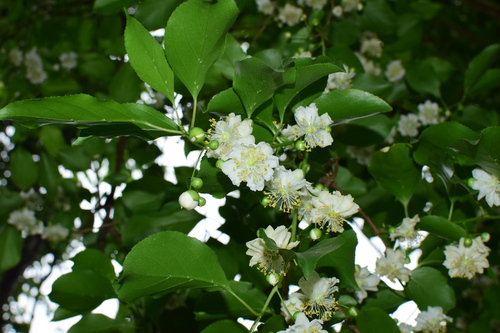
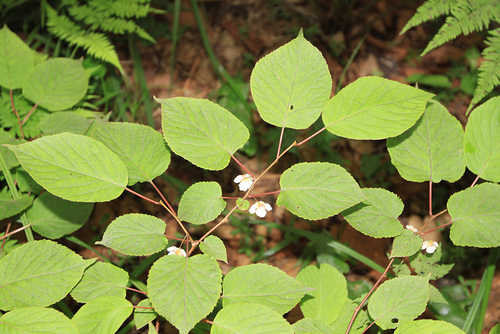
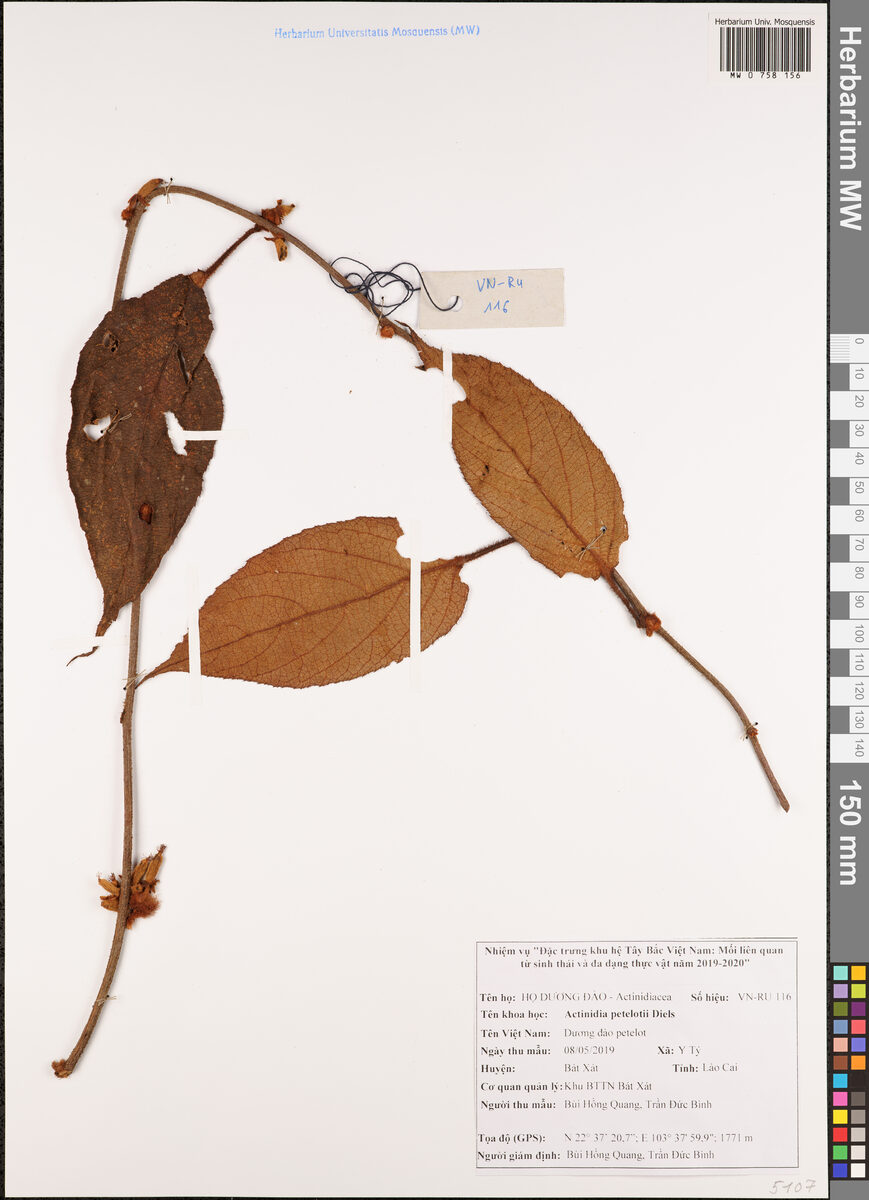
Actinidia pilosula
(Finet. & Gagnep.) Stapf. ex Hand-Mazz.
wikimedia· cc-by-sa
Wikimedia Commons - Steve Law from Henfield, England
wikimedia· cc-by-sa
Wikimedia Commons - Гурьева Светлана (zooclub.ru)
Summary
Source: WikipediaActinidia pilosula is a plant species in the Actinidiaceae family. It is endemic to China. The Tibetan people of Shangri-La and nearby areas eat its fruit.
Description
A climbing shrub. It grows up to 7 m long. It loses its leaves during the year. The fruit are round and 2.3 cm across.
This description is brief — help expand it
Edible Uses
The globose fruit can be eaten raw or cooked. When fully ripe it is hairless and about 23mm in diameter. It contains numerous small seeds, which are soft enough to eat along with the flesh.
Traditional Uses
The fruit is eaten raw or cooked.
This uses section is brief — help expand it
Medicinal Uses
None known.
Distribution
It grows naturally in S.W. China to N. Burma in forests between 2100 - 3300 metres. In Yunnan.
Where It Grows
Asia, China, Himalayas, Indochina, Myanmar, SE Asia, Tibet,
Cultivation
It can be grown as a hedge.
Propagation
Sow seed in spring in a greenhouse. Best results come from 3 months of stratification — either sow in a cold frame as soon as the seed is ripe in November, or as soon as it is received. Fresh seed germinates in 2–3 months at 10°c; stored seed may take longer. Once seedlings are large enough to handle, prick them out into individual pots and grow on in light shade in the greenhouse for at least their first winter. When plants reach 30cm or more, plant out into permanent positions in late spring or early summer, after the last expected frosts. Most seedlings will be male. Seedlings are prone to damping off and must be kept well ventilated. Take softwood cuttings in spring as soon as material is ready, half-ripe cuttings in July/August, or ripe wood cuttings in October/November — all in a frame. Half-ripe cuttings have a very high success rate.
Other Uses
None known.
Notes
There are 40-60 Actinidia species. The Actinidiaceae are a mainly tropical family.
Synonyms
Also Known As
Zhemenkoubu
References (4)
- Cheng, Z., et al, 2022, Ethnobotanical study on wild edible plants used by Dulong people in northwestern Yunnan, China. Journal of Ethnobiology and Ethnomedicine (2022) 18:3
- Ju, Y., et al, 2013, Eating from the wild: diversity of wild edible plants used by Tibetans in Shangri-la region, Yunnan, China, Journal of Ethnobiology and Ethno medicine 9:28
- Plants for a Future database, The Field, Penpol, Lostwithiel, Cornwall, PL22 0NG, UK. http://www.scs.leeds.ac.uk/pfaf/
- Symb. sin. 7:390. 1931