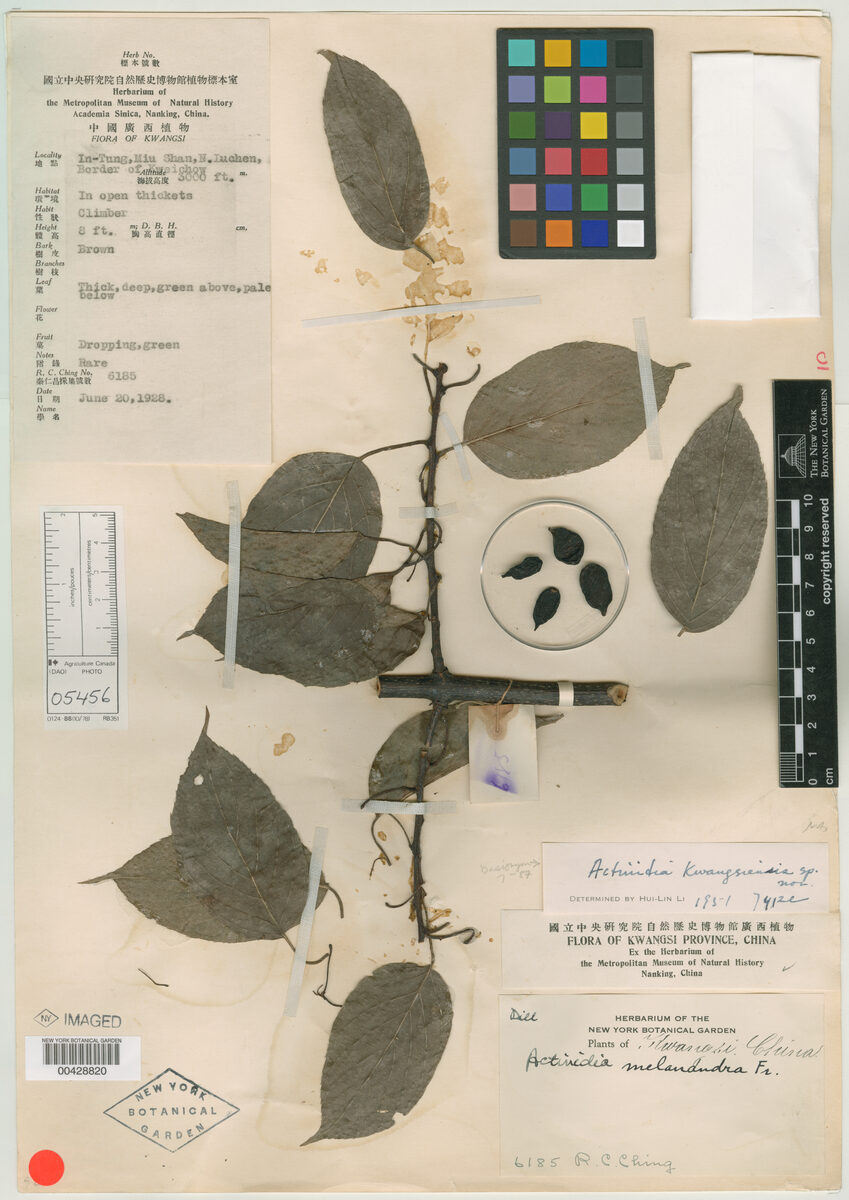
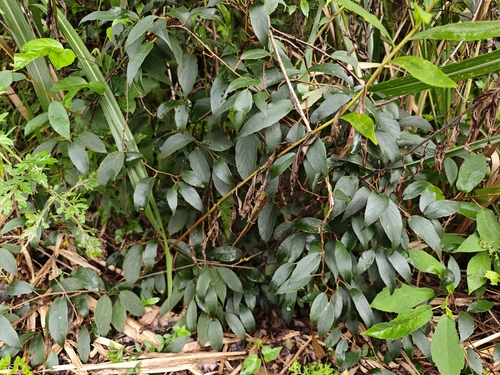
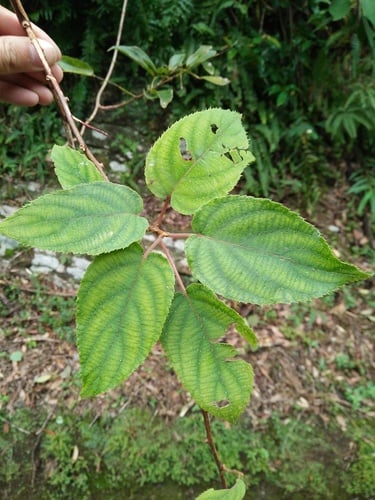
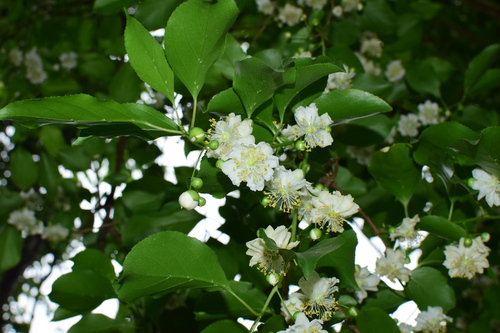
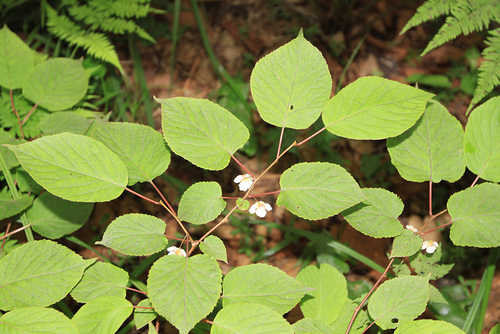
Actinidia melliana
Hand-Mazz
gbif· cc0
President and Fellows of Harvard College
Summary
Deciduous climbing vine reaching 9 meters tall with frost-tender growth. Flowers appear May to June and requires both male and female plants for seed production. Grows well in sandy, loamy, or clay soils across a range of pH levels, tolerating semi-shade to full sun in moist conditions. Pollinated by bees and insects.
Description
Deciduous climbing vine reaching 9 meters tall with frost-tender growth. Flowers appear May to June and requires both male and female plants for seed production. Grows well in sandy, loamy, or clay soils across a range of pH levels, tolerating semi-shade to full sun in moist conditions. Pollinated by bees and insects.
Edible Uses
The fruit can be eaten raw or cooked. When fully ripe it is hairless, measuring up to 2.2cm long by 1.5cm wide. It contains numerous small seeds, which are soft enough to eat along with the flesh.
Traditional Uses
The fruit is eaten raw or cooked.
This uses section is brief — help expand it
Medicinal Uses
None known.
Distribution
It is a tropical plant. It grows naturally in Jiangsi, Guangxi, Guangdong and Hainan Provinces in China in forests between 800 - 1350 metres.
Where It Grows
Asia, China,
Cultivation
We have very little information on this species and do not know if it will be hardy in Britain, though judging by its native range it might succeed outdoors at least in the milder areas of the country. It is closely related to A. hemsleyana. The following notes are based on the general needs of the genus. Prefers a sound loamy neutral soil. Succeeds in semi-shade but full sun is best for fruit production. Prefers a sheltered position. Young spring growth is susceptible to frost damage. Fruits are formed on second year wood and also on fruit spurs on older wood, any pruning is best carried out in the winter. This is a climbing plant, supporting itself by twining around branches etc. Plants in this genus are notably resistant to honey fungus. Dioecious. Male and female plants must be grown if seed is required.
Propagation
Sow seed in spring in a greenhouse. Best results come from 3 months of stratification — either sow in a cold frame as soon as the seed is ripe in November, or as soon as it is received. Fresh seed germinates in 2–3 months at 10°c; stored seed may take longer. Once seedlings are large enough to handle, prick them out into individual pots and grow on in light shade in the greenhouse for at least their first winter. When plants reach 30cm or more, plant out into permanent positions in late spring or early summer, after the last expected frosts. Most seedlings will be male. Seedlings are prone to damping off and must be kept well ventilated. Take softwood cuttings in spring as soon as material is ready, half-ripe cuttings in July/August, or ripe wood cuttings in October/November — all in a frame. Half-ripe cuttings have a very high success rate.
Other Uses
None known.
Notes
There are 40-60 Actinidia species. The Actinidiaceae are a mainly tropical family.
References (2)
- Anz. Akad. Wiss. Wien, Math.-Naturwiss. Kl. 59:57. 1922
- Plants for a Future database, The Field, Penpol, Lostwithiel, Cornwall, PL22 0NG, UK. http://www.scs.leeds.ac.uk/pfaf/