Coffea liberica
Bull. ex Heirn.
Coffee (Liberian)
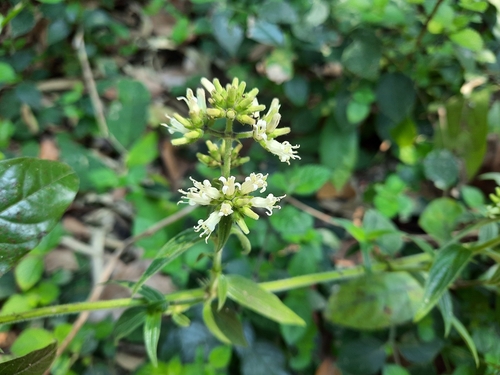
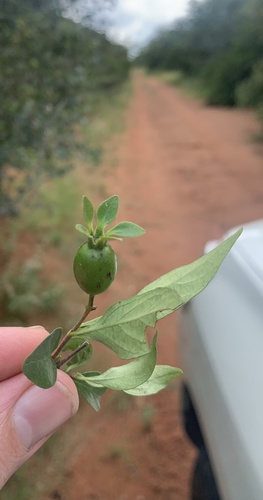
iNaturalist· cc-by
(c) Adam Kamal, some rights reserved (CC BY)
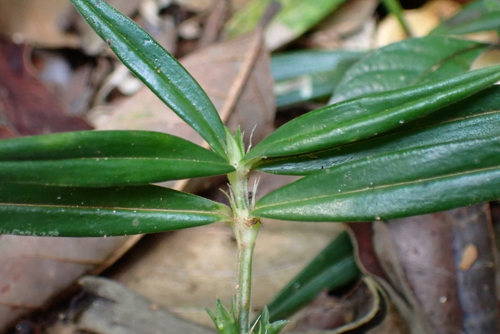
iNaturalist· cc-by-nc
(c) Liselle Santos, some rights reserved (CC BY-NC), uploaded by Liselle Santos
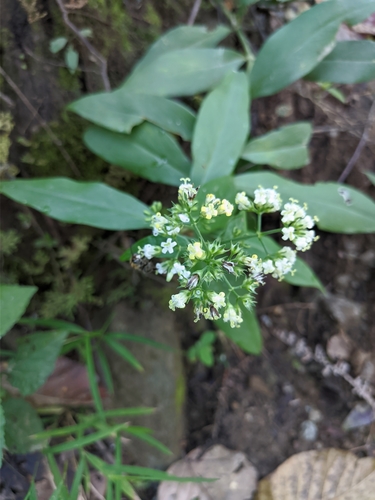
iNaturalist· cc-by
(c) Adam Kamal, some rights reserved (CC BY)
Summary
Source: WikipediaCoffea liberica, commonly known as Liberian coffee, is a species of flowering plant in the family Rubiaceae from which coffee is produced. It is native to western and central Africa (from Liberia to Uganda and Angola), and has become naturalised in areas including Colombia, Venezuela, the Philippines, Borneo and Java.
Description
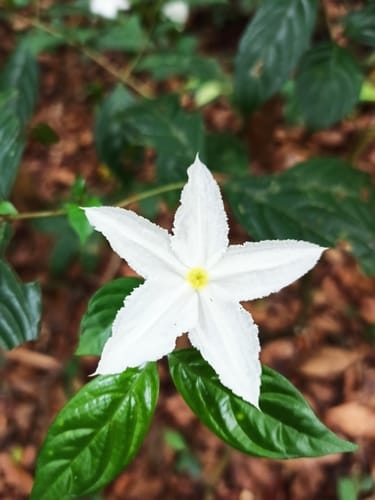
An evergreen tree up to 17 m high. There are two kinds of branches, those which grow upwards and those which grow sideways, bearing fruit. The leaves are large and leathery. They are oblong and 15-30 cm long by 5-15 cm wide. They taper to a short tip and the base is wedge shaped. There are 7-10 pairs of side veins. The leaf stalk is stout and 1-2 cm long. The flower cluster is in the axils of leaves. There are usually 1-3 flower clusters in each axil, with 1-4 flowers in each. The flowers are white, star like, and have a scent. The fruit are oval and 2-3 cm long by 2-2.5 cm wide. They are streaked red when ripe, and mature black. The mature seeds are up to 1.5 cm long.
Edible Uses
The roasted, powdered seed is used to make the well-known drink coffee. That made from this species has a more bitter taste than that of the well-known arabica or robusta coffees. The taste of excelsa coffee, which originates from a botanical variety of this species, is less bitter than that of true Liberian coffee. On a dry matter basis the beans contain about 0.5 - 1.8% of caffeine.
Traditional Uses
The seeds make a bitter drink. They are roasted.
This uses section is brief — help expand it
Medicinal Uses
The leaves are used to treat headaches and sore eyes.
Distribution
A tropical plant. It suits the hot, wet, lowland tropics. It requires heavy rainfall and high temperatures. It benefits from light shade. It can grow on a range of soils, including poor soils. It can grow in temperatures between 18-28°C. It cannot tolerate frost. It grows naturally in Liberia in West Africa. It grows up to 1,200 m above sea level. In Yunnan.
Where It Grows
Africa, Angola, Asia, Australia, Cameroon, Central Africa, Central America, China, Congo DR, Costa Rica, Côte d'Ivoire, Cuba, East Africa, East Timor, Fiji, Gabon, Ghana, Grenada, Guam, Guianas, Guinea, Guinée, Guinea-Bissau, Guyana, Hawaii, India, Indochina, Indonesia, Ivory Coast, Liberia, Malaysia, Mozambique, Myanmar, Nigeria, Pacific, Papua New Guinea, PNG, Philippines, Rotuma, Samoa, Sao Tome and Principe, SE Asia, Sierra Leone, Singapore, South Africa, Southern Africa, South America, Suriname, Thailand, Timor-Leste, Trinidad, USA, Venezuela, Wallis and Futuna, West Africa*, West Indies,
Cultivation
Plants are grown from seed. Seed breed fairly true. The seed are put in a nursery and planted out at 4 m x 4 m spacing. Trees are often not pruned. Sometimes the plants are topped at 2 m and excessive side branches removed. Usually fruit are dried on the tree and processed by dry methods. The seeds have a hard shell making it more difficult to remove than Arabican coffee. Plants can also be grown from cuttings or by grafting.
Propagation
Propagation is usually by seed. The viability of the seeds is comparatively short, depending upon conditions, and it is advisable to plant within 2 months of harvesting. Seeds are sown in seedbeds prepared from alluvial sand, about 1.5 cm deep and 5 - 8 cm apart or in rows 30 cm apart. The seeds can be planted with the parchment attached but germination is quicker when it is removed. Germination can take about 50 days, but the older the seeds, the longer they take to germinate. Seedlings are planted in polythene bags 8 - 12 weeks after sowing when they have 2 - 4 pairs of leaves. They are transplanted into the field when they have developed 6 - 8 pairs of leaves, which under normal circumstances will be 8 - 10 months after sowing. The time of transplanting should ideally coincide with the onset of the rainy season. Seedlings can be raised in shaded nurseries, planting them out into their permanent positions when 6 - 12 months old. Cuttings. Layering Air layering Grafting.
Other Uses
Seedlings are sometimes used as rootstocks for Arabica (C. arabica) and Robusta (C. canephora) plants.
Production
Flowering occurs at irregular intervals but not in flushes. Fruit mature one year after flowering. Fruit of various stages of ripeness are found on the one tree. Plants are cross pollinated.
Notes
There are about 40 Coffea species.
Synonyms
Also Known As
Cofeeiro, Kopi liberia, Liberian coffee
References (24)
- Ambasta, S.P. (Ed.), 2000, The Useful Plants of India. CSIR India. p 135
- Anderson, E. F., 1993, Plants and people of the Golden Triangle. Dioscorides Press. p 207
- Bodkin, F., 1991, Encyclopedia Botanica. Cornstalk publishing, p 271
- Bodner, C. C. and Gereau, R. E., 1988, A Contribution to Bontoc Ethnobotany. Economic Botany, 43(2): 307-369
- Brouk, B., 1975, Plants Consumed by Man. Academic Press, London. p 346
Show all 24 references Hide references
- Burkill, I.H., 1966, A Dictionary of the Economic Products of the Malay Peninsula. Ministry of Agriculture and Cooperatives, Kuala Lumpur, Malaysia. Vol 1 (A-H) p 635
- Cooper, W. and Cooper, W., 2004, Fruits of the Australian Tropical Rainforest. Nokomis Editions, Victoria, Australia. p 438
- Cundall, P., (ed.), 2004, Gardening Australia: flora: the gardener's bible. ABC Books. p 400
- Dalziel, J. M., 1937, The Useful plants of west tropical Africa. Crown Agents for the Colonies London.(Also as Coffea excelsa)
- Facciola, S., 1998, Cornucopia 2: a Source Book of Edible Plants. Kampong Publications, p 212
- Ferwerda, F.P., 1979, Coffees, in Simmonds, N.W., (ed), Crop Plant Evolution. Longmans. London. p 257
- Hedrick, U.P., 1919, (Ed.), Sturtevant's edible plants of the world. p 209
- Hu, Shiu-ying, 2005, Food Plants of China. The Chinese University Press. p 680
- Lyle, S., 2006, Discovering fruit and nuts. Land Links. p 151
- Miguel, E., et al, 1989, A checklist of the cultivated plants of Cuba. Kulturpflanze 37. 1989, 211-357
- Purseglove, J.W., 1968, Tropical Crops Dicotyledons, Longmans. p 488
- Ruiters-Welcome, A. K., 2019, Food plants of southern Africa. Ph.D. thesis. Univ. of Johannesburg p 96
- Small, E., 2009, Top 100 Food Plants. The world's most important culinary crops. NRC Research Press. p 207
- Sukarya, D. G., (Ed.) 2013, 3,500 Plant Species of the Botanic Gardens of Indonesia. LIPI p 616
- Trans. Linn. Soc. London, Bot. ser. 2, 1:171, t. 24. 1876
- Welcome, A. K. & Van Wyk, B.-E., 2019, An inventory and analysis of the food plants of southern Africa. South African Journal of Botany 122 (2019) 136–179
- Wiersema, J. H. & Leon, B., 2013, World Economic Plants. A Standard Reference CRC Press. 2nd Ed. p 190
- World Checklist of Useful Plant Species 2020. Royal Botanic Gardens, Kew
- Zuchowski W., 2007, Tropical Plants of Costa Rica. A Zona Tropical Publication, Comstock Publishing. p 195