Coccinia grandis
(L.) J. O. Voigt.
Ivy gourd, Little gourd
iNaturalist· cc0
no rights reserved, uploaded by 葉子
iNaturalist· cc-by-nc
(c) michaelsteer, some rights reserved (CC BY-NC)
Summary
Source: WikipediaCoccinia grandis, the ivy gourd, also known as scarlet gourd, is a tropical vine. It grows primarily in tropical climates and is commonly found in the Indian states where it forms a part of the local cuisine. Coccinia grandis is cooked as a vegetable dish. In Southeast Asia, it is grown for its edible young shoots and edible fruits.
Description
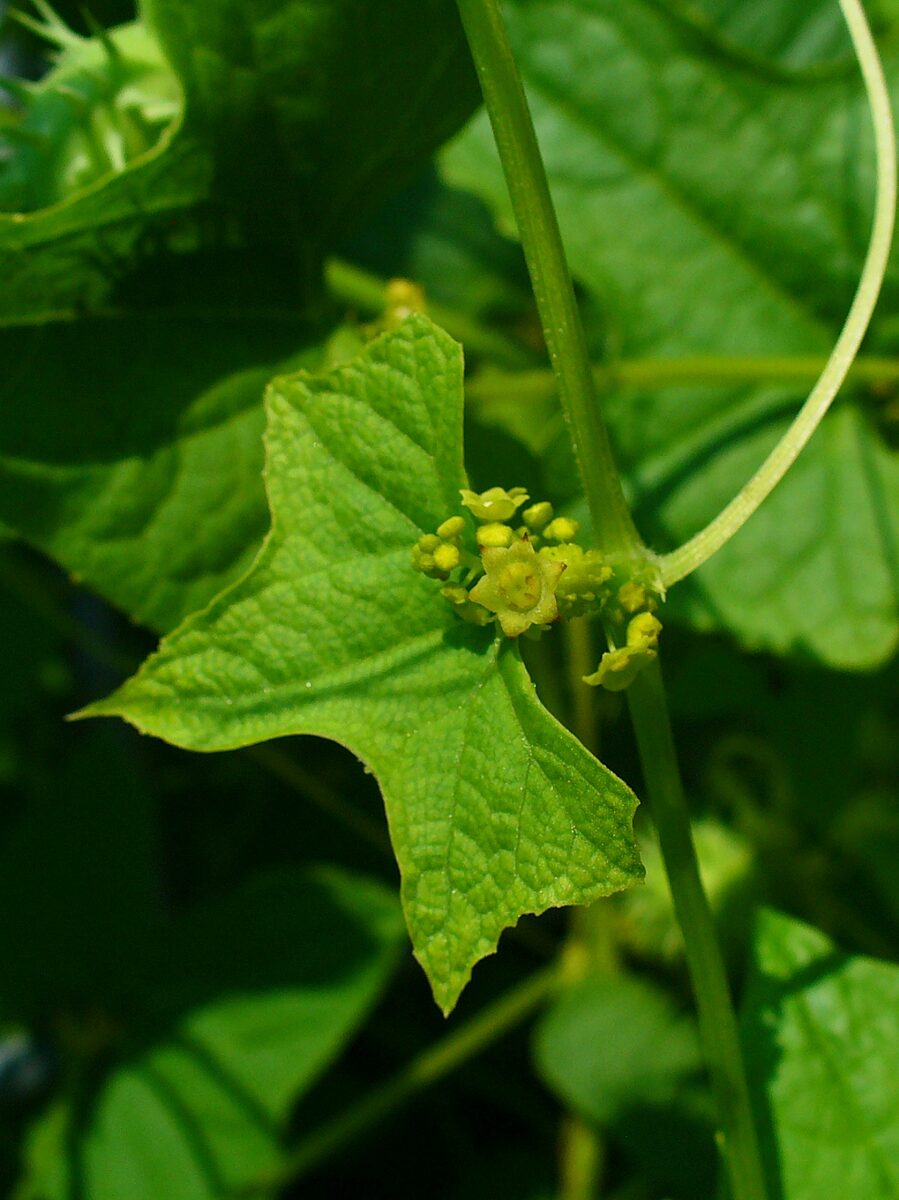
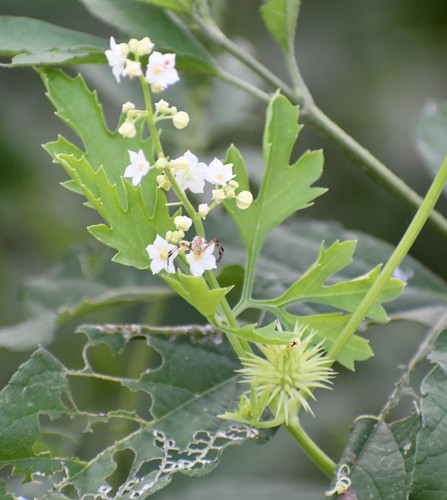
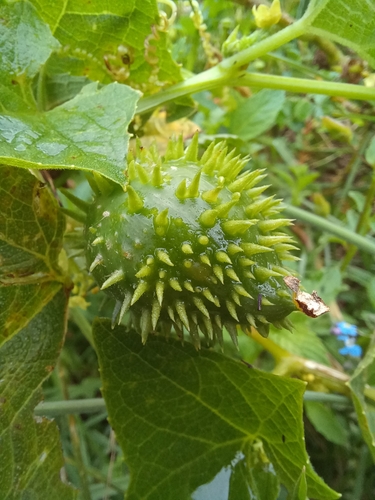
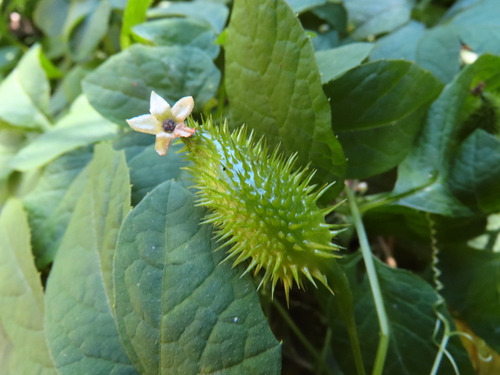
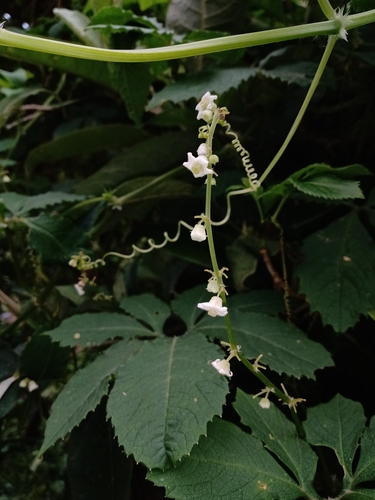
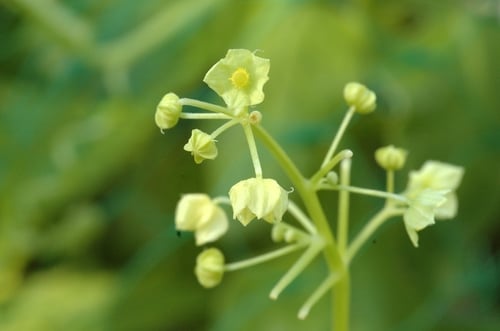
A pumpkin family plant. It is a climbing or trailing herb. It can climb 20 m high. It has single tendrils. It has long tuberous roots. The leaves are heart shaped, with the lobes towards the base in an angular shape. The leaves are 5-10 cm across. The edges of the leaves are irregular. The flowers occur as male and female flowers on separate plants. The flowers are large and white and occur singly. The fruit is oblong and up to 10 cm long by 2.5 cm across. It is green with white stripes. The fruit become bright red when mature. The seeds are white or light brown. They are hairy and flattened with a broad rim.
Edible Uses
Young leaves and the long slender tops of stems are cooked and eaten as a potherb or added to soups. Young, tender green fruits can be eaten raw in salads or cooked in curries. The ripe scarlet fruit is eaten raw — it is fleshy and sweet, and grows up to 5 cm long.
Traditional Uses
The leaves, shoots, and immature fruits are cooked as a vegetable. Mature fruits are eaten raw. The ripe red fruit are collected, peeled and cut into small pieces and added to porridge. The leaf tips are cooked as a vegetable. They are also used in soups. The leaves can be stored for 10 days. The unripe fruit are cooked as a vegetable. They are used in curries. Sometimes the fruit are candied.
Medicinal Uses
The juice of the roots and leaves is considered useful for treating diabetes. The juice of the stem is dripped into the eyes to treat cataracts. The leaves are applied as a poultice for skin eruptions. The plant acts as a laxative and is used internally in the treatment of gonorrhoea. Both aqueous and ethanolic extracts of the plant have demonstrated hypoglycaemic activity.
Distribution
A tropical plant. It does well in warm climates. In cold weather, plants remain dormant. They cannot grow in waterlogged soil. Plants grow between 550 and 1600 m altitude in Ethiopia. It requires a well distributed rainfall and a fairly high humidity. It grows in areas with an annual rainfall between 1,000-1,600 mm. It requires a sandy soil with good drainage and a high level of organic material. In Nepal the plants grow up to 1400 m altitude. In south Vietnam it grows up to 1,500 m above sea level. In the Himalayas in India it grows between 1,200-2,000 m above sea level. It can grow in arid places. In Yunnan.
Where It Grows
Africa, Andamans, Asia, Australia, Bangladesh, Barbados, Benin, Cambodia, Cameroon, Caribbean, Central Africa, Central African Republic, CAR, Chad, China, Colombia, Congo, Côte d'Ivoire, Cuba, East Africa, East Timor, Egypt, Eritrea, Ethiopia, Fiji, Gambia, Ghana, Guam, Guiana, Guinea, Guinée, Guinea-Bissau, Guyana, Hawaii, Himalayas, India, Indochina, Indonesia, Ivory Coast, Jamaica, Kenya, Laos, Malaysia, Mali, Mauritius, Micronesia, Middle East, Mozambique, Myanmar, Nepal, Niger, Nigeria, North Africa, Northeastern India, Pacific, Pakistan, Papua New Guinea, PNG, Philippines, Puerto Rico, Rotuma, Sahel, Samoa, Saudi Arabia, SE Asia, Senegal, Sierra Leone, Solomon Islands, Somalia, South America, South Sudan, Sri Lanka, Sudan, Tanzania, Thailand, Timor-Leste, Togo, Tonga, Trinidad-Tobago, Uganda, USA, Vanuatu, Vietnam, West Africa, West Indies, Yemen, Zambia,
Cultivation
Plants are grown from stem cuttings or tuberous roots. They can also be grown from seeds. Stem cuttings about 12-15 cm long are suitable. The plant needs a trellis to climb over. One male plant to every ten female plants is enough to ensure pollination. A spacing of 150 cm apart is suitable. During dry periods watering is required.
Propagation
Seed — sow in March in a warm greenhouse in pots of fairly rich soil, placing 2–3 seeds per pot. Germination usually occurs within 2–4 weeks at 20°c. Thin to the strongest seedling per pot, grow on quickly with occasional liquid feeds, and plant out after the last expected frost, providing protection such as a cloche until plants are establishing well.
Other Uses
No other uses are known for this plant.
Production
Plants can grow for 3 or 4 years. The yield of fruit can be about 10 kg per plant. In Tanzania the fruit are collected in June to August.
Other Information
It is a commercially cultivated vegetable. The fruit are popular. It is not known if it is eaten in Papua New Guinea. It is a cultivated plant in Africa. The seeds are only occasionally chewed. It is sold in local markets.
Notes
It can be invasive. It is illegal to grow it in some places. It is used in medicine.
Nutrition
| Part | Moisture | kJ | kcal | Protein | Vit A | Vit C | Iron | Zinc |
|---|---|---|---|---|---|---|---|---|
| Leaves | 90.6 | 117 | 28 | 4.1 | 36 | — | 4.6 | — |
| Fruit | 93.6 | 83 | 20 | 0.7 | — | — | 0.6 | — |
Synonyms
Also Known As
Amballa gosa, Ariapongos, Aroi papasan, Babasa tahan, Baby cucumber, Bak tam nin, Ban kakri, Bana torada, Bankakro, Bat, Belipoka, Bimbika, Bolu teke, Buta, Bwlai, Cheri, Chiloda, Chum bat, Covakai, Covay kai, Donda, Edaldalksin, Enkaiserariai, Gol kakri, Golenda, Golkankri, Golkakari, Golyakakadi, Hong gua, Imondiu, Imore, Jangli kundru, Jangli tondare, Kandaroi, Kanduri, Kapasan, Kattukoval, Kauwa-luli, Khai-khruk, Kimowe, Kimuya, Kiukamapa 'ae 'initia, Koba, Kovai, Kovakai, Kova keerai, Kundari, Kundaru, Kundri, Kundri ja, Kundru, Kunduli, Kunduri, Lacheta, Lyungulyungu, Mad, Ma dian lu, Malual, Maqd, Marr 'had, Mogad, Na odio, Ndegegeya, Ni qi, li po luo, Pak tam lung, Pake, Papasan, Pepasan, Phak tam leung, Phak tam ling, Phak tam nin, Phak tamlueng, Sarap alas, Scarlet fruited gourd, Scarlet gourd, Sleuk bah, Sleuk bas, Sloek Bas, Tala kachu, Tala kucha, Tam ling, Tam lung, Tam nin, Tam-lueng, Tandli, Teingninhi, Telakucha, Telkocha, Tilkakri, Tilkocha, Tindola, Tindora, Tinduri, Tondali, Tonde-konde, Tondli, Tongli, Tudu, Tumlueng, Tunanyira, Vo-ak thoithe, Watani badrang
References (144)
- Addis, G., et al, 2005, Ethnobotanical Study of Edible Wild Plants in Some Selected Districts of Ethiopia. Human Ecology, Vol. 33, No. 1, pp. 83-118
- Addis, G., et al, 2013, Dietary values of wild and semi-wild edible plants in Southern Ethiopia. African Journal of Food, Agriculture, Nutrition and Development. 13(2)
- Addis, G., Asfaw, Z & Woldu, Z., 2013, Ethnobotany of Wild and Semi-wild Edible Plants of Konso Ethnic Community, South Ethiopia. Ethnobotany Research and Applications. 11:121-141
- Addis, G., et al, 2013, The Role of Wild and Semi-wild Edible Plants in Household Food Sovereignty in Hamer and Konso Communities, South Ethiopia. Ethnobotany Research & Applications. 11:251-271
- Al-Fatimi, M. A., Wild Edible Plants Traditionally Collected and Used in Southern Yemen. Research Square. University of Aden. p 17
Show all 144 references Hide references
- Ambasta, S.P. (Ed.), 2000, The Useful Plants of India. CSIR India. p 133 (As Coccinia cordifolia)
- Ambasta S.P. (Ed.), 2000, The Useful Plants of India. CSIR India. p 115, (As Coccinia indica)
- Anderson, E. F., 1993, Plants and people of the Golden Triangle. Dioscorides Press. p 207
- Anywar, G., et al, 2014, Wild Plants Used as Nutraceuticals from Nebbi District, Uganda. European Journal of medicinal Plants. 4(6):641-660
- Ara, R. I. T., 2015, Leafy Vegetables in Bangladesh. Photon eBooks. p 121 (As Coccinia cordifolia)
- Arinathan, V., et al, 2007, Wild edibles used by Palliyars of the western Ghats, Tamil Nadu. Indian Journal of Traditional Knowledge. 6(1) pp 163-168
- Arora, R. K., 2014, Diversity in Underutilized Plant Species - An Asia-Pacific Perspective. Bioversity International. p 47
- Aryal, K. P., et al, 2018, Diversity and use of wild and non-cultivated edible plants in the Western Himalaya. Journal of Ethnobiology and Ethnomedicine (2018) 14:10
- Asfaw, Z. and Tadesse, M., 2001, Prospects for Sustainable Use and Development of Wild Food Plants in Ethiopia. Economic Botany, Vol. 55, No. 1, pp. 47-62
- AVRDC files
- Balkrishna, A., et al, 2022, Indigenous Uses of Plants among Forest-dependent Communities of Seijosa, Arunachal Pradesh. International Journal of Economic Plants 2022, 9(1):064-080
- Bandyopadhyay, S. et al, 2009, Wild edible plants of Koch Bihar district, West Bengal. Natural Products Radiance 8(1) 64-72
- Bandyopadhyay, S., et al, 2012, A Census of Wild Edible Plants from Howrah District, West Bengal, India. Proceedings of UGC sponsored National Seminar 2012
- Banerjee, A., et al, 2013, Ethnobotanical Documentation of Some Wild Edible Plants in Bankura District, West Bengal, India. The Journal of Ethnobiology and Traditional Medicine. Photon 120 (2013) 585-590
- BARC, 2016, State of Biodiversity for Food and Agriculture in Bangladesh. Bangladesh Agricultural Research Council.
- Baro, D., Baruah, S. and Borthukar, S. K. 2015, Documentation on wild vegetables of Baksa district, BTAD (Assam). Scholars Research Library. Archives of Applied Science Research, 2015, 7 (9):19-27
- Binu, S., 2010, Wild edible plants by the tribals in Pathanamthitta district, Kerala. Indian Journal of Traditional Knowledge. 9(2): 309-312
- Boedecker, J., et al, 2014, Dietary contribution of Wild Edible Plants to women’s diets in the buffer zone around the Lama forest, Benin – an underutilized potential. Food Sec. 6:833–849
- Burkill, H. M., 1985, The useful plants of west tropical Africa, Vol. 1. Kew.
- Burkill, I.H., 1966, A Dictionary of the Economic Products of the Malay Peninsula. Ministry of Agriculture and Cooperatives, Kuala Lumpur, Malaysia. Vol 1 (A-H) p 600 (As Coccinia indica)
- Cao, Y., et al, 2020, Ethnobotanical study on wild edible plants used by three trans-boundary ethnic groups in Jiangcheng County, Pu’er, Southwest China. Journal of Ethnobiology and Ethnomedicine (2020) 16:66
- Cengel, D. J. & Dany, C., (Eds), 2016, Integrating Forest Biodiversity Resource Management and Sustainable Community Livelihood Development in the Preah Vihear Protected Forest. International Tropical Timber Organization p 124
- Chowdery, T., et al, 2014, Wild edible plants of Uttar Dinajpur District, West Bengal. Life Science Leaflets. 47:pp 20-36 http://lifesciencesleaflets.ning.com
- Chowdhury, M. & Mukherjee, R., 2012, Wild Edible Plants Consumed by Local Communities of Maldah of West Bengal, India. Indian J.Sci.Res.3(2) : 163-170
- Chunduri, J. R., 2013, Antioxidant and nutritional analysis of edible Cucurbitaceae vegetables of India. International Journal of Bioassays. 02(08) 1124-1129 (As Coccinia indica)
- Cooper, W. and Cooper, W., 2004, Fruits of the Australian Tropical Rainforest. Nokomis Editions, Victoria, Australia. p 140
- CRÉAC'H, (As Coccinia cordifolia)
- Cruz-Garcia, G. S., & Price, L. L., 2011, Ethnobotanical investigation of 'wild' food plants used by rice farmers in Kalasin, Northeast Thailand. Journal of Ethnobiology and Ethnomedicine 7:33
- Dangol, D. R. et al, 2017, Wild Edible Plants in Nepal. Proceedings of 2nd National Workshop on CUAOGR, 2017.
- Deb, D., et al, 2013, Wild Edible Plants and Their Utilization in Traditional Recipes of Tripura, Northeast India. Advances in Biological Research 7(5):203-211
- Dobriyal, M. J. R. & Dobriyal, R., 2014, Non Wood Forest Produce an Option for Ethnic Food and Nutritional Security in India. Int. J. of Usuf. Mngt. 15(1):17-37
- Duguma, H. T., 2020, Wild Edible Plant Nutritional Contribution and Consumer Perception in Ethiopia. Hindawi International Journal of Food Science Volume 2020, Article ID 2958623, 16 pages
- Dutta, U., 2012, Wild Vegetables collected by the local communities from the Churang reserve of BTD, Assam. International Journal of Science and Advanced Technology. Vol. 2(4) p 120
- Esquinas-Alcazar, et al, 1983, Genetic Resources of Cucurbitaceae. International Board of Plant Genetic Resources.
- Facciola, S., 1998, Cornucopia 2: a Source Book of Edible Plants. Kampong Publications, p 85
- FAO, 1988, Traditional Food Plants, FAO Food and Nutrition Paper 42. FAO Rome p 207
- Flora of Australia, Volume 8, Lecythidales to Batales, Australian Government Publishing Service, Canberra (1982) p 176
- Flora of Pakistan. www.eFloras.org
- Food Composition Tables for use in East Asia FAO http://www.fao.org/infoods/directory No. 552, 553 (As Coccinia indica et al)
- French, B.R., 2010, Food Plants of Solomon Islands. A Compendium. Food Plants International Inc. p 311
- GAMMIE, (As Cephalandra indica)
- Gautam, R. S., et al, 2020, Wild Edible Fruits of Nepal. Int. J. Appl. Sci. Biotechnol. Vol 8(3): 289-304
- Gautam, R. S., et al, 2022, Ethnobotanical Review of Wild Edible Plants of Nepal. Journal of Natural History Museum Volume 32, 2021-22 p 110
- Ghosh, A, 2014, Survey of Ethno-medicinal Climbing plants in Andaman and Nicobar Islands, India. Int. J. of Pharm. Life Sci. 5(7): July, 2014:3671-3677
- Goode, P., 1989, Edible Plants of Uganda. FAO p 30
- Grivetti, L. E., 1980, Agricultural development: present and potential role of edible wild plants. Part 2: Sub-Saharan Africa, Report to the Department of State Agency for International Development. p 41
- Grubben, G. J. H. and Denton, O. A. (eds), 2004, Plant Resources of Tropical Africa 2. Vegetables. PROTA, Wageningen, Netherlands. p 202
- GUPTA & KANODIA,
- Hedrick, U.P., 1919, (Ed.), Sturtevant's edible plants of the world. p 206 (As Coccinia indica) and (As Coccinia moimoi)
- Hill, M. & Hallam, D., (eds), 1997, Na Hang Nature Reserve, Tat Ke Sector. Site description and conservation evaluation. Hanoi. p 76
- Holstein, N., 2015, Monograph of Coccinia (Cucurbitaceae). PhytoKeys 54: 1–166
- Hort. suburb. Calcutt. 59. 1845
- Hussey, B.M.J., Keighery, G.J., Cousens, R.D., Dodd, J., Lloyd, S.G., 1997, Western Weeds. A guide to the weeds of Western Australia. Plant Protection Society of Western Australia. p 140
- Imbumi, M.D., 2004. Coccinia grandis (L.) Voigt. [Internet] Record from Protabase. Grubben, G.J.H. & Denton, O.A. (Editors). PROTA (Plant Resources of Tropical Africa), Wageningen, Netherlands. < http://database.prota.org/search.htm>. Accessed 14 October 2009.
- Jacquat, C., 1990, Plants from the Markets of Thailand. D.K. Book House p 54
- Jadhav, R., et al, 2015, Forest Foods of Northern Western Ghats: Mode of Consumption, Nutrition and Availability. Asian Agri-History Vol. 19, No. 4: 293-317
- Japanese International Research Centre for Agricultural Science www.jircas.affrc.go.jp/project/value_addition/Vegetables
- Jardin, C., 1970, List of Foods Used In Africa, FAO Nutrition Information Document Series No 2.p 68
- Jiwajinda, S., et al, 2002, Suppressive Effects of Edible Thai Plants on Superoxide and Nitric Oxide Generation. Asian Pacific Journal of Cancer Prevention, Vol 3, 2002
- Kannan, M., et al, 2015, Ethnobotanical survey on wild edible plants of Kalrayan Hills, Salem District, Tamil Nadu, India. Global J. Res. Med Plants & Indigen. med. 4(12): 236-246 (As Coccinia indica)
- Karthi, Sathya, & Salome, 2014, Uncultivated Edible Greens from Small Millet Farms Tamil Nadu India. IDRC (As Coccinia cordifolia)
- Kays, S. J., and Dias, J. C. S., 1995, Common Names of Commercially Cultivated Vegetables of the World in 15 languages. Economic Botany, Vol. 49, No. 2, pp. 115-152
- Kenneally, K.E., Edinger, D. C., and Willing T., 1996, Broome and Beyond, Plants and People of the Dampier Peninsula, Kimberley, Western Australia. Department of Conservation and Land Management. p 95
- Khan, M. T., et al, 2016, Ethnobotanical Study of Wild Flora in the Remote Areas of Northern Pakistan. Wulfenia Journal Vol. 23, No 10 p 153
- Kiple, K.F. & Ornelas, K.C., (eds), 2000, The Cambridge World History of Food. CUP p 1790 (As Coccinia cordifolia)
- Kiran, K. C., et al, 2019, Diversity and Seasonal Availability of Potential Wild Edible Plants from Vidarbha Region of Maharashtra State, India. Int.J.Curr.Microbiol.App.Sci (2019) 8(2): 1434-1446
- Kohila, A. & Kensa, V. M., 2019, Survey of Wild Edible Plants of Dhanakarkulam Panchayath, Tirunelveli District, Tamil Nadu, India. Kong. Res. J. 6(2): 20-27, 2019 (As Coccinia indica)
- Kumar, A., 2013, Ethnobotanical study of wild vegetables used by rural communities of Kannauj district, Uttar Pradesh, India. Emir. J. Food Agric. 2013. 25 (10): 760-766
- Kumar, R. & Saikia, P., 2020, Wild edible plants of Jharkhand and their utilitarian perspectives. Indian Journal of Traditional Knowledge Vol 19 (2), April 2020, pp 237-250
- Luczaj, L., et al, 2021, Wild food plants and fungi sold in the markets of Luang Prabang, Lao PDR. Journal of Ethnobiology and Ethnomedicine (2021) 17:6
- Lulekal, E., et al, 2011, Wild edible plants in Ethiopia: a review on their potential to combat food insecurity. Afrika Focus - Vol. 24, No 2. pp 71-121
- Manandhar, N.P., 2002, Plants and People of Nepal. Timber Press. Portland, Oregon. p 162
- Marinelli, J. (Ed), 2004, Plant. DK. p 450
- Martin, F.W. & Ruberte, R.M., 1979, Edible Leaves of the Tropics. Antillian College Press, Mayaguez, Puerto Rico. p 189 (As Coccinia cordifolia)
- Maundu, P. et al, 1999, Traditional Food Plants of Kenya. National Museum of Kenya. 288p
- McMakin, P.D., 2000, Flowering Plants of Thailand. A Field Guide. White Lotus. p 91 (As Coccinia indica)
- Miguel, E., et al, 1989, A checklist of the cultivated plants of Cuba. Kulturpflanze 37. 1989, 211-357
- Milow, P., et al, 2013, Malaysian species of plants with edible fruits or seeds and their evaluation. International Journal of Fruit Science. 14:1, 1-27
- Misra S. & Misra M., 2016, Ethnobotanical and Nutritional Evaluation of Some Edible Fruit Plants of Southern Odisha, India. International Journal of Advances in Agricultural Science and Technology, Vol.3 Issue.1, March- 2016, pg. 1-30
- Misra, S., 2020, Survey of edible plants for human consumption in south Odisha, India. Journal of Emerging Technologies and Innovative Research (JETIR) Vol. 7, Issue 12 p 278
- Mutie, F. G., 2020, Conservation of Wild Food Plants and Their Potential for Combatting Food Insecurity in Kenya as Exemplified by the Drylands of Kitui County. Plants 2020, 9, 1017
- Mutie, F. M., et al, 2023, Important Medicinal and Food Taxa (Orders and Families) in Kenya, Based on Three Quantitative Approaches. Plants 2023, 12, 1145
- Nakahara, K. et al, 2002, Antimutagenicity of Some Edible Thai Plants, and a Biocative Carbazole Alkaloid, Mahanine, Isolated from Micromelum minutum. Journal of Agricultural and Food Chemistry. 50: 4796-4892
- Ngugi, G., 2000, Case Study from Kenya on Indigenous Wild Vegetables. Paper 4 Workshop in Kenya 1999. p 33
- Ochse, J.J. et al, 1931, Vegetables of the Dutch East Indies. Asher reprint. p 188 (As Coccinia cordifolia)
- Omawale, 1973, Guyana's edible plants. Guyana University, Georgetown p 3 (As Coccinia indica)
- Paczkowska, G. & Chapman, A.R., 2000, The Western Australian Flora. A Descriptive Catalogue. Western Australian Herbarium. p 221
- Patiri, B. & Borah, A., 2007, Wild Edible Plants of Assam. Geethaki Publishers. p 61
- Peters, C. R., O'Brien, E. M., and Drummond, R.B., 1992, Edible Wild plants of Sub-saharan Africa. Kew. p 99
- Phangchopi, U., et al, 2015, Diversity of wild edible plants in Marat Longri Wildlife Sanctuary, Assam. Indian Journal of Natural Products and Resources Vol. 6(4), December 2015 pp. 305-313
- Phatlamphu, N., et al, 2021, Ethnobotany of edible plants in Muang District, Kalasin Province, Thailand, Biodiversitas Vol. 22, No. 12 pp 5432-5444
- Phon, P., 2000, Plants used in Cambodia. © Pauline Dy Phon, Phnom Penh, Cambodia. p 164
- Plants for a Future database, The Field, Penpol, Lostwithiel, Cornwall, PL22 0NG, UK. http://www.scs.leeds.ac.uk/pfaf/
- Prachi, K., et al, 2012, Underutilized wild fruits of North Maharashtra. Journal of Research in Plant Sciences. (2012) 1:071-076
- Prafulla, S., 2017, Wild Food Diversity of Nawegaon-Nagzira Tiger Reserve in Gondia-Bhandara district of Maharashtra, India. Int. J. of Life Sciences, 2017, Vol. 5 (4): 620-626
- Radha, B., et al, 2013, Wild Edible Plant Resources of the Lohba Range of Kedarnath Forest Division (KFD), Garhwal Himalaya, India. Int. Res J. Biological Sci. Vol. 2 (11), 65-73
- Ramachandran, V. S., 2007, Wild edible plants of the Anamalais, Coimbatore district, western Ghats, Tamil Nadu. Indian Journal or Traditional Knowledge. 6(1) pp 173-176
- Ramakrishna, N. & Singh, DSR, R., 2020, Ethno-Botanical Studies of Edible Plants Used by Tribal Women in Nirmal District. IJSRSET p 309
- Rasingam, L., 2012, Ethnobotanical studies on the wild edible plants of Irula tribes of Pillur Valley, Coimbatore district, Tamil Nadu, India. Asian Pacific Journal of Tropical Biomedicine. (2012) S1493-S1497
- Reddy, B. M., 2012, Wild edible plants of Chandrapur district, Maharashtra, India. Indian Journal of Natural Products and Resources. 3(1) pp 110-117
- Reddy, K.R., 1989, Additional Notes on the Wild Edible Plants of India. J. Econ. Tax. Bot. Vol. 13 No. 1 pp 125-127 (As Coccinia cordifolia)
- Rodriguez-Amaya, D. B., 1999, Carotenoides y Prepracion de Alimentos. University Estadual de Campinas, Brasil, Ph.D. thesis. p 21
- Royal Botanic Gardens, Kew (1999). Survey of Economic Plants for Arid and Semi-Arid Lands (SEPASAL) database. Published on the Internet; http://www.rbgkew.org.uk/ceb/sepasal/internet [Accessed 15th April 2011]
- Rubaihayo, E. B., Conservation and use of traditional vegetables in Uganda. Bioversity International.
- Ruffo, C. K., Birnie, A. & Tengnas, B., 2002, Edible Wild Plants of Tanzania. RELMA p 208
- Saikia, M., 2015, Wild edible vegetables consumed by Assamese people of Dhemaji District of Assam, NE India and their medicinal values. Archives of Applied Science Research, 2015, 7 (5):102-109
- Sakar, A. & Das, A. P., 2018, The traditional knowledge on edible wild leafy vegetables of Rabha Tribe in Duars of North Bengal: a potential reinforcement to food security. Pleione 12(2): 275 - 281. 2018.
- Sarvalingam, A., et al, 2014, Wild edible plant resources used by the Irulas of the Maruthamalai Hills, Southern Western Ghats, Coimbatore, Tamil Nadu. Indian Journal of Natural Products and Resources 5(2):198-201
- Sasi, R. & Rajendran, A., 2012, Diversity of Wild Fruits in Nilgiri Hills of the Southern Western Ghats - Ethnobotanical Aspects. IJABPT, 3(1) p 82-87
- SAXENA,
- Schneider, E., 2001, Vegetables from Amaranth to Zucchini: The essential reference. HarperCollins. p 664
- Seidemann J., 2005, World Spice Plants. Economic Usage, Botany, Taxonomy. Springer. p 112
- Shah, G.L., 1984, Some economically important plant of Salsette Island near Bombay. J. Econ. Tax. Bot. Vol. 5 No. 4 pp 753-765
- Sharma, B.B., 2005, Growing fruits and vegetables. Publications Division. Ministry of Information and broadcasting. India. p 176
- SHORTT, (As Coccinia indica)
- Siemonsma, J. S. and Piluek, K. (Eds), 1994, Plant Resources of South-East Asia No. 8 Vegetables. Prosea Foundation, Bogor, Indonesia, p 150
- Singh, A. G., Panthi, M. P., & Tewari, D. D., 2012, Wild Plants Used as Vegetable in Rupandehi District of Nepal and their Ethnomedicinal Importance. J. Nat. Hist. Mus. Vol. 26, 2012, 111-125
- Singh, V. and Singh, P., 1981, Edible Wild Plants of Eastern Rajasthan. J. Econ. Tax. Bot. Vol 2 pp 197-207
- Smith, A.C., 1981, Flora Vitiensis Nova, Lawaii, Kuai, Hawaii, Volume 2 p 677
- Somnasang, P., Moreno, G and Chusil K., 1998, Indigenous knowledge of wild hunting and gathering in north-east Thailand. Food and Nutrition Bulletin 19(4) p 359f
- Sivakumar, A. & Murugesan, M., 2005, Ethnobotanical Studies of the wild edible plants used by the tribals of the Anaimalai Hills, the Western Ghats. Ancient Science of Life. XXV(2) Oct-Dec. (As Coccinia indica)
- Staples, G.W. and Herbst, D.R., 2005, A tropical Garden Flora. Bishop Museum Press, Honolulu, Hawaii. p 265
- Tanaka, Y. & Van Ke, N., 2007, Edible Wild Plants of Vietnam: The bountiful garden. Orchid books. p 70
- Teklehaymanot, T., and Mirutse Giday, M., 2010, Ethnobotanical study of wild edible plants of Kara and Kwego semi-pastoralist people in Lower Omo River Valley, Debub Omo Zone, SNNPR, Ethiopia Journal of Ethnobiology and Ethnomedicine 2010, 6:23
- Termote, C., et al, 2014, Assessing the potential of wild foods to reduce the cost of a nutritionally adequate diet: An example from eastern Baringo District, Kenya. Food and Nutrition Bulletin, vol. 35, no. 4
- Teron, R. & Borthakur, S. K., 2016, Edible Medicines: An Exploration of Medicinal Plants in Dietary Practices of Karbi Tribal Population of Assam, Northeast India. In Mondal, N. & Sen, J.(Ed.) Nutrition and Health among tribal populations of India. p 150 (As Cephalandra indica)
- Thapa, L. B., et al, 2014, Wild Edible Plants used by endangered and Indigenous Raji Tribe in Western Nepal. International Journal of Applied Sciences and Biotechnology. Vol 2(3):243-252
- Thorng, R., et al, 2015, Roles of Wild Food Plants in Ethnic Group Communities in Mondulkiri Province, Northeastern Cambodia. Journal of Mekong Societies Vol.11 No.2 May-August 2015 pp. 1-17
- Tindall, H.D., 1983, Vegetables in the tropics. Macmillan p. 152 (As Coccinia cordifolia)
- Uprety, Y., et al, 2011, Plant biodiversity and ethnobotany inside the projected impact area of the Upper Seti Hydropower Project, Western Nepal. Environ. Dev. Sustain. (2011) 13:463-492
- Uprety, Y., et al, 2012, Diversity of use and local knowledge of wild edible plant resources in Nepal. Journal of Ethnobotany and Ethnomedicine 8:16
- Uprety, Y., et al, 2016, Traditional use and management of NTFPs in Kangchenjunga Landscape: implications for conservation and livelihoods. Journal of Ethnobiology and Ethnomedicine (2016) 12:19
- USDA, ARS, National Genetic Resources Program. Germplasm Resources Information Network - (GRIN). [Online Database] National Germplasm Resources Laboratory, Beltsville, Maryland. Available: www.ars-grin.gov/cgi-bin/npgs/html/econ.pl (10 April 2000)
- Wiersema, J. H. & Leon, B., 2013, World Economic Plants. A Standard Reference CRC Press. 2nd Ed. p 188
- Wild edible plants of Himachal Pradesh
- World Checklist of Useful Plant Species 2020. Royal Botanic Gardens, Kew
- Xu, You-Kai, et al, 2004, Wild Vegetable Resources and Market Survey in Xishuangbanna, Southwest China. Economic Botany. 58(4): 647-667
- Yesodharan, K. & Sujana, K. A., 2007, Wild edible plants traditionally used by the tribes in the Parambokulam Wildlife Sanctuary, Kerala, India. Natural Product Radiance 6(1) pp 74-80
- Zeven, A. C. & de West, J. M. J., 1982, Dictionary of cultivated plants and their regions of diversity. Wageningen. p 72 (As Coccinia cordifolia)