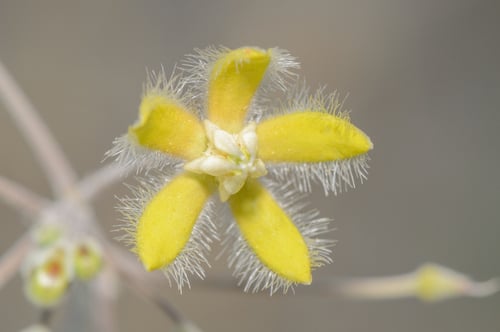
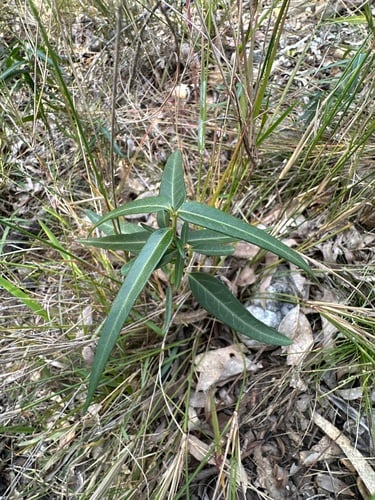
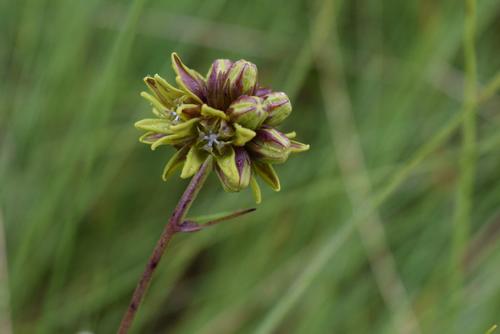
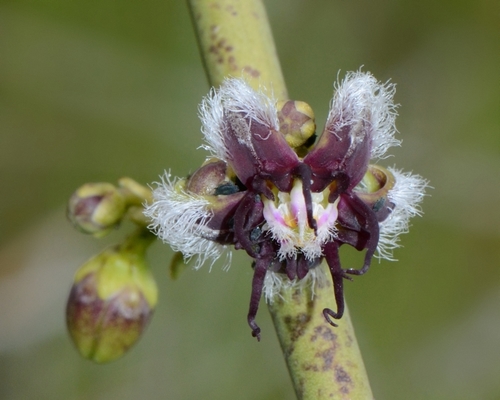
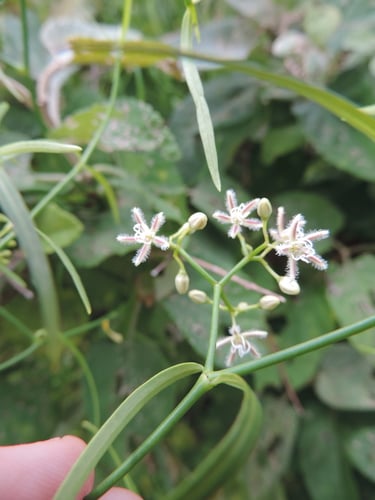
Orthopichonia barteri
(Stapf) H. Huber
Apocynaceae Edible: Leaves, Fruit
wikimedia· cc-by-sa
Vinayaraj (via Wikimedia Commons)
Description
A woody creeping vine of the Apocynaceae family found on forest edges in tropical regions, bearing yellow fruit 5-6 cm across when ripe.
This description is brief — help expand it
Edible Uses
The fruit is eaten raw along with the seeds.
Traditional Uses
The fruit is eaten raw along with the seeds.
This uses section is brief — help expand it
Distribution
A tropical plant. It grows on the edge of forests.
Where It Grows
Africa, Central Africa, Central African Republic, CAR, Congo DR, Côte d'Ivoire, Ivory Coast, Nigeria, West Africa,
Production
In Central African Republic it flowers in September.
Synonyms
Clitandra barteri StapfClitandra kabulu De Wild.Clitandra lacourtina De Wild.Orthandra barteri (Stapf) PichonOrthandra lacourtiana (De Wild.) PichonOrthopichonia lacourtiana (De Wild.) Pichon
Also Known As
Akale, Akare, Makalasei, Mangocha, Mapa
References (5)
- Harris, D. J., 2002, The vascular plants of the Dzanga-Sangha Reserve, Central African Republic. National Botanic Garden of Belgium, 2002. – 274 pages p 52
- Jardin, C., 1970, List of Foods Used In Africa, FAO Nutrition Information Document Series No 2.p 68 (As Clitandra lacourtiana)
- Martin, F.W. & Ruberte, R.M., 1979, Edible Leaves of the Tropics. Antillian College Press, Mayaguez, Puerto Rico. p 181 (As Clitandra lacourtiana)
- Tanno, T., 1981, Plant Utilization of the Mbuti Pygmies: With Special reference to their Material Culture and Use of Wild Vegetable Foods. Kyoto University Research. African Study Monographs 1:1-53 (As Orthopichonia lacourtiana)
- Terashima, H., & Ichikawa, M., 2003, A comparative ethnobotany of the Mbuti and Efe hunter-gatherers in the Ituri Forest, Democratic Republic of Congo. African Study Monographs, 24 (1, 2): 1-168, March 2003 (As Orthopichonia lacourtiana)