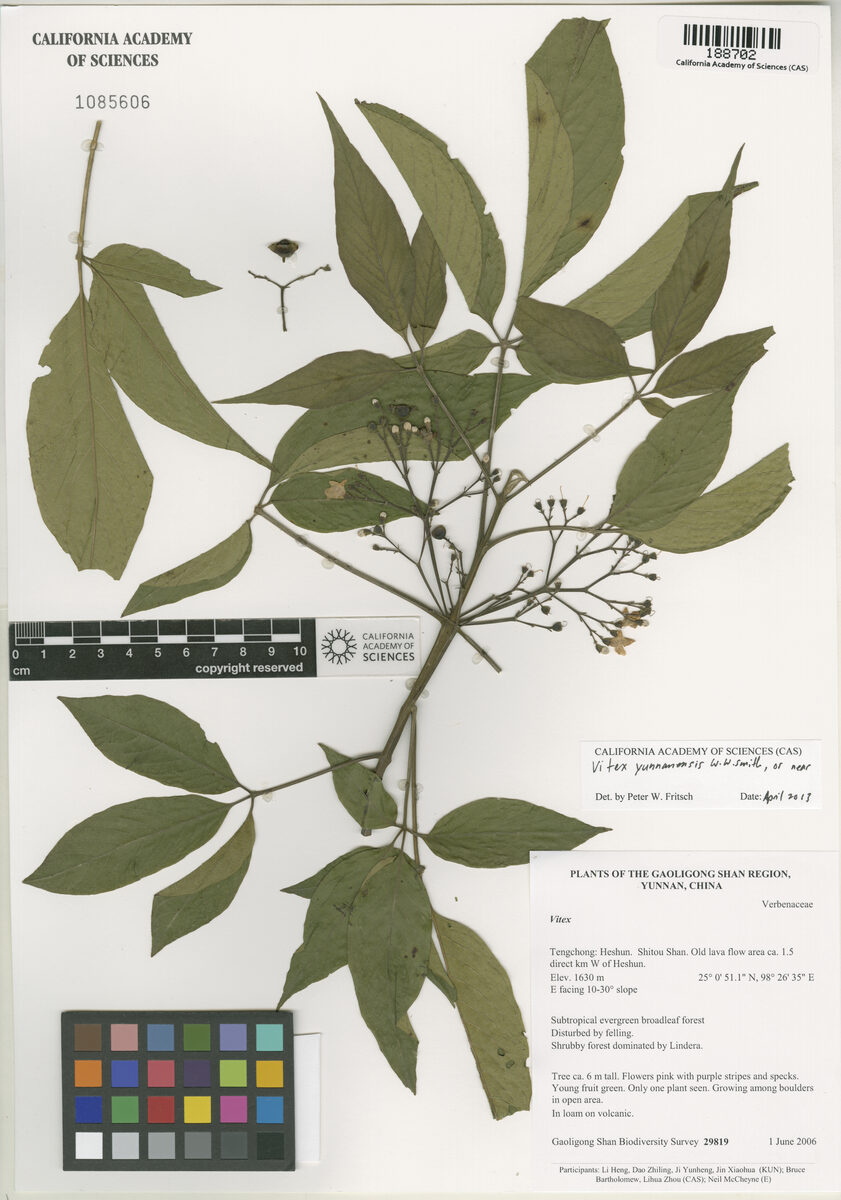
Clerodendrum floribundum
R.Br.
Thurkoo, Lollybush, Bleeding heart, Smooth Spiderbush, Smooth Clerodendrum
iNaturalist· cc-by-nc
(c) Nathanael Green, some rights reserved (CC BY-NC), uploaded by Nathanael Green
iNaturalist· cc-by-nc-sa
(c) Reiner Richter, some rights reserved (CC BY-NC-SA), uploaded by Reiner Richter
iNaturalist· cc-by-nc-sa
(c) Arthur Chapman, some rights reserved (CC BY-NC-SA), uploaded by Arthur Chapman
Summary
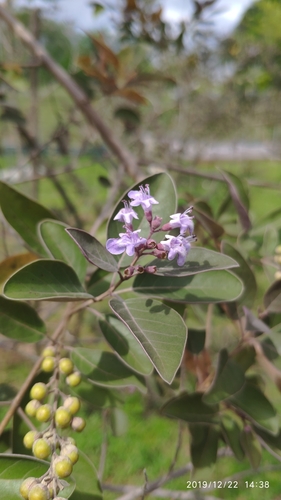
Source: WikipediaClerodendrum floribundum, known as the lolly bush or smooth clerodendrum, is a shrub or tree found in Australia and New Guinea. Its habitat is in or at the margins of coastal rainforests, up to 300 metres above sea level. In Western Australia it grows in drier areas, such as rocky sites, gorges, cliffs, floodplains and creek beds.
Description
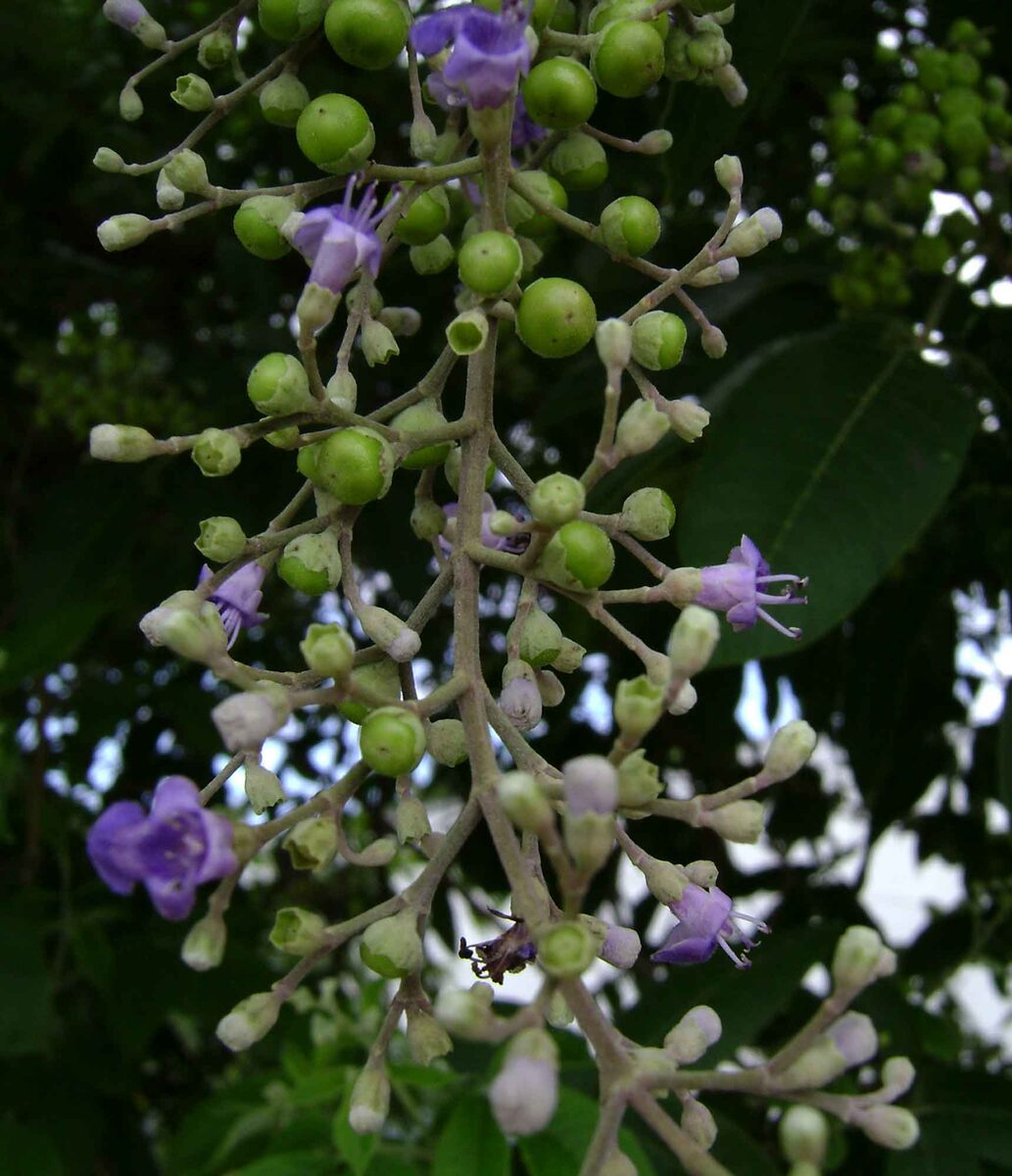
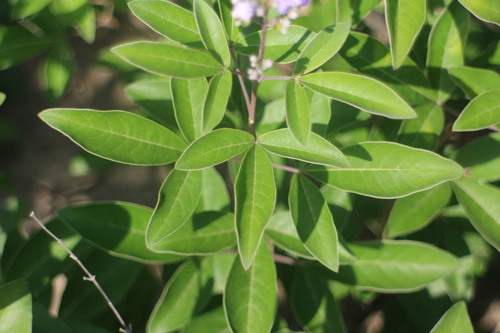
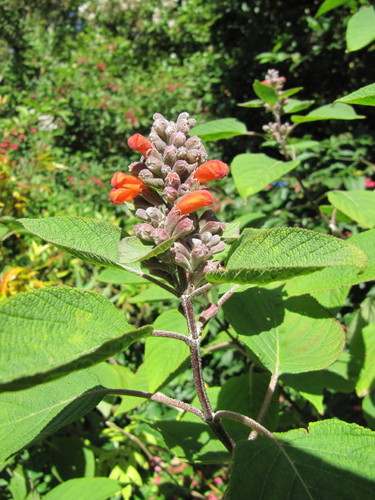
A shrub or small tree. It grows 1.5-4 m high. Plants often sucker freely. The leaves vary in size and shape. They are often oval. The blade is 6-17 cm long by 3.5-13 cm wide. The leaves have a long stalk and pointed tip. The flowers are white and like tubes with stamens sticking out the end. They are 2-7 cm long in open groups which are 15-25 cm across. They are produced towards the ends of branches. The fruit is a round dry capsule with lobes. There is a red star like calyx at the base. The fruit is 1-1.5 cm across. It is red and turns black when ripe. There are several varieties.
Edible Uses
The roots are boiled and eaten. While the fruit is noted as not typically edible, some sources claim the ripe fruit are eaten.
Traditional Uses
The roots are boiled and eaten. (The fruit are not edible.) Some claim the ripe fruit are eaten.
This uses section is brief — help expand it
Medicinal Uses
A lotion made from the branches or bark was used for easing bodily aches. The roots were boiled and eaten
Known Hazards
The fruit are generally not considered edible.
Distribution
A tropical plant. It suits tropical, subtropical and warm temperate regions. It grows in coastal areas on sand dunes. In tropical Queensland it grows from sea level to 1200 m altitude. It can grow in arid places. It suits hardiness zones 10-12.
Where It Grows
Asia, Australia*, China, East Timor, SE Asia, Timor-Leste,
Cultivation
Plants can be grown from seed. They can also be grown from cuttings and root suckers. They can be pruned to shape the plant.
Propagation
Seed - - best sown as soon as it is ripe. Germination is rather unreliable and can take several months. Softwood cuttings Cuttings of half-ripe wood Root cuttings Division of suckers
Notes
There are about 400 Clerodendrum species.
Nutrition
| Part | Moisture | kJ | kcal | Protein | Vit A | Vit C | Iron | Zinc |
|---|---|---|---|---|---|---|---|---|
| Root | 52.3 | 918 | 220 | 1.6 | — | — | — | — |
Also Known As
Babirda, Babirdirmi
References (32)
- Bindon, P., 1996, Useful Bush Plants. Western Australian Museum. p 85
- Bodkin, F., 1991, Encyclopedia Botanica. Cornstalk publishing, p 266
- Brock, J., 1993, Native Plants of Northern Australia, Reed. p 122
- Calvert, G., 2010, The Burdekin Delta Tree Guide. Lower Burdekin Landcare Association., Inc., Ayr p 53
- Cancilla, D., 2018, Ethnobotanical and Ethnozoological Values Desktop Assessment - Eliwana Project. p 10
Show all 32 references Hide references
- Cherikoff V. & Isaacs, J., The Bush Food Handbook. How to gather, grow, process and cook Australian Wild Foods. Ti Tree Press, Australia p 198
- Cooper, W. and Cooper, W., 2004, Fruits of the Australian Tropical Rainforest. Nokomis Editions, Victoria, Australia. p 234
- Cowie, I, 2006, A Survey of Flora and vegetation of the proposed Jaco-Tutuala-Lore National Park. Timor-Lests (East Timor) www.territorystories.nt/gov.au p 55
- Cundall, P., (ed.), 2004, Gardening Australia: flora: the gardener's bible. ABC Books. p 393
- Elliot, W.R., & Jones, D.L., 1984, Encyclopedia of Australian Plants suitable for cultivation. Vol 3. Lothian. p 49
- Etherington, K., & Imwold, D., (Eds), 2001, Botanica's Trees & Shrubs. The illustrated A-Z of over 8500 trees and shrubs. Random House, Australia. p 216
- Haslam, S., 2004, Noosa's Native Plants. Noosa Integrated Catchment Assn. Inc. p 21
- Hibbert, M., 2002, The Aussie Plant Finder 2002, Florilegium. p 70
- Hiddins, L., 1999, Explore Wild Australia with the Bush Tucker Man. Penguin Books/ABC Books. p 149
- Hinton, B & B., 1982, A Wilderness in Bloom. Wildflowers of tropical Australia. p 69 (cover)
- Jones D, L, 1986, Ornamental Rainforest Plants in Australia, Reed Books, p 207
- Kenneally, K.E., Edinger, D. C., and Willing T., 1996, Broome and Beyond, Plants and People of the Dampier Peninsula, Kimberley, Western Australia. Department of Conservation and Land Management. p 195
- Latz, P.K., 1996, Bushfires and Bushtucker: Aboriginal plant use in Central Australia. IAD Press Alice Springs p 149
- Melzer, R. & Plumb, J., 2011, Plants of Capricornia. Belgamba, Rockhampton. p 151
- Milson, J., 2000, Trees and Shrubs of north-west Queensland. DPI p 300
- Nicholson, N & H., 1996, Australian Rainforest Plants 3, Terania Rainforest Publishing. NSW. p 16
- Paczkowska, G . & Chapman, A.R., 2000, The Western Australian Flora. A Descriptive Catalogue. Western Australian Herbarium. p 566
- Pearson, S. & A., 1992, Rainforest Plants of Eastern Australia. Kangaroo Press p 65
- Plants for a Future database, The Field, Penpol, Lostwithiel, Cornwall, PL22 0NG, UK. http://www.scs.leeds.ac.uk/pfaf/
- Scarth-Johnson, V., 2000, National Treasures. Flowering Plants of Cooktown and Northern Australia. Vera Scarth-Johnson Gallery Association. Cooktown, Australia. p 166
- Smith, N. M., 1991, Ethnobotanical Field Notes from the Northern Territory, Australia, J. Adelaide Bot. Gard. 14(1): 1-65
- Townsend, K., 1994, Across the Top. Gardening with Australian Plants in the tropics. Society for Growing Australian Plants, Townsville Branch Inc. p 136
- Townsend, K., 1999, Field Guide to Plants of the Dry Tropics. Society for Growing Australian Plants, Townsville Branch Inc. p 34
- Urban, A., 1990, Wildflowers of Inland Australia. Portside editions. p 162
- Wheeler, J.R.(ed.), 1992, Flora of the Kimberley Region. CALM, Western Australian Herbarium, p 786
- Wightman, G. & Brown, J., 1994, Jawoyn Plant Identikit, Common Useful Plants in the Katherine Area of Northern Australia. Conservation Commission Northern Territory. p 41
- Williams, J.B., Harden, G.J., and McDonald, W.J.F., 1984, Trees and shrubs in rainforests of New South Wales and Southern Queensland. Univ. of New England, Armidale. p 121