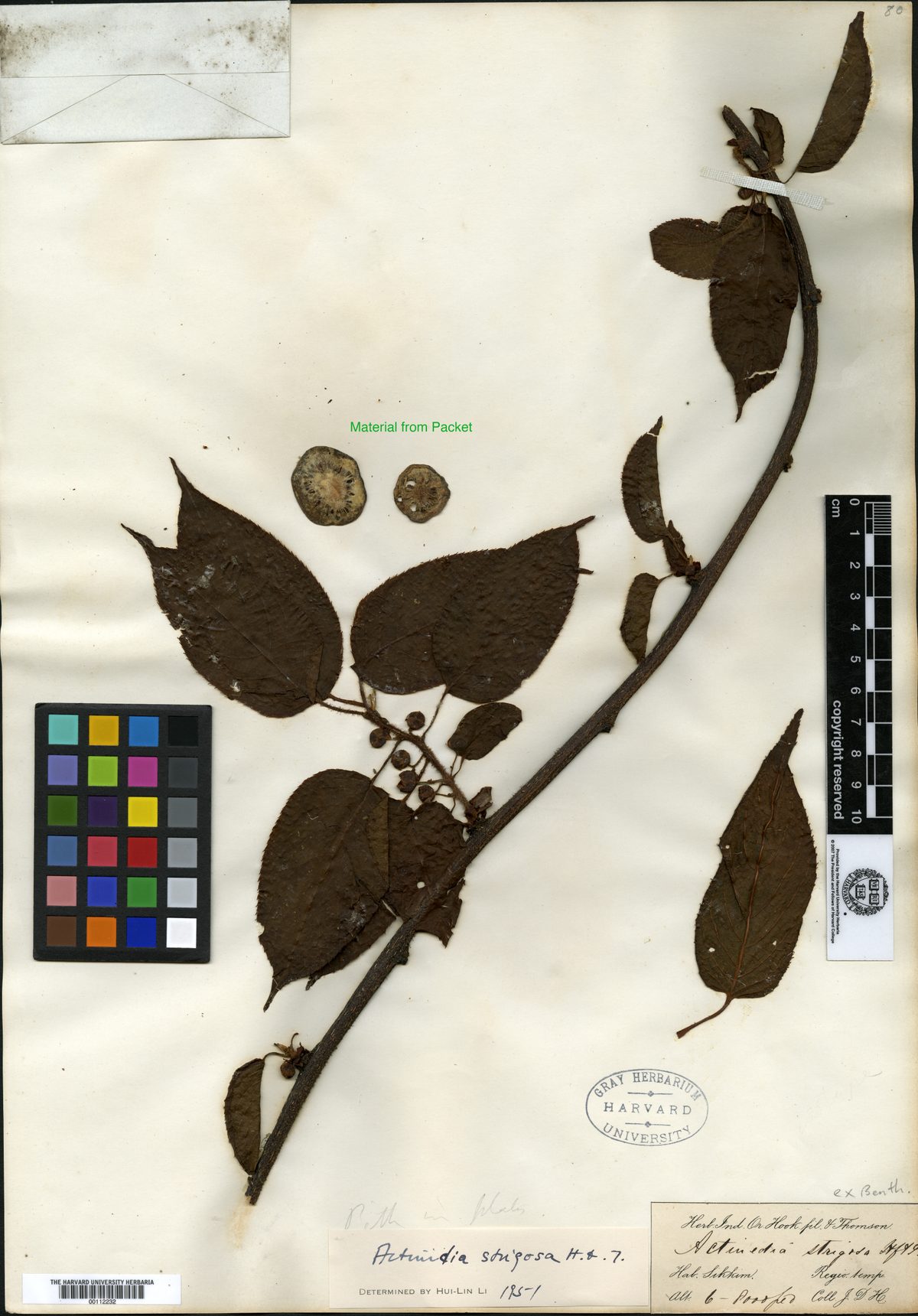
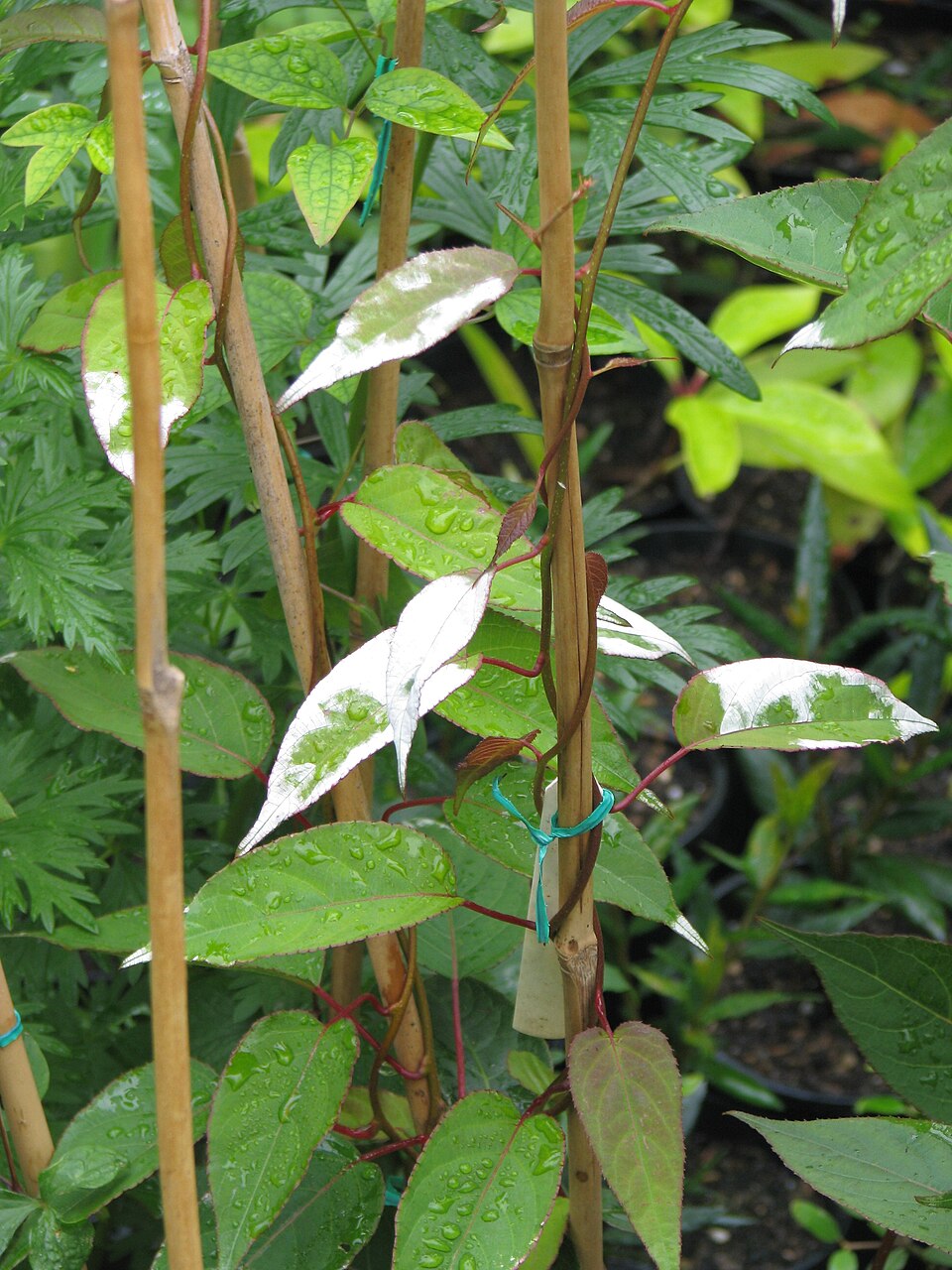
Actinidia deliciosa
(A. Chev.) Liang & A. R. Ferguson
Chinese gooseberry, Kiwifruit
iNaturalist· cc-by-nc
(c) Mel, some rights reserved (CC BY-NC)
iNaturalist· cc-by-nc
(c) Mel, some rights reserved (CC BY-NC)
iNaturalist· cc-by-nc
(c) Mel, some rights reserved (CC BY-NC)
Summary
A deciduous climbing vine growing to 9 m at a fast rate, hardy to UK zone 7. Flowers bloom July to August with seeds ripening October to December. Dioecious species requiring separate male and female plants for seed production; not self-fertile and pollinated by bees and insects. Noted for attracting wildlife. Suitable for light sandy, medium loamy, and heavy clay soils with preference for mildly acidic pH. Grows in semi-shade or full sun and tolerates both dry and moist soil conditions.
Description
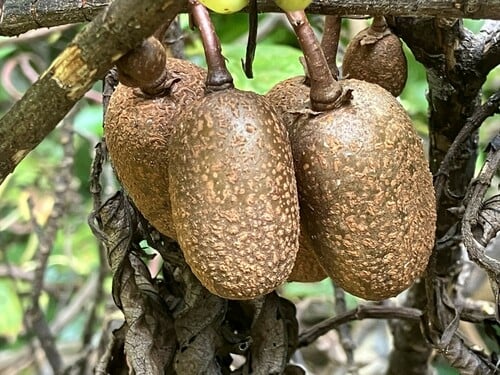
A large woody vine. It loses its leaves during the year. The leaves are large and heart shaped. They are 20 cm long. Male and female flowers occur on separate plants. The flowers are cream and scented. The fruit are brown and fuzzy. They have green flesh and black seeds.
Edible Uses
The fruit can be eaten raw or cooked. It grows up to 8cm long, is very juicy when fully ripe, and has a delicious, refreshing, acid flavour. It contains a number of small seeds, which are easily eaten with the flesh. Fresh fruit is rich in vitamin C, containing 100–420mg per 100g, along with 8–14% carbohydrate and an acidity of 1–2%, mainly from citric acid. The fruit ripens in November and can be stored for 3–4 months. Yields of 8–30 tonnes per hectare are possible. The leaves can also be eaten as a famine food.
Traditional Uses
The fruit are eaten raw or cooked.
This uses section is brief — help expand it
Medicinal Uses
The fruits, stems, and roots are diuretic, febrifuge, and sedative. They are used in the treatment of stones in the urinary tract, rheumatoid arthralgia, and cancers of the liver and oesophagus.
Distribution
It is a temperate plant. It is a plant derived in cultivation from Actinidia chinensis, it is not known in a truly wild situation. Plants requires a 6-8 month frost-free growing season. They are hardy to about -12°C when fully dormant but young growth is very subject to damage by late frosts, being killed back at -2°C. Plants also require a winter chilling of 600 - 1100 hours below 7°C and a long warm summer to ripen the fruit. Temperatures above 35°C and low humidity scorch leaves. Plants prefer a sound loamy acid soil, and dislike alkaline soils becoming chlorotic at pH 6 or higher. They tolerates a pH in the range 5.5 to 7.3. It suits hardiness zones 7-10.
Where It Grows
Australia, Brazil, Britain, Canada, China, Europe, New Zealand, North America, Pacific, Slovenia, South America, Switzerland, Tasmania, Uruguay,
Cultivation
Male and female plants must usually be grown if seed is required, one male to five or six females is normally adequate. Plants can be grown from softwood cuttings. Cuttings 1 cm thick and 20-30 cm long are suitable. They are taken when well matured and dormant. They can be grown from seed but these take 7 years to fruit. Fruit grow on current season's growth, so regular pruning is important. A spacing of 4-6 m is suitable. One male plant near each nine female plants is a suitable ratio.
Propagation
Sow seed in spring in a greenhouse. Three months of stratification is recommended — either sow fresh seed in a cold frame as soon as it ripens in November, or stratify stored seed before spring sowing. Fresh seed germinates in 2–3 months at 10°C; stored seed may take longer. Once seedlings are large enough to handle, prick them out into individual pots and grow on in light shade in the greenhouse for at least their first winter. Plant out into permanent positions in late spring or early summer when plants are 30cm or more tall, after the last expected frosts. Note that most seedlings are male. Seedlings are prone to damping off and must be kept well ventilated. Softwood cuttings can be taken as soon as they are ready in spring, in a frame. Half-ripe cuttings can be taken in July/August in a frame, with a very high success rate. Ripe wood cuttings can be taken in October/November in a frame.
Other Uses
Paper is made from the bark. If the bark is removed in one piece from near the root and placed in hot ashes, it becomes very hard and can be used as a tube for a pencil. The flowers are rich in nectar and pollen, attracting pollinators such as bees. The fruit is edible and nutritious for wildlife, and the dense foliage can provide shelter for invertebrates, with leaf litter offering overwintering sites. The sprawling vine habit may also create beneficial ground cover. The aromatic leaves and flowers may help confuse pests, potentially offering a degree of pest control.
Production
Vines produce after 4-5 years. Yields of 8 - 30 tonnes per hectare are possible. One plant can produce 50-100 kg of fruit. Fruit can be kept at room temperature for up to 8 weeks.
Notes
Rich in vitamin C, fresh fruit containing 100 - 420 mg of vitamin C per 100 g and 8 - 14% carbohydrate. There are 40-60 Actinidia species. The Actinidiaceae are a mainly tropical family.
Nutrition
| Part | Moisture | kJ | kcal | Protein | Vit A | Vit C | Iron | Zinc |
|---|---|---|---|---|---|---|---|---|
| Fruit - raw | 83.1 | 255 | 61 | 1 | 18 | 98 | 0.4 | 0.2 |
| Fruit | 81.2 | 217 | 52 | — | — | — | — | — |
Synonyms
Also Known As
Delicious donkey fruit, Kivi, Meiwei Mihoutao
References (20)
- Arora, R. K., 2014, Diversity in Underutilized Plant Species - An Asia-Pacific Perspective. Bioversity International. p 55
- Brickell, C. (Ed.), 1999, The Royal Horticultural Society A-Z Encyclopedia of Garden Plants. Convent Garden Books. p 76
- Cheifetz, A., (ed), 1999, 500 popular vegetables, herbs, fruits and nuts for Australian Gardeners. Random House p 167
- Cundall, P., (ed.), 2004, Gardening Australia: flora: the gardener's bible. ABC Books. p 96
- Facciola, S., 1998, Cornucopia 2: a Source Book of Edible Plants. Kampong Publications. p 2
Show all 20 references Hide references
- Guihaia 4:181. 1984
- INFOODS:FAO/INFOODS Databases
- Janick, J. & Paul, R. E. (Eds.), 2008, The Encyclopedia of Fruit & Nuts. CABI p 1
- Lazarides, M. & Hince, B., 1993, Handbook of Economic Plants of Australia, CSIRO. p 8
- Lyle, S., 2006, Discovering fruit and nuts. Land Links. p 47
- Morton, J. F., 1987, Fruits of Warm Climates. Wipf & Stock Publishers p 293
- Plants for a Future database, The Field, Penpol, Lostwithiel, Cornwall, PL22 0NG, UK. http://www.scs.leeds.ac.uk/pfaf/
- Recher, P, 2001, Fruit Spirit Botanical Gardens Plant Index p 1
- Sharma, B.B., 2005, Growing fruits and vegetables. Publications Division. Ministry of Information and broadcasting. India. p 77
- Solomon, C., 2001, Encyclopedia of Asian Food. New Holland. p 195
- Tankard, G., 1990, Tropical fruit. An Australian Guide to Growing and using exotic fruit. Viking p 54
- USDA, ARS, National Genetic Resources Program. Germplasm Resources Information Network - (GRIN). [Online Database] National Germplasm Resources Laboratory, Beltsville, Maryland. Available: www.ars-grin.gov/cgi-bin/npgs/html/econ.pl (10 April 2000)
- Valder, P., 1999, The Garden Plants of China. Florilegium. p 186
- van Wyk, B., 2005, Food Plants of the World. An illustrated guide. Timber press. p 42
- Wiersema, J. H. & Leon, B., 2013, World Economic Plants. A Standard Reference CRC Press. 2nd Ed. p 16