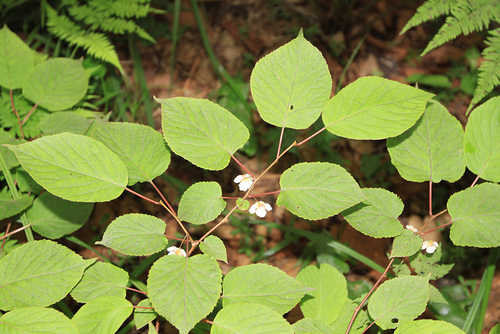
Actinidia chinensis
Planch.
Chinese gooseberry
iNaturalist· cc-by-nc
(c) Chuangzao, some rights reserved (CC BY-NC), uploaded by Chuangzao
iNaturalist· cc-by-nc
(c) rubecula, some rights reserved (CC BY-NC)
iNaturalist· cc-by-nc
(c) Dave Holland, some rights reserved (CC BY-NC), uploaded by Dave Holland
Summary
Source: WikipediaActinidia chinensis is a fruiting vine native to China. It is one of some 40 related species of the genus Actinidia, and the origin of most commercial varieties of kiwifruit. There are three accepted varieties of the species. Actinidia chinensis var. deliciosa, a form which grows primarily in southwestern China that has hairier fruit, was brought to New Zealand in 1904. Varieties which were developed from these plants are the origin of the major green kiwifruit varieties. Actinidia chinensis var. chinensis is a variety which has smoother skin, and typically grows in southeastern China. Fruit from this variety were developed into gold kiwifruit and red kiwifruit cultivar in the late 20th and early 21st century, including Zespri Gold, Zespri SunGold, Jintao, Hongyang and Donghong. The third variety, Actinidia chinensis var. setosa, grows exclusively in Taiwan.
Description
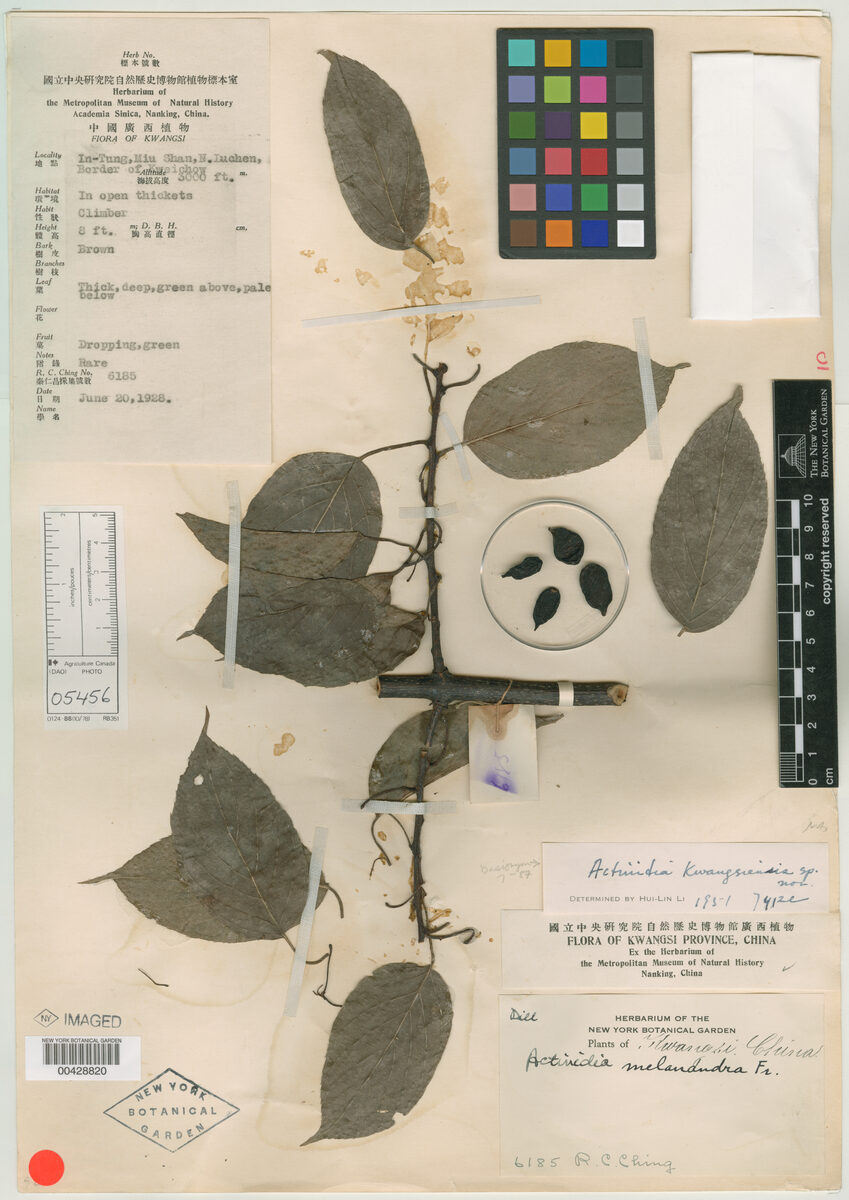
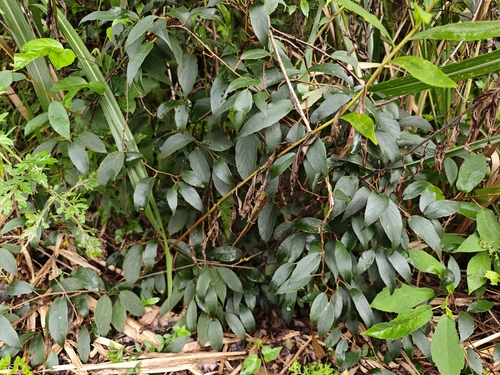
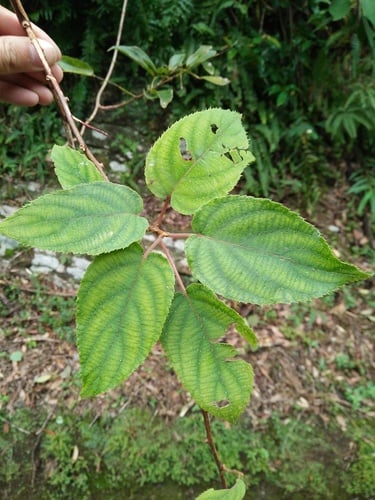
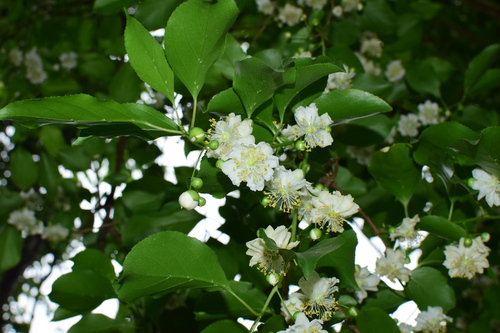
A hardy climbing shrub that loses all its leaves at one time. It climbs up to 10 m by twining around its support. The leaves are heart shaped and up to 20 cm long. Male and female flowers are on separate plants. The flowers have a sweet scent. The fruit is up to 8 cm long and 3 cm across and mostly covered with fine hairs. The inside flesh is green. This plant is the parent of Kiwifruit which are now listed as Actinidia deliciosa. The smooth skinned kind is now kept as Actinidia chinensis and the hairy one as Actinidia deliciosa.
Edible Uses
The fruit can be eaten raw or cooked and has a delicious flavour. Fruits grow up to 3cm across and contain a number of small seeds, which are easily eaten with the flesh. Fresh fruit contains 100–420mg of vitamin C per 100g and 8–14% carbohydrate, with an acidity of 1–2%, mainly from citric acid. The leaves can be cooked and eaten in times of need as a famine food.
Traditional Uses
The fruit is eaten raw. It can also be used in preserves and cooking. The leaves can be eaten cooked as an emergency food. The fruit is also made into jams and jellies.
Medicinal Uses
The fruits, stems, and roots are diuretic, febrifuge, and sedative. They are used in the treatment of stones in the urinary tract, rheumatoid arthralgia, and cancers of the liver and oesophagus. A decoction of the leaves is used to treat mange in dogs. Stem juice is used in the treatment of gravel.
Distribution
It is a temperate plant. Young shoots and fruit are damaged by frost. Plants have fruited at 1000 m altitude in equatorial regions. It grows naturally in China in thickets and oak forests on slopes or in ravines between 200-2300 metres altitude. It cannot tolerate wet soils. It needs shelter from wind and frost. It has a winter chilling requirement of 500-800 hours below 7°C. Fruit are smaller in shade. In Hobart Botanical gardens. It suits hardiness zones 7-10. In Sichuan and Yunnan.
Where It Grows
Asia, Australia, Britain, China, Colombia, Europe, India, Indochina, Mexico, New Zealand, Niue, Pacific, Papua New Guinea, PNG, Philippines, SE Asia, Serbia, South America, Taiwan, Tasmania, Vietnam,
Cultivation
It can be grown from seeds or cuttings but often plants of known quality and sex are grafted on. It needs a support to climb over. It needs regular pruning because fruit develop on the current year's growth. Plants or grafted branches of both sexes are needed. Male and female plants must be grown if seed is required. Plants can be grown from seed. Fresh seed germinates in 2 - 3 months at 10°C and stored seed can take longer. Seedlings should be transplanted out when 30 cm tall and after the last frosts. (Most seedlings are male.)
Propagation
Sow seed in spring in a greenhouse. Three months of stratification is recommended — either sow fresh seed in a cold frame as soon as it ripens in November, or stratify stored seed before spring sowing. Fresh seed germinates in 2–3 months at 10°C; stored seed may take longer. Once seedlings are large enough to handle, prick them out into individual pots and grow on in light shade in the greenhouse for at least their first winter. Plant out into permanent positions in late spring or early summer when plants are 30cm or more tall, after the last expected frosts. Note that most seedlings are male. Seedlings are prone to damping off and must be kept well ventilated. Softwood cuttings can be taken as soon as they are ready in spring, in a frame. Half-ripe cuttings can be taken in July/August in a frame, with a very high success rate. Ripe wood cuttings can be taken in October/November in a frame.
Other Uses
Paper is made from the bark. If the bark is removed in one piece from near the root and placed in hot ashes, it becomes very hard and can be used as a tube for a pencil. The plant is also said to have insecticidal properties, though no further details are recorded.
Production
Healthy plants can remain productive for 60 years.
Other Information
It has been introduced to Papua New Guinea on a trial basis.
Notes
Fresh fruits contain 100 - 420 mg vitamin C per 100 g and 8 - 14% carbohydrates. There are 40-60 Actinidia species. The Actinidiaceae are a mainly tropical family.
Synonyms
Also Known As
Golden kiwifruit, Ichang gooseberry, Yangtao, Yemihoutao
References (32)
- Bianchini, F., Corbetta, F., and Pistoia, M., 1975, Fruits of the Earth. Cassell. p 174 (As Actinidea sinensis)
- Bircher, A. G. & Bircher, W. H., 2000, Encyclopedia of Fruit Trees and Edible Flowering Plants in Egypt and the Subtropics. AUC Press. p 9
- Bodkin, F., 1991, Encyclopedia Botanica. Cornstalk publishing, p 47
- Cull, B.W., 1995, Fruit Growing in Warm Climates. Reed. p 167
- Cundall, P., (ed.), 2004, Gardening Australia: flora: the gardener's bible. ABC Books. p 96
Show all 32 references Hide references
- Facciola, S., 1998, Cornucopia 2: a Source Book of Edible Plants. Kampong Publications. p 2
- Flowerdew, B., 2000, Complete Fruit Book. Kyle Cathie Ltd., London. p 134
- French, B., 1986, Food Plants of Papua New Guinea, Asia Pacific Science Foundation p 303
- Hu, Shiu-ying, 2005, Food Plants of China. The Chinese University Press. p 550
- INFOODS:FAO/INFOODS Databases
- Janick, J. & Paull, R. E. (Eds.), 2008, The Encyclopedia of Fruit & Nuts. CABI p 1
- John, L., & Stevenson, V., 1979, The Complete Book of Fruit. Angus & Robertson p 111
- Kang, Y., et al, 2012, Wild food plants and wild edible fungi in two valleys on the Qinling Mountains (Shaanxi, central China) Journal of Ethnobiology and Ethnomedicine; 9:26
- Kang, Y., et al, 2012, Wild food plants and wild edible fungi of Heihe valley (Qinling Mountains, Shaanxi, central China): Herbophilia and indifference to fruits and mushrooms. Acta Societas Botanicorum Poloniae 81(4):4-5-413
- Kiple, K.F. & Ornelas, K.C., (eds), 2000, The Cambridge World History of Food. CUP p 1796
- Lazarides, M. & Hince, B., 1993, Handbook of Economic Plants of Australia, CSIRO. p 8
- Liu, Yi-tao, & Long, Chun-Lin, 2002, Studies on Edible Flowers Consumed by Ethnic Groups in Yunnan. Acta Botanica Yunnanica. 24(1):41-56
- London J. Bot. 6:303. 1847
- Lord, E.E., & Willis, J.H., 1999, Shrubs and Trees for Australian gardens. Lothian. p 326
- Lyle, S., 2006, Discovering fruit and nuts. Land Links. p 47
- Macmillan, H.F. (Revised Barlow, H.S., et al) 1991, Tropical Planting and Gardening. Sixth edition. Malayan Nature Society. Kuala Lumpur. p 312
- Pham-Hoang Ho, 1999, An Illustrated Flora of Vietnam. Nha Xuat Ban Tre. p 408
- Plants for a Future database, The Field, Penpol, Lostwithiel, Cornwall, PL22 0NG, UK. http://www.scs.leeds.ac.uk/pfaf/
- READ,
- Roa, J. A. G. & Boada, D. S. G., 2018, Fundación para el Fortalecimiento de la Fruticultura y Plantas Alimenticias no Convencionales en Colombia.
- Sharma, B.B., 2005, Growing fruits and vegetables. Publications Division. Ministry of Information and broadcasting. India. p 76
- Smith, K., 1998. Growing Uncommon Fruits and Vegetables. New Holland. p 82
- UPHOF
- van Wyk, B., 2005, Food Plants of the World. An illustrated guide. Timber press. p 42
- Wiersema, J. H. & Leon, B., 2013, World Economic Plants. A Standard Reference CRC Press. 2nd Ed. p 16
- World Checklist of Useful Plant Species 2020. Royal Botanic Gardens, Kew
- Zeven, A. C. & de West, J. M. J., 1982, Dictionary of cultivated plants and their regions of diversity. Wageningen. p 32