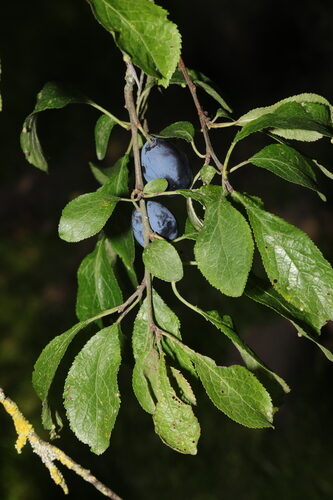
Prunus ilicifolia
(Nutt. ex Hook. & Arn.) D. Dietr.
Hollyle, af cherry
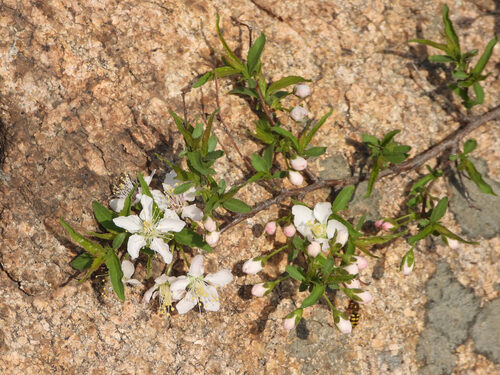
iNaturalist· cc-by-nc
(c) possiblybuddha, some rights reserved (CC BY-NC)
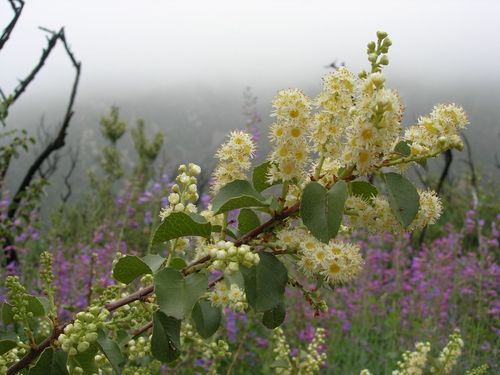
iNaturalist· cc-by
(c) rappman, some rights reserved (CC BY), uploaded by rappman
Summary
Source: WikipediaPrunus ilicifolia (Common names: hollyleaf cherry, evergreen cherry; islay - Salinan Native American) is native to the chaparral areas of coastal California (from Mendocino County to San Diego County), Baja California, and Baja California Sur. as well as the desert chaparral areas of the Mojave Desert. Prunus ilicifolia is an evergreen shrub to tree, producing edible cherries, with shiny and spiny toothed leaves similar in appearance to those of holly. This resemblance is the source of both the common name "holly-leaved cherry" and the scientific epithet "ilicifolia" (Ilex-leaved). It grows 2.4 to 9.1 metres (8 to 30 feet) tall, with thick, alternate leaves 2.5 to 5.1 centimetres (1 to 2 inches) in length. It has small white flowers growing in clusters, similar in appearance to most members of the rose family, Rosaceae, flowering from March to May. The flowers are terminal on small stalks, with the youngest at the cluster center. The purple to black fruit is sweet, with a very thin pulp around a large single stone (drupe). The plant is prized for cultivation, showy and easily grown from seed, and has been cultivated for centuries as a food source, and tolerates twice yearly pruning when often used as a hedge. The plant likes full sun, loose open soil (porous), and tolerates drought conditions well, but needs regular watering when young. Despite its name, it is not a true cherry (P. subg. Cerasus) species. It is traditionally included in P. subg. Laurocerasus, but molecular research indicates it is nested with species of P. subg. Padus. Ilicifolia or "ilex foliage," means "holly-like leaves" in Latin
Description
An evergreen shrub reaching 4 m with moderate growth rate. Hardy to UK zone 9, frost tender. Year-round foliage with flowers in July, seeds ripen November to December. Hermaphroditic flowers are insect-pollinated. Tolerates light sandy, medium loamy, and heavy clay soils preferring good drainage. Adapts to mildly acidic, neutral, and mildly alkaline pH. Grows in semi-shade or full sun and tolerates both dry and moist conditions.
Edible Uses
The fruit can be eaten raw, cooked, or dried for later use. It has a pleasant tart taste and is considered by some to be a great delicacy, though the flesh is thin, slightly acid, and astringent. The fruit can also be mixed with lemon to make a sauce. It is about 15mm in diameter with only a very thin layer of flesh surrounding one large seed. The seed can be eaten raw or cooked; it can be ground into a meal, leached to remove bitterness, and then mixed with flour to make bread. Leaching is done by placing the meal in a basket and pouring warm water over it. The seed should not be consumed if it is too bitter.
Medicinal Uses
An infusion of the leaves, or of the bark and roots, has been used as a cough medicine. Although no specific further medicinal use has been noted for this species, all members of the genus contain amygdalin and prunasin, compounds that break down in water to release hydrocyanic acid (cyanide or prussic acid). In small amounts, this highly poisonous substance is said to stimulate respiration, improve digestion, and produce a sense of well-being.
Known Hazards
The pulp of the cherry is edible. However, the seeds of the hollyleaf cherry are considered to be toxic, and the plant must undergo certain leaching processes to make it safe for consumption. Native Americans fermented the fruit into an intoxicating drink. Some also cracked the dried cherries and made meal from the seeds after grinding and leaching them. It has also been made into jam. The method of preparation for the cherry was to first extract and crush the kernel in a mortar, and the resulting powder would then be leached in order to eliminate remaining bad chemicals. The final step was to boil the leached powder into an atole. Once this process was completed, Native Californians would then make soup base, tortillas, or tamale-like foods using the resulting ground meal. Other times, the kernel would be kept whole, leached to remove its hydrocyanic acid content, roasted for a couple hours, and then used to make cakes or balls. Aside from food, the hollyleaf cherry was also used for medicinal purposes by some Native Californian tribes, including the Diegueño and the Cahuilla. Specifically, infusions made from the bark and roots of hollyleaf cherry plants would be used as treatment for common colds and coughs.
Distribution
It is a Mediterranean climate plant.
Where It Grows
Mexico, North America, USA,
Propagation
Seed requires 2–3 months of cold stratification and is best sown in a cold frame as soon as it is ripe. Stored seed should be sown in a cold frame as early in the year as possible and protected from mice. Germination can be slow, sometimes taking 18 months. Prick out seedlings into individual pots when large enough to handle, overwinter in a greenhouse or cold frame, and plant out in late spring or early summer the following year. Cuttings of half-ripe wood with a heel can be taken in July or August in a frame. Softwood cuttings from strongly growing plants can be taken in spring to early summer in a frame. Layering can be done in spring.
Other Uses
A green dye can be obtained from the leaves, and a dark grey to green dye from the fruit. The wood is heavy, hard, strong, and close-grained. It is usually too small to be of commercial importance and is used mainly as fuel.
Synonyms
Also Known As
Cereza verde, Islaya
References (2)
- Kermath, B. M., et al, 2014, Food Plants in the Americas: A survey of the domesticated, cultivated and wild plants used for Human food in North, Central and South America and the Caribbean. On line draft. p 712
- Segura, S., et al, 2018, The edible fruit species in Mexico. Genet Resour Crop Evol (2018) 65:1767–1793