Cissampelos pareira
L.
Velvet leaf
iNaturalist· cc-by
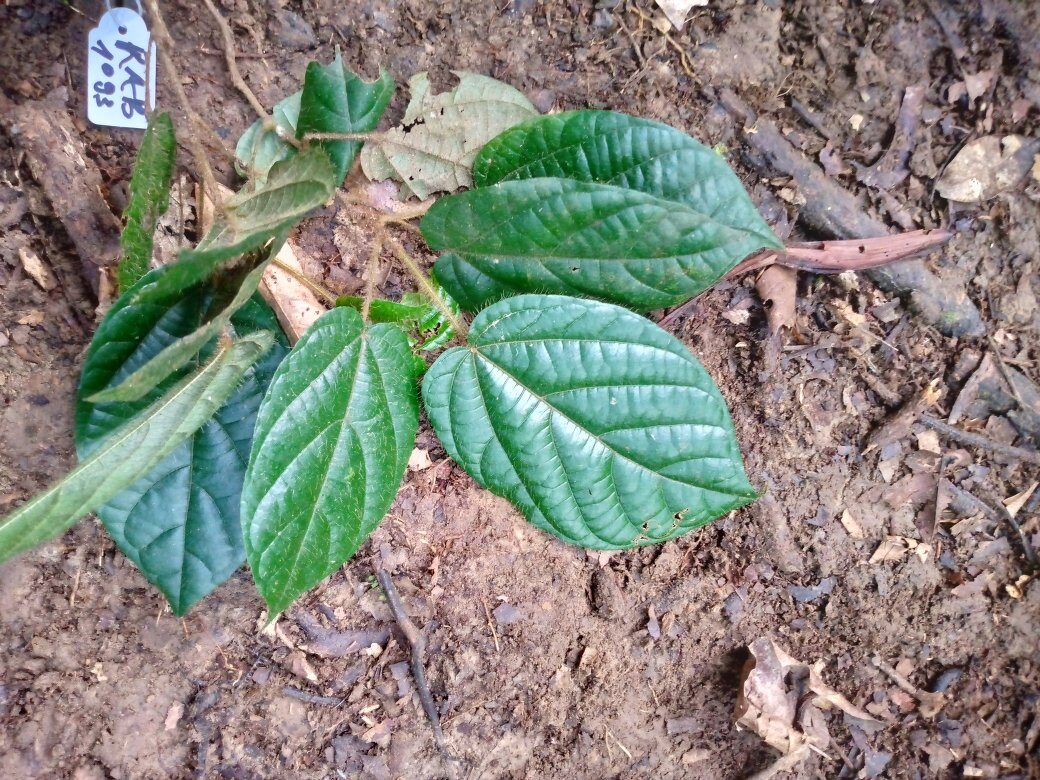
(c) Neptalí Ramírez Marcial, some rights reserved (CC BY), uploaded by Neptalí Ramírez Marcial
iNaturalist· cc-by-nc
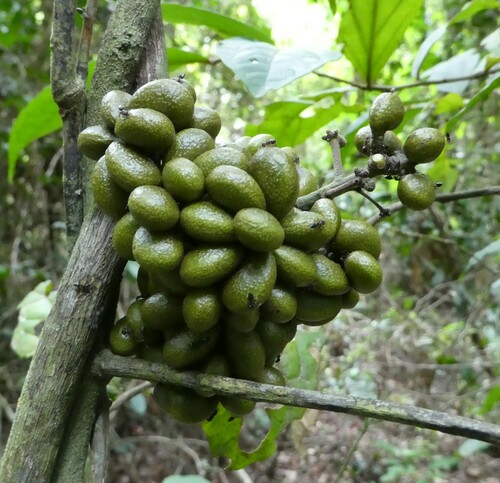
(c) Luís A. Funez, some rights reserved (CC BY-NC)
iNaturalist· cc-by-nc
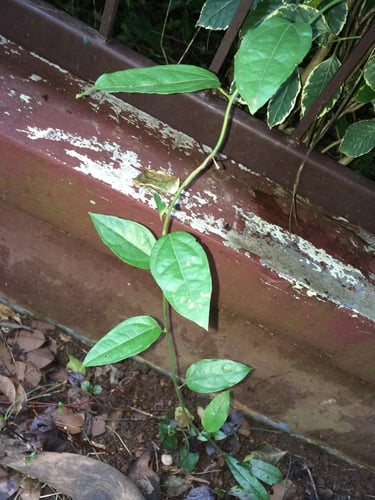
(c) Luís A. Funez, some rights reserved (CC BY-NC)
Summary
Source: WikipediaCissampelos pareira (velvetleaf) is a species of flowering plant in the family Menispermaceae.
Description
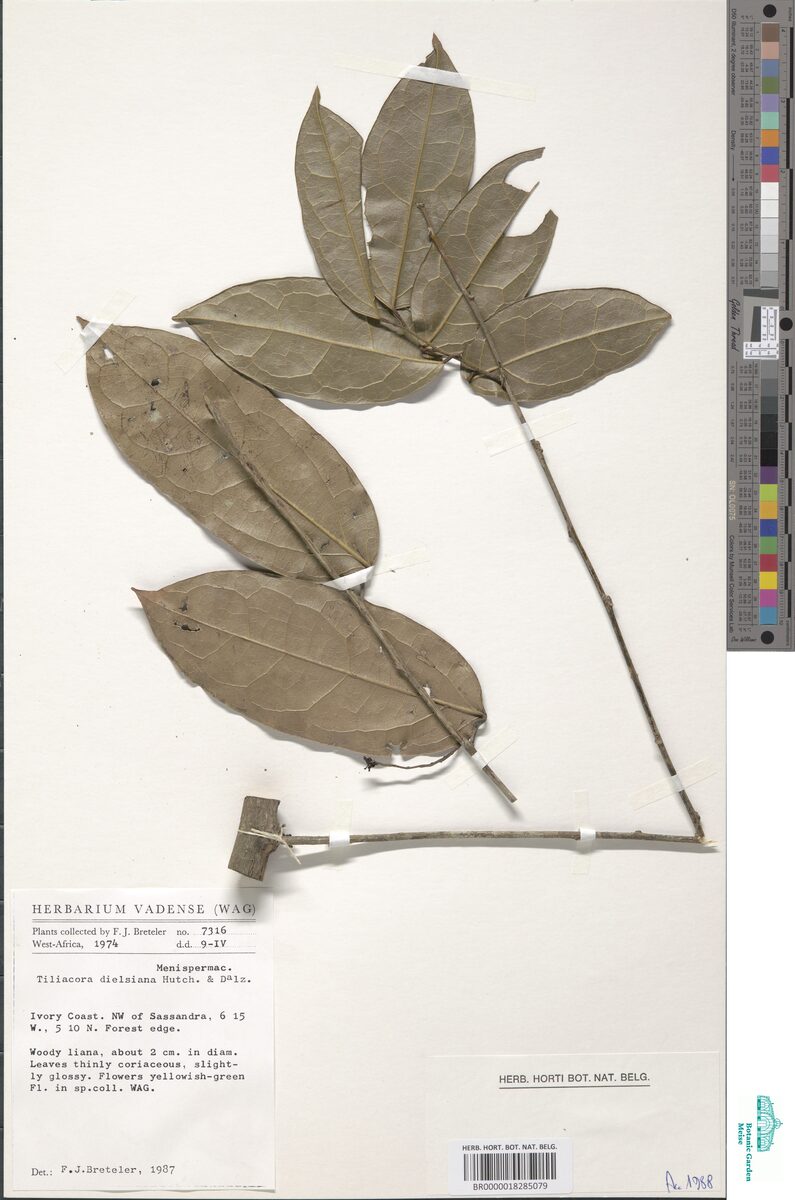
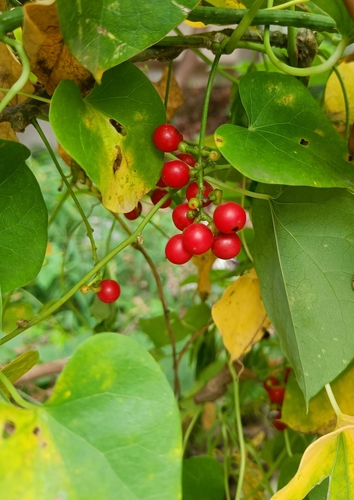
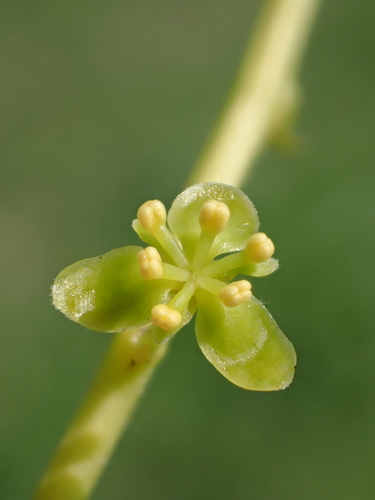
A woody vine or climber. The branches are slender. They are usually densely hairy. The leaves are simple and 5-12 cm long by 5-12 cm wide. The leaf stalk joins the leaf blade away from the edge. The leaf blade is papery. Plants are separately male and female. A group of flowers occur in the axils of leaves. The flowers have 1 petal and are cup shaped. They are white or yellow. The fruit is fleshy and yellow, orange or red. It is 5-7 mm long and wide. It is hairy. It occurs amongst bracts 1-2 cm long. There is 1 seed. It is brown and 4-5 mm long. Variety pariera occur only in America and Africa. Variety hirsuta occurs in Asia.
Edible Uses
The leaves are harvested, crushed, filtered, and the sap is left to solidify and eaten as a sweet. The fruit is eaten. The dried root powder is added to rice liquor to improve fermentation. The roots are cooked and eaten to alleviate constipation.
Traditional Uses
The leaves are harvested, crushed and filtered and the sap left to solidify. It is eaten as a sweet. The fruit is eaten. The dried root powder is added to rice liquor to improve fermentation.
Medicinal Uses
Cissampelos pareira is used in Chinese herbology, where it is called xí shēng téng (Chinese: 锡生藤) or yà hū nú (Chinese: 亞乎奴). The species is also known as abuta and called laghu patha in Ayurvedic medicine. In Tamil Nadu it is called ponmusutai and it is used for a number of medicinal purposes. Some attention has been paid to it in Kenya, Tanzania, and other places for its purported antimalarial properties in particular, as well as in India for its antiviral properties, especially against Dengue virus.
Known Hazards
The edible portion is marked with caution. The plant contains alkaloids including Seeprine, Bebeerine, and Cissampeline.
Distribution
They are tropical. In Pakistan it is common in hedges up to 2,300 m altitude. It can grow in arid places. In Yunnan.
Where It Grows
Africa, Antigua-Barbuda, Argentina, Asia, Australia, Bahamas, Barbados, Belize, Bolivia, Brazil, Cambodia, Central Africa, Central America, China, Colombia, Comoros, Congo, Costa Rica, Cuba*, Dominican Republic, East Africa, Ecuador, Ethiopia, Grenada, Guatemala, Guianas, Guyana, Haiti, Himalayas, India, Indochina, Indonesia, Jamaica*, Kenya, Laos, Madagascar, Malaysia, Martinique, Mauritius, Mexico, Mozambique, Myanmar, Nepal, Nicaragua, North America, Northeastern India, Pakistan, Papua New Guinea, PNG, Paraguay, Peru, Philippines, Puerto Rico, Reunion, SE Asia, Seychelles, Sierra Leone, South America, Sri Lanka, Suriname, Tanzania, Thailand, Trinidad-Tobago, Uganda, Uruguay, USA, Venezuela, Vietnam, West Africa, West Indies*, Zambia, Zimbabwe,
Cultivation
Plants can be grown by seeds or cuttings.
Other Uses
A thin rope can be made from the rhizomes.
Notes
There are about 20-25 Cissampelos species. The roots are cooked and eaten to alleviate constipation. It contains alkaloids - Seeprine, Bebeerine and Cissampeline.
Synonyms
Also Known As
Abutua, Adivi banka tige, Akanadi, Ambashtha, Appatta, Bai maa noi, Batul paate, Bohivory, Caa peba, Charrua, Chutu lutur, Cipo, False pareira brava, Gasing-gasing, Gegasing, Hamafana, Kattuvalli, Krea manoi, Krue ma noi, Kywet-abaung, Mempanang, Mil hombres, Mulika chera, Padavali, Paharvel, Ranu red, Tabo, Venivel, Vishkhapri, Xi sheng teng, Zarza
References (27)
- Ambasta, S.P. (Ed.), 2000, The Useful Plants of India. CSIR India. p 126
- Bodkin, F., 1991, Encyclopedia Botanica. Cornstalk publishing, p 258
- Burkill, I.H., 1966, A Dictionary of the Economic Products of the Malay Peninsula. Ministry of Agriculture and Cooperatives, Kuala Lumpur, Malaysia. Vol 1 (A-H) p 566
- Cooper, W. and Cooper, W., 2004, Fruits of the Australian Tropical Rainforest. Nokomis Editions, Victoria, Australia. p 294
- Cruz-Garcia, G. S., & Price, L. L., 2011, Ethnobotanical investigation of 'wild' food plants used by rice farmers in Kalasin, Northeast Thailand. Journal of Ethnobiology and Ethnomedicine 7:33
Show all 27 references Hide references
- Dey, A. & Mukhererjee, A., 2015, Living and Survival Amidst Hunger: Wild Edible Botanicals as a Prime Forest Productivity in the Rural Purulia District, West Bengal, India from Colonial to Present. Research Journal of Forestry 9(3): 71-86
- Eiadthong, W., et al, 2010, Management of the Emerald Triangle Protected Forests Complex. Botanical Consultant Technical Report. p 47
- Flora of Pakistan. www.eFloras.org
- Fowler, D. G., 2007, Zambian Plants: Their Vernacular Names and Uses. Kew. p 48 (As var. orbiculata)
- Japanese International Research Centre for Agricultural Science www.jircas.affrc.go.jp/project/value_addition/Vegetables
- Jardin, C., 1970, List of Foods Used In Africa, FAO Nutrition Information Document Series No 2.p 67
- Kachenchart, B., et al, 2008, Phenology of Edible Plants at Sakaerat Forest. In Proceedings of the FORTROP II: Tropical Forestry Change in a Changing World. Bangkok, Thailand.
- Khumgratok, S., Edible Plants in Cultural Forests of Northeastern Thailand. Mahasarakham University Thailand.
- Lo Hsienshui, Chen Tao, Menispermaceae. Flora of China.
- Malezas Comestibles del Cono Sur, INTA, 2009, Buernos Aires
- Manandhar, N.P., 2002, Plants and People of Nepal. Timber Press. Portland, Oregon. p 154
- Misra, R. C., et al, 2013, Genetic resources of wild tuberous food plants traditionally used in Similipal Biosphere Reserve, Odisha, India. Genetic Resources and Crop Evolution. Vol. 60 No. 2. Springer
- Molla, A., Ethiopian Plant Names. http://www.ethiopic.com/aplants.htm
- Murtem, G. & Chaudhrey, P., 2016, An ethnobotanical note on wild edible plants of Upper Eastern Himalaya, India. Brazilian Journal of Biological Sciences, 2016, v. 3, no. 5, p. 63-81.
- Pandy, R. K. & Saini, S. K., 2007, Edible plants of tropical forests among tribal communities of Madhya Pradesh. Indian Journal of Traditional Knowledge. 6(1), pp 185-190
- Pham-Hoang Ho, 1999, An Illustrated Flora of Vietnam. Nha Xuat Ban Tre. p 338
- Plants of Haiti Smithsonian Institute http://botany.si.edu/antilles/West Indies
- Royal Botanic Gardens, Kew (1999). Survey of Economic Plants for Arid and Semi-Arid Lands (SEPASAL) database. Published on the Internet; http://www.rbgkew.org.uk/ceb/sepasal/internet [Accessed 3rd May 2011] (var. hirsutum)
- Sp. pl. 2:1031. 1753
- Srichaiwong, P., et al, 2014, A Study of the Biodiversity of Natural Food Production to Support Community Upstream of Chi Basin, Thailand. Asian Social Science 10 (2):
- Suksri, S., et al, 2005, Ethnobotany in Bung Khong Long Non-Hunting Area, Northeast Thailand. Kasetsart J., (Nat. Sci) 39: 519-533
- World Checklist of Useful Plant Species 2020. Royal Botanic Gardens, Kew