Cyclanthus bipartitus
Poit. ex A. Rich.
Split-leaf cyclanthus
iNaturalist· cc-by-nc
(c) Marcus Athaydes, some rights reserved (CC BY-NC), uploaded by Marcus Athaydes
iNaturalist· cc-by-nc
(c) Hubert Szczygieł, some rights reserved (CC BY-NC)
Summary
Source: WikipediaCyclanthus bipartitus a species of plant in the family Cyclanthaceae, first described as a genus in 1824. It is native to southern Mexico, Central America, Trinidad, Windward Islands, northern South America (Venezuela, the Guianas, Colombia, Ecuador, Peru, Bolivia, northwestern Brazil).
Description
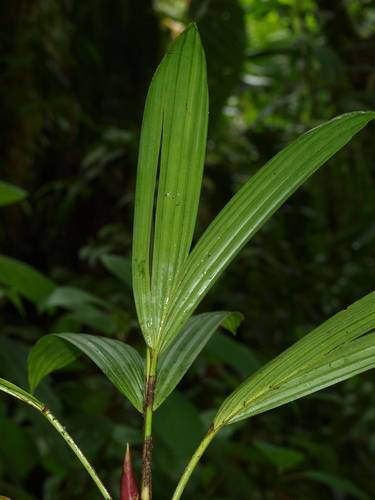
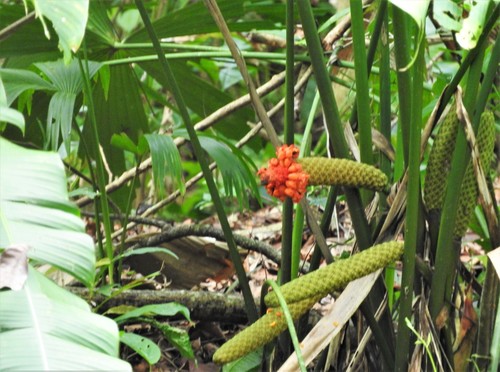
A herb. It grows 2.5 m tall. The leaves are a long oval shape and 45-50 cm long by 30 cm wide. They taper to both ends. The edges are wavy. They are shiny green and silvery underneath. The leaf stalks can be 1 m long. The flowers are small and cream. The fruit is a flat capsule. They are yellow to brown and in a beehive form. The are many small black seeds.
Edible Uses
The fruit and leaves (prepared with salt) are eaten.
Medicinal Uses
The plant (part not specified) is used in the treatment of snake bites and cataracts.
Distribution
It is a tropical plant. It grows in rainforests and up to 4,600 m above sea level. Cairns BG.
Where It Grows
Amazon, Andes, Asia, Australia, Belize, Bolivia, Brazil, Caribbean*, Central America*, Colombia, Costa Rica, Ecuador, French Guiana, Guatemala, Guyana, Honduras, Indonesia, Mexico, Nicaragua, Panama, Peru, SE Asia, South America, Suriname, Trinidad-Tobago, Venezuela, Winward, Is.,
Cultivation
The flowers have a pleasing fragrance, described as being between those of cinnamon and vanilla.
Other Uses
The fragrant, showy bracts of the inflorescence have a pleasing fragrance, described as being between those of cinnamon and vanilla. They are used as a perfume and body ornament, being trimmed with fringes and then secured under wristbands.
Other Information
It is cultivated.
Synonyms
Also Known As
Calzon panga, Chita papanku, Daun jahit, Daun senayan, Liaura panka, Na remedyu tape, Papanku papak, Pinta, Sainkaij im pih
References (7)
- Barfod, A. S. & Kvist, L. P., 1996, Comparative Ethnobotanical Studies of the Amerindian Groups in Coastal Ecuador. The Danish Academy of Sciences and Letters. p 78
- Kermath, B. M., et al, 2014, Food Plants in the Americas: A survey of the domesticated, cultivated and wild plants used for Human food in North, Central and South America and the Caribbean. On line draft. p 288
- Kew Plants of the World Online
- Roa, J. A. G. & Boada, D. S. G., 2018, Fundación para el Fortalecimiento de la Fruticultura y Plantas Alimenticias no Convencionales en Colombia.
- Standley, P. & Steyermark, J., 1958, Flora of Guatemala. Fieldiana: Botany, Volume 24 part 1 p 302
Show all 7 references Hide references
- Sukarya, D. G., (Ed.) 2013, 3,500 Plant Species of the Botanic Gardens of Indonesia. LIPI p 1101
- Torre, de la, L., et al, 2008, Enciclopedia de las Plantas Útiles del Ecuador. Herbario QCA. Pontificia Universidad Católica del Ecuador. p 303