Carludovica palmata
Ruiz & Pavon
Panama hat plant
iNaturalist· cc-by-nc
(c) Gustavo Morejon Jaramillo, some rights reserved (CC BY-NC), uploaded by Gustavo Morejon Jaramillo
iNaturalist· cc-by
(c) Alexis López Hernández, some rights reserved (CC BY)
iNaturalist· cc-by
(c) Alexis López Hernández, some rights reserved (CC BY)
Summary
Source: WikipediaCarludovica palmata (also known as Panama hat plant, toquilla palm, calá, palmilla, palmero, pojom, jiraca, junco, soyacal, tepejilote, and jipijapa) is a species of flowering plant in the family Cyclanthaceae. It is not a true palm, but its leaves are similar to the leaves of some true palms, such as Chelyocarpus ulei. Unlike several true palms, C. palmata does not develop a woody trunk. Its female flowers (which mature first) have large stigmas, and its male flowers (which mature later) have a lot of pollen.
Description
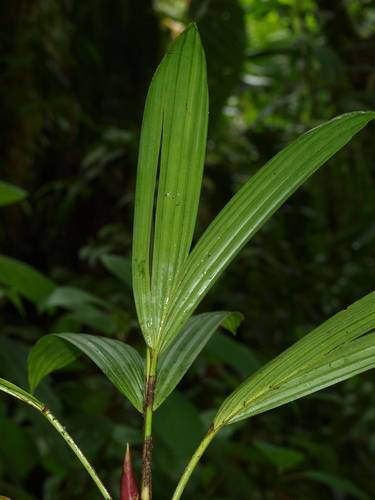
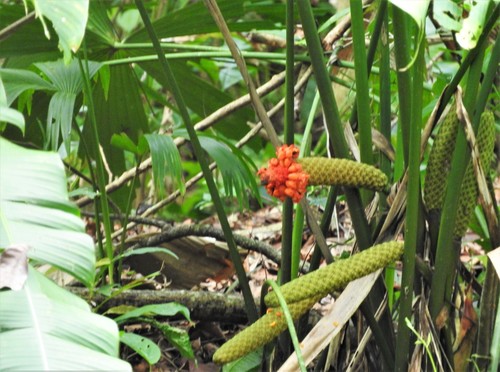
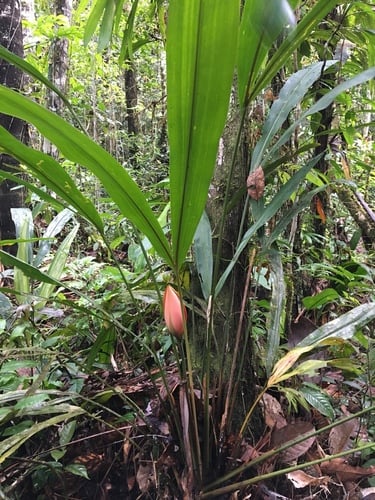
An evergreen shrub. It is palm like. It is erect and in tufts. It grows 3-4 m high. The leaves are papery and spread out like fingers on a hand. The leaves are in 4 parts and they are 40-80 cm long. The leaf stalk is rigid and has a groove running along it. The flowers grow in a fleshy spike from the ground level. There are 3-4 per plant. They are 10-20 cm long. The flowers are of one sex with both sexes on the one stalk. They are arranged in a spiral around a stalk. The fruit have a reddish, sweet pulp.
Edible Uses
Young leaves and shoot tips can be eaten raw in salads and are said to taste of asparagus. The inner portions of the lower leafstalks are also edible. The fruit has a red, slightly sweet pulp, though it contains calcium oxalate crystals, which can produce a sensation of small needles in the mouth. Roots can be eaten raw or cooked — added to salads or prepared as a potherb. Young inflorescences are also edible.
Traditional Uses
The young leaves and shoot tips are eaten in salads. The inner portion of the lower leaf stalk is eaten. The berries are eaten. The rhizomes are used as a salad and potherb. The young flowering stalk is also eaten. CAUTION: The fruit can contain calcium oxalate crystals that irritate the throat.
Medicinal Uses
No medicinal uses are known for this plant.
Known Hazards
The fruits contain calcium oxalate crystals. (Parts of plant are poisonous if ingested)
Distribution
It is a tropical plant. It suits moist, humid conditions. It needs fertile, well-drained soil. It is best in light shade. In the Cairns Botanical Gardens. It suits hardiness zones 10-12.
Where It Grows
Africa, Australia, Belize, Bolivia, Brazil, Central America, Colombia, Costa Rica, Cuba, Dominican Republic, Ecuador, El Salvador, Guam, Guatemala, Guiana, Haiti, Hawaii, Honduras, India, Jamaica, Mexico, Nicaragua, Niue, North America, Pacific, Panama, Peru, Puerto Rico, Sao Tome and Principe, South America, Suriname, Trinidad-Tobago, USA, Venezuela, West Indies,
Cultivation
A plant of the moist tropics, where it is found at elevations up to 800 metres. It grows best in areas where annual daytime temperatures are within the range 24 - 32°c, but can tolerate 12 - 37°c. It prefers a mean annual rainfall in the range 1,200 - 1,800mm, but tolerates 800 - 2,200mm. Succeeds in full sun, but prefers a shady position, growing well in the shade of trees. Prefers a fertile, moist but well-drained soil. Prefers a pH in the range 5 - 6, tolerating 4.5 - 6.5. When grown from seed, the first leaves are ready for harvesting after about 7 years. If suckers are used, the leaves can be harvested after about 18 months, by which stage there will be about 20 - 30 leaves. Suitable for growing in containers.
Propagation
Propagate from seed, germinating in vitro in gelatin, agar, or another suitable medium. Remove any fleshy coating from seeds before storing. Can also be propagated by division from the root clump.
Other Uses
A fibre obtained from the stems is used to make Panama hats, cigar cases, small bags, and mats. Despite the English name, the famous Panama hats — known locally as 'sombreros de Jipijapa' — are made in a restricted area of Ecuador where atmospheric conditions are especially suited to their production. For hat-making, leaves are cut young, the stiff parallel veins removed, and the blade slit into shreds (but kept attached at the stalk end), then briefly immersed in boiling water and bleached in the sun. The fibre is prized for its strength, durability, and flexibility. Leaves are split in two for use as thatch, and whole leaves serve as emergency umbrellas in sudden downpours. The plant is also used for making brooms and is suitable for growing in containers.
Notes
There are 3 Carludovica species. The leaves are used to make hats. One million hats are exported from Ecuador each year.
Synonyms
Also Known As
Boda, Bombonaje, Bombonassa, Chapeu-panama, Chidra, Dogogo, Elotillo, Isan, Jipi, Jipijapa, Lisan, Lisan yuyu, Pagoman, Palma de jipi, Pumpuna, Ouchuwa, Pe'so, Pumpuna, Rampida, Tanshi, Toquilla, Turu panka, Uttuvo
References (22)
- Ambasta S.P. (Ed.), 2000, The Useful Plants of India. CSIR India. p 106
- Bennett, B. C., 1990, Useful Plants of Amazonian Ecuador. US Agency for International Development. Fifth Progress Report. New York Botanical Gardens. p 40
- Brickell, C. (Ed.), 1999, The Royal Horticultural Society A-Z Encyclopedia of Garden Plants. Convent Garden Books. p 230
- Castaneda, H., & Stepp, J. R., 2007, Ecosystems as Sources of Useful Plants for the Guaymi People of Costa Rica. Ethnobotany Journal. 5:249-257
- Chizmar Fernandez, C., et al, 2009, Plantas comestibles de Centroamerica. Instituto de Biodiversidad, Costa Rica. p 169
Show all 22 references Hide references
- D'Ambrosio, U., & Puri, R. K., 2016, Foodways in transition: food plants, diet and local perceptions of change in a Costa Rican Ngäbe community. Journal of Ethnobiology and Ethnomedicine (2016) 12:3 p 24
- Ekman Herbarium records Haiti
- Facciola, S., 1998, Cornucopia 2: a Source Book of Edible Plants. Kampong Publications, p 90
- Garcia-Serrano, C. R., & Del Monte, J. P., 2004, The Use of Tropical Forest (Agroecosystems and wild Plant harvesting) as a Source of Food in the Bribri and Cabecar Cultures in the Caribbean Coast of Costa Rica. Economic Botany 58(1) pp 58-71
- Heywood, V.H., Brummitt, R.K., Culham, A., and Seberg, O., 2007, Flowering Plant Families of the World. Royal Botanical Gardens, Kew. p 363
- Hibbert, M., 2002, The Aussie Plant Finder 2002, Florilegium. p 60
- Kew Plants of the World On line
- Langlois, H. C., 2004, Ethnobotanical analysis of different successional stages as sources of wild edible plants for the Guaymi people in Costa Rica. M. Sc. thesis University of Florida.
- Lim, T. K., 2015, Edible Medicinal and Non Medicinal Plants. Volume 9, Modified Stems, Roots, Bulbs. Springer p 23
- Lorenzi, H., Bacher, L., Lacerda, M. & Sartori, S., 2006, Brazilian Fruits & Cultivated Exotics. Sao Paulo, Instituto Plantarum de Estuados da Flora Ltda. p 399
- Purseglove, J.W., 1972, Tropical Crops. Monocotyledons. Longmans p 94
- Roa, J. A. G. & Boada, D. S. G., 2018, Fundación para el Fortalecimiento de la Fruticultura y Plantas Alimenticias no Convencionales en Colombia.
- Segura, S., et al, 2018, The edible fruit species in Mexico. Genet Resour Crop Evol (2018) 65:1767–1793
- Syst. veg. fl. peruv. chil. 291. 1798
- Torre, de la, L., et al, 2008, Enciclopedia de las Plantas Útiles del Ecuador. Herbario QCA. Pontificia Universidad Católica del Ecuador. p 301
- Van den Eynden, V., et al, 2003, Wild Foods from South Ecuador. Economic Botany 57(4): 576-603
- World Checklist of Useful Plant Species 2020. Royal Botanic Gardens, Kew