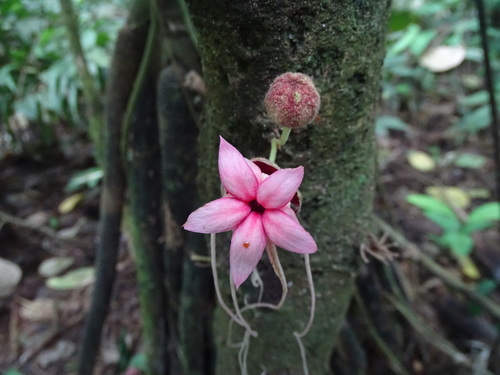
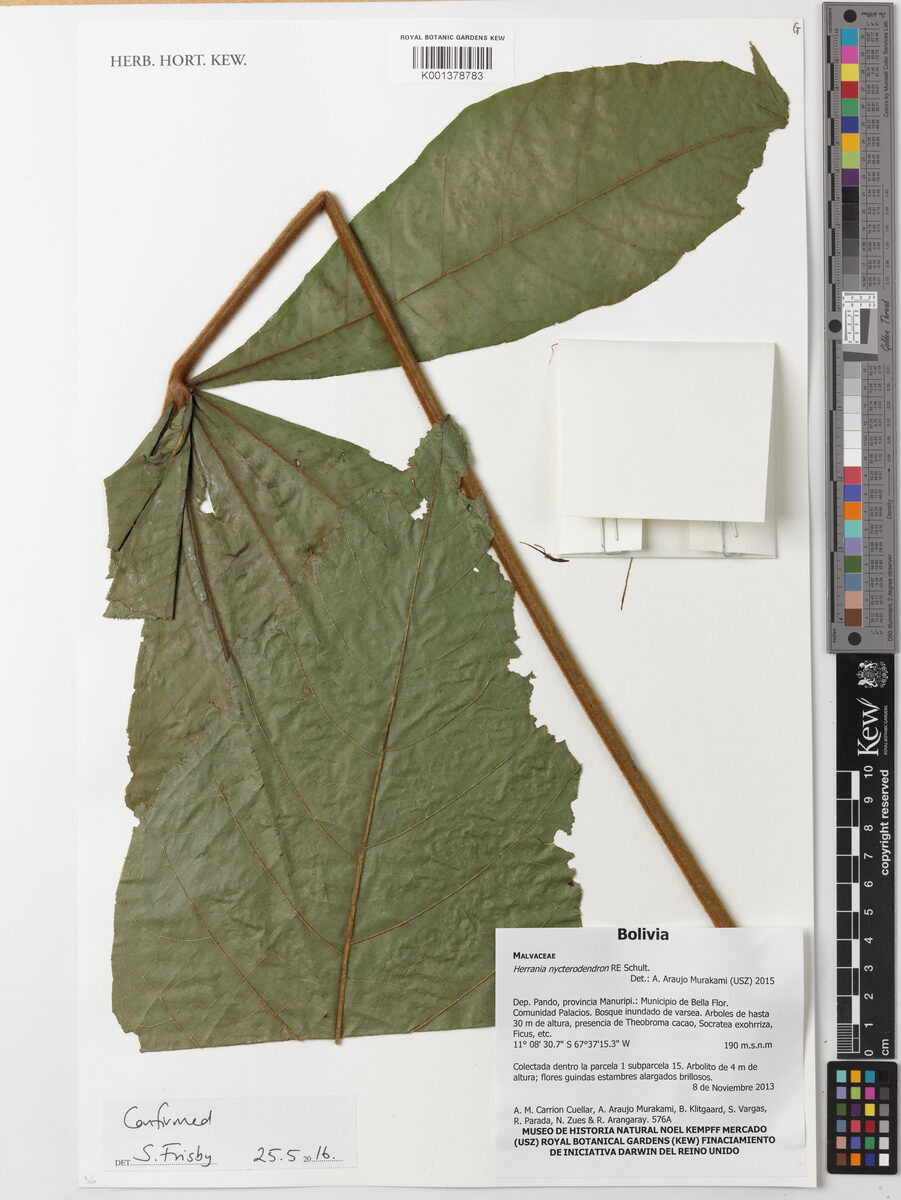
Cavanillesia platanifolia
(Humb. & Bonpl.) Kunth
Cuipo
iNaturalist· cc-by-nc-sa
(c) Mateo Hernandez Schmidt, some rights reserved (CC BY-NC-SA), uploaded by Mateo Hernandez Schmidt
iNaturalist· cc-by-nc
(c) Riley Fortier, some rights reserved (CC BY-NC), uploaded by Riley Fortier
iNaturalist· cc-by-nc
(c) Carlos Rangel, some rights reserved (CC BY-NC), uploaded by Carlos Rangel
Summary
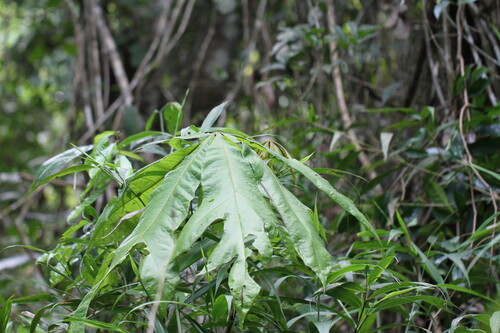
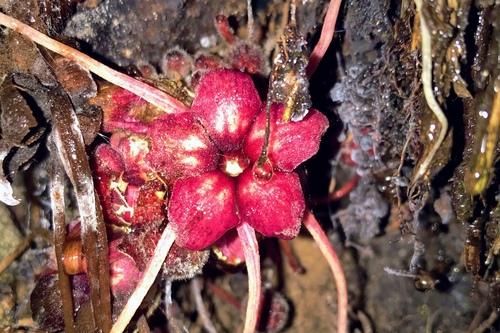
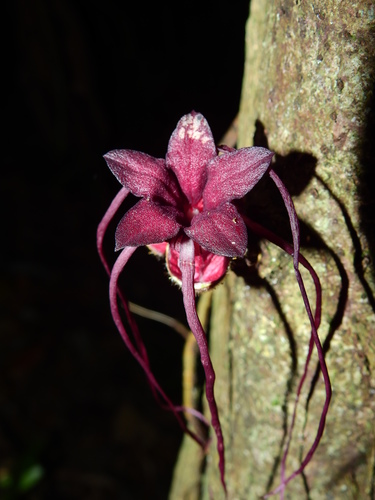
Source: WikipediaCavanillesia platanifolia, known as pijio, bongo, pretino, petrino, cuipo, hameli or hamelí in Spanish or macondo, is a flowering plant species in the family Malvaceae. It grows in lowland rainforests in Nicaragua, Costa Rica, Panama, Colombia, Ecuador, and Peru. The tree grows to 45–60 metres (148–197 feet) in height, with leaves only near the top for one month a year. Its reddish-gray bark has characteristic rings along the entire trunk. The roots are orangish-brown. A root fragment can be cut off and cleaned (while kept horizontal) then tipped to pour water, which has a taste of potatoes. Rope can be made from the inner bark of branches and saplings. The wood, along with balsa, is extremely soft, one of the softest according to the Janka hardness test, and may have commercial applications.
Description
A tall tropical tree reaching 50 m in height, belonging to the mallow family. It is found in tropical regions.
This description is brief — help expand it
Edible Uses
Seeds are eaten. Water can be obtained from the roots.
Traditional Uses
The seeds are eaten. The root has potable water.
This uses section is brief — help expand it
Medicinal Uses
The oil from the seed is used medicinally.
Distribution
It is a tropical plant.
Where It Grows
Asia, Brazil, Central America, Colombia, Costa Rica, Ecuador, Nicaragua, Panama, Peru, South America*, Sri Lanka,
Cultivation
Prefers a humid, well-drained soil and a position in full sun. Established plants are very drought tolerant.
Other Uses
The inner bark yields a fibre much resembling Cuba bast (Hibiscus elatus). It bleaches readily and makes a strong, white, opaque paper. The white or yellowish wood is coarse, soft, and pith-like. It is extremely light. No commercial use is made of it, although it has been suggested as a substitute for balsa {Ochroma). The trunks are traditionally used by local people to make dug-out canoes, and also for floating rafts of hardwood logs.
Production
It is fast growing.
Notes
In the subfamily Bombacoideae.
Synonyms
Also Known As
Bonga, Bongo, Bruya, Ceiba bonga, Ceiba guipa, Cuipo, Guipo, Hamat, Malambo, Macondo, Pigio, Pijio, Pretino, Quipo
References (5)
- Grandtner, M. M. & Chevrette, J., 2013, Dictionary of Trees, Volume 2: South America: Nomenclature, Taxonomy and Ecology. Academic Press p 110
- Kermath, B. M., et al, 2014, Food Plants in the Americas: A survey of the domesticated, cultivated and wild plants used for Human food in North, Central and South America and the Caribbean. On line draft. p 198
- Kew Plants of the World Online
- Roa, J. A. G. & Boada, D. S. G., 2018, Fundación para el Fortalecimiento de la Fruticultura y Plantas Alimenticias no Convencionales en Colombia.
- Torre, de la L., et al, 2008, Enciclopedia de las Plantas Útiles del Ecuador. Herbario QCA. Pontificia Universidad Católica del Ecuador. p 248