Gambeya lacourtiana
(De Wild.) Aubr. et Pellegr.
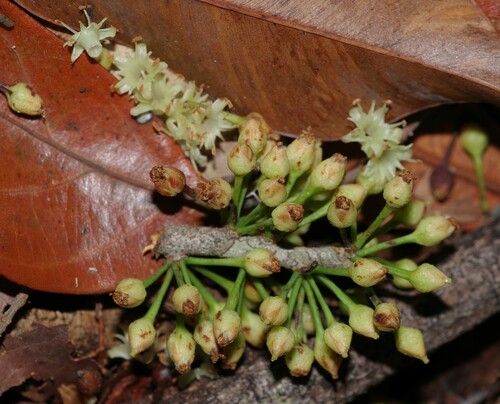
iNaturalist· cc-by-nc
(c) Gwili Gibbon, some rights reserved (CC BY-NC)
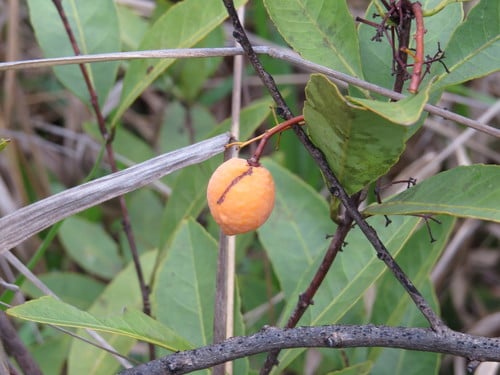
iNaturalist· cc-by-nc
(c) Carel Jongkind, some rights reserved (CC BY-NC)
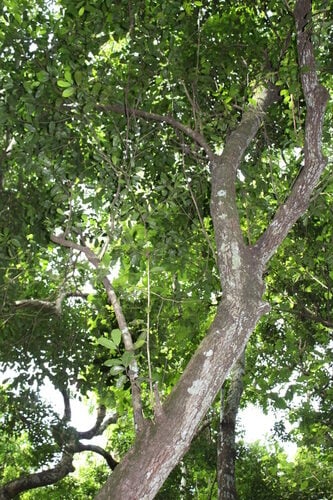
iNaturalist· cc-by-nc
(c) Carel Jongkind, some rights reserved (CC BY-NC)
Description
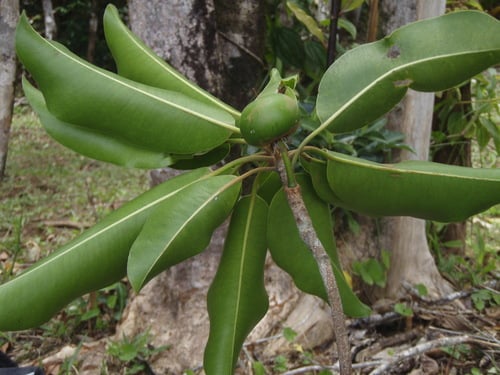
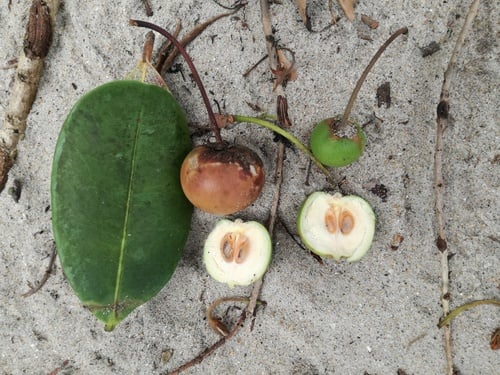
A tree. It grows 30 m high. The trunk is 90 cm across. The leaves are oblong and pointed. They are 11-36 cm long by 4.5-12.5 cm wide. They taper to the base. The leaf stalks are 2-3 cm long. The fruit are apple shaped and dark red to light orange. They are 10 cm long by 7 cm wide.
Edible Uses
The fruit pulp is eaten by poking a hole in the end and sucking out the contents. After consuming this fruit, other foods eaten subsequently taste sweeter.
Traditional Uses
The fruit are eaten by poking a hole in the end and sucking the pulp out. After eating this fruit others things eaten taste sweet.
This uses section is brief — help expand it
Distribution
A tropical plant. It grows in tropical Africa in forests.
Where It Grows
Africa, Cameroon, Central Africa, Central African Republic, CAR, Congo DR, Congo R, Gabon, Sierra Leone, West Africa,
Production
Fruiting is seasonal. In Central African Republic flowers have been recorded in October and fruit in December. In Congo fruit are available March to April.
Other Information
It is sold in local markets.
Notes
There are about 80-150 Chrysophyllum species. They are mostly in tropical America. There are 44 species in tropical America.
Synonyms
Also Known As
Abam, Bambambo, Bambu, Bolinda, Edinda, Idinda, Kilofe, Lilinda, Mamba, Mbele, Mbelese, Mubamfu, Mukulumu, Obom, Ohambu, Ohamu, Olinda, Onda, Sosi
References (17)
- Facciola, S., 1998, Cornucopia 2: a Source Book of Edible Plants. Kampong Publications, p 227 (As Chrysophyllum lacourtiana)
- Ferns, Useful Tropical Plants (As Chrysophyllum lacourtiana)
- Gallois, S., et al, 2020, Methodological priorities in assessing wild edible plant knowledge and use – a case study among the Baka in Cameroon. (As Chrysophyllum lacourtiana)
- http://aflora.africa.kyoto-u.ac.jp (As Chrysophyllum lacourtiana)
- Iponga, D. M., et al, 2016, The contribution of NTFP-gathering to rural people’s livelihoods around two timber concessions in Gabon. Agroforest Syst. Springer
Show all 17 references Hide references
- Jardin, C., 1970, List of Foods Used In Africa, FAO Nutrition Information Document Series No 2.p 127 (As Chrysophyllum lacourtiana)
- Latham, P., 2004, Useful Plants of Bas-Congo province. Salvation Army & DFID p 134 (As Gambeya lacourtiana)
- Liengola, I. B., 2001, A contribution to the study of native edible plants by the Turumbu and Lokele of the Tshopo District, Province Orientale, D. R. Congo. Syst. Geogr. Pl. 71:687-698 (As Chrysophyllum lacourtiana)
- Mosango, M., Szafranski, F., 1985, Plantes sauvages à fruits comestibles dans les environs de Kisangani (Zaïre). In: Journal d'agriculture traditionnelle et de botanique appliquée, 32e année, pp. 177-190 (As Gambeya lacourtiana)
- Moutsambote, J., 1996, Vegetation forestiere et plantes alimentaires de la region de la Sangha. Chp. 11 of Bien Manger et Bien Vivre. ORSTOM p 119 (As Gambeya lacourtiana)
- Nkeoua, G. & Boundzanga, G. C., 1999, Donnees sur les produits forestieres non ligneux en Republique du Congo. FAO. p 27 (As Gambeya lacourtiana)
- Terashima, H., & Ichikawa, M., 2003, A comparative ethnobotany of the Mbuti and Efe hunter-gatherers in the Ituri Forest, Democratic Republic of Congo. African Study Monographs, 24 (1, 2): 1-168, March 2003 (As Gambeya lacourtiana)
- Termote, C., et al, 2011, Eating from the wild: Turumbu, Mbole and Bali traditional knowledge of non-cultivated edible plants, District Tshopo, DRCongo, Gen Resourc Crop Evol. 58:585-618 (As Chrysophyllum lacourtiana)
- Termote, C., et al, 2012, Wild Edible Plant Markets in Kisangani, Democratic Republic of Congo. Human Ecology 40:269-285 (As Chrysophyllum lacourtiana)
- Vivien, J. & Faure, J.J., 1985, Abres des forets dense d'Afrique Centrale. Agence de Cooperation Culturelle et Technique. Paris. p 424 (As Gambeya lacourtiana)
- Vivien, J., & Faure, J.J., 1996, Fruitiers Sauvages d'Afrique. Especes du Cameroun. CTA p 319 (As Gambeya lacourtiana)
- World Checklist of Useful Plant Species 2020. Royal Botanic Gardens, Kew (As Gambeya lacourtiana)