Biancaea sappan
(L.) Tod.
Rainbow wood, Sappanwood tree, Indian redwood
iNaturalist· cc-by-sa
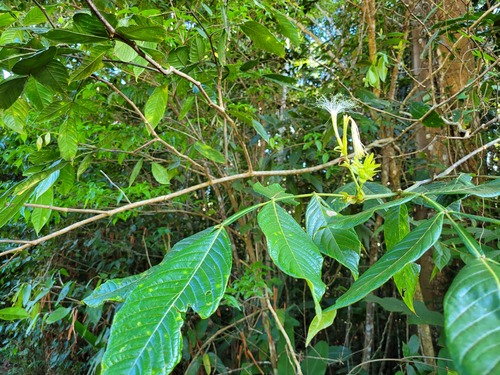
(c) Abu Hamas, some rights reserved (CC BY-SA), uploaded by Abu Hamas
iNaturalist· cc-by-sa
(c) Abu Hamas, some rights reserved (CC BY-SA), uploaded by Abu Hamas
iNaturalist· cc-by-nc
(c) Naufal Urfi Dhiya'ulhaq, some rights reserved (CC BY-NC)
Summary
Source: WikipediaBiancaea sappan is a species of flowering tree in the legume family, Fabaceae, that is native to tropical Asia. Common names in English include sappanwood and Indian redwood. It was previously ascribed to the genus Caesalpinia. Sappanwood is related to brazilwood (Paubrasilia echinata), and was itself called brasilwood in the Middle Ages. Biancaea sappan can be infected by twig dieback (Lasiodiplodia theobromae). This plant has many uses. It has antibacterial and anticoagulant properties. It also produces a valuable reddish dye called brazilin, used for dyeing fabric as well as making red paints and inks. Slivers of heartwood are used for making herbal drinking water in various regions, such as Kerala, Karnataka and Central Java, where it is usually mixed with ginger, cinnamon, and cloves. The heartwood also contains juglone (5-hydroxy-1,4-naphthoquinone), which has antimicrobial activity. Homoisoflavonoids (sappanol, episappanol, 3'-deoxysappanol, 3'-O-methylsappanol, 3'-O-methylepisappanol and sappanone A) can also be found in B. sappan. The wood is somewhat lighter in color than brazilwood and other related trees. Sappanwood was a major trade good during the 17th century, when it was exported from Southeast Asian nations (especially Thailand) aboard red seal ships to Japan.
Description
A shrub or small tree. It grows 6-10 m tall. The trunk is 14 cm across. It has ridges and prickles. Young plant parts are hairy. The leaves are 30-45 cm long. There are 7-13 pairs of pinnae that are 8-12 cm long and these have 10-17 pairs of leaflets. These are 1-2 cm long by 5-7 mm papery. The pods are reddish brown and 7 cm long by 4 cm wide. There are 3 or 4 seeds.
Edible Uses
A few drops of wood extract in drinking water is considered refreshing, due to the fragrance and colour it imparts. The dye obtained from the wood is sometimes used to colour food.
Traditional Uses
The dye from the wood is used as a food colouring.
This uses section is brief — help expand it
Medicinal Uses
Sappanwood is used in the traditional medicines of various Asiatic countries. Modern research has identified various medically active compounds in the plant, particularly brazilin, which is found in the heartwood. Brazilin has been shown to have a positive effect on the immune functions; plus a hypoglycaemic action and increased glucose metabolism. A decoction of the wood has shown antibiotic activity against Staphylococcus, Salmonella typhi, Shigella flexneri, Shigella dysenteriae and Bacillus subtilis. An extract of Caesalpinia sappan was found to be a potent agent for inactivating human sperm in vitro; about 2.5 mg/ml is required to reduce motility to 50%. The heartwood is considered to be antibacterial, antiinflammatory, antioxidant, strongly astringent, demulcent, strongly emmenagogue, haemostatic, hepatoprotective and hypoglycaemic. It is used in the treatment of bacillary dysentery, diarrhoea, tuberculosis, intestinal and uterine haemorrhages, post-partum haematometra, contusions, wounds, dysmenorrhoea, colic, furunculosis, impetigo, leucorrhoea and parturient's anaemia. It is administered in a dose of 6 to l2g per day as a decoction, liquid extract or pills. The concentrated decoction is used externally as a wash to treat wounds etc. The macerated leaves and bark are used as a poultice in the treatment of wounds, impetigo etc. The seeds serve as a sedative.
Distribution
It is a tropical plant. It grows in hill areas with clay soil and limestone rocks. It grows at low to medium altitude. In Sichuan and Yunnan.
Where It Grows
Asia, Brazil, Cambodia, China, East Timor, India, Indochina, Indonesia, Laos, Malaysia, Maldives, Myanmar, North America, SE Asia, Sri Lanka, Thailand, Timor-Leste, USA, Vietnam,
Cultivation
Plants can be grown by seed.
Propagation
Seed - pre-soak for 12 - 24 hours in warm water prior to sowing. The seed usually germinates within a few days. When large enough to handle, prick the seedlings out into individual pots and grow them on until large enough to plant out. Softwood cuttings in sand in a frame.
Other Uses
A red dye is obtained from the wood[. Silk, wool, cotton, matting and basket fibres can be dyed with it. The wood is ground into a coarse powder, moistened with water and allowed to ferment for a few weeks to increase the colouring power of the dye. It is then boiled in water and the liquid can either be used immediately or evaporated and stored as a dry soluble extract for future use. The mordants used (e.g. aluminium acetate, stannic salts, oxalic acid) determine the final colour of the cloth, which can vary from shades of red to pink, violet and brown. A yellow dye is obtained from the bark. The fruits contain tannin and were used in the past to prepare a black dye in combination with an iron mordant. The seedpods are used, like those of several other related species, together with protosulphate of iron, to make an ink or black dye. The leaves can be used to hasten ripening of fruits such as bananas and mangoes. A gum is obtained from the stem. The leaves contain a pleasant smelling volatile oil. The wood is straight grained with a fine to moderately fine texture, fairly heavy, hard and lustrous. It is difficult to dry and is susceptible to warping and collapse, but moderately easy to work; it takes a high finish, and is tough and resistant to termite attack. It has been used in cabinet-making since mediaeval times, especially for inlay decoration. It is often used for carving. The wood is also is a good source of firewood. The tree is often planted as a living fence. Owing to its easy growth and dense growth habit, it is used for defining the boundaries of land and for protecting plantations against grazing animals.
Notes
Also as Caesalpinaceae.
Synonyms
Also Known As
Beys fathangu, Fang deng, Fang pa, Maikpan, Pohon secang, Pohon soga jawa, Sunthe, Teinnyet, Tomoc, Vang, Vang nhuom
References (7)
- Selvam, V., 2007, Trees and shrubs of the Maldives. RAP Publication No. 2007/12 p 46 (As Caesalpinia sappan)
- Sujanapal, P., & Sankaran, K. V., 2016, Common Plants of Maldives. FAO & Kerala FRI, p 65 (As Caesalpinia sappan)
- Sukarya, D. G., (Ed.) 2013, 3,500 Plant Species of the Botanic Gardens of Indonesia. LIPI p 169 (As Caesalpinia sappan)
- Sukenti, K., et al, 2016, Ethnobotanical study on local cuisine of the Sasak tribe in Lombok Island, Indonesia. Journal of Ethnic Foods. 3 (2016) 189-200 p 198 (As Caesalpinia sappan)
- Sutjaritjai, N., et al, 2019, Traditional Uses of Leguminosae among the Karen in Thailand. Plants 2019, 8, 600 p 5 (As Biancaea sappan)
Show all 7 references Hide references
- Van Sam, H. et al, 2008, Uses and Conservation of Plant Species in a National Park. A case study of Ben En, Vietnam. Economic Botany 62:574-593 (As Caesalpinia sappan)
- Wiersema, J. H. & Leon, B., 2013, World Economic Plants. A Standard Reference CRC Press. 2nd Ed. p 126 (As Caesalpinia sappan)