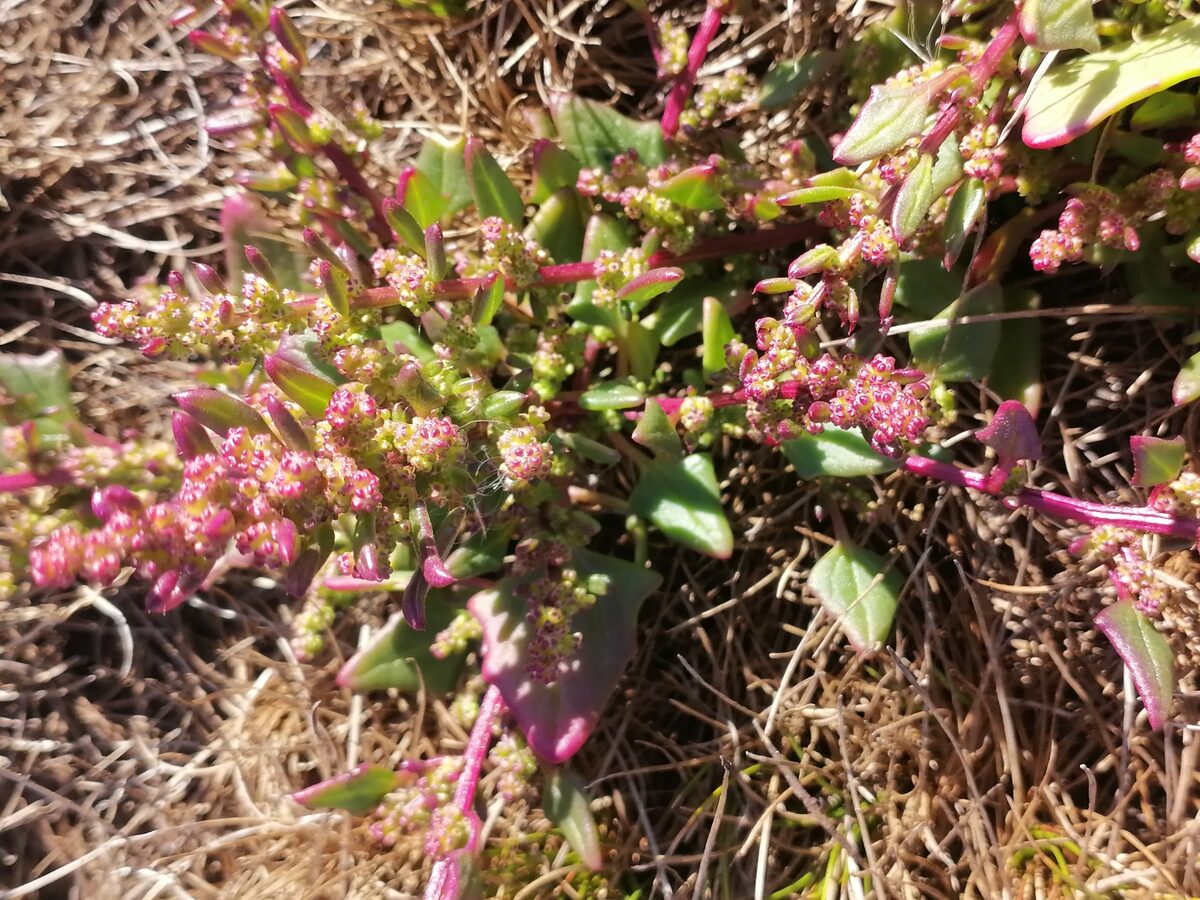
Chenopodium berlandieri
Miq.
Berlandier’s lamb’s quarters
iNaturalist· cc-by-sa
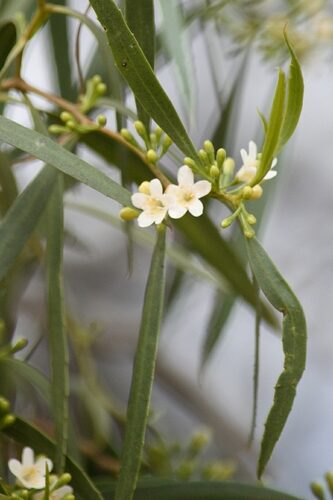
(c) Matt Lavin, some rights reserved (CC BY-SA)
iNaturalist· cc-by-nc-sa
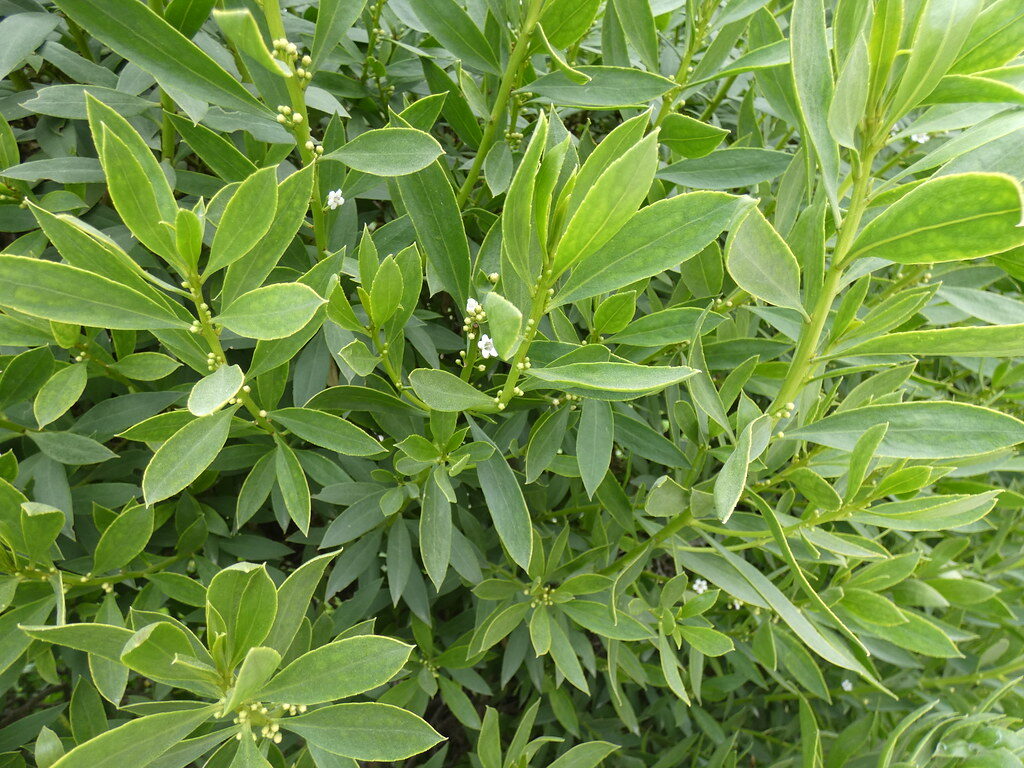
(c) 2005 Brent Miller, some rights reserved (CC BY-NC-SA)
iNaturalist· cc-by-nc-sa
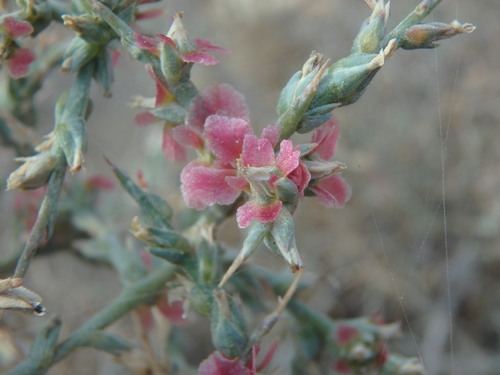
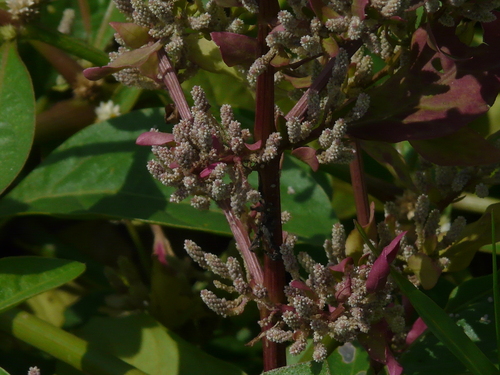
(c) 2008 Keir Morse, some rights reserved (CC BY-NC-SA)
Summary
Source: WikipediaChenopodium berlandieri, also known by the common names pitseed goosefoot, lamb's quarters (or lambsquarters), and huauzontle (Nahuatl), is an annual herbaceous plant in the family Amaranthaceae. The species is widespread in North America, where its range extends from Canada south to Michoacán, Mexico. It is found in every U.S. state except Hawaii. The fast-growing, upright plant can reach heights of more than 3 m. It can be differentiated from most of the other members of its large genus by its honeycomb-pitted seeds, and further separated by its serrated, evenly lobed (more or less) lower leaves. Although widely regarded as a weed, this species was once one of several plants cultivated by Native Americans in prehistoric North America as part of the Eastern Agricultural Complex. C. berlandieri was a domesticated pseudocereal crop, similar to the closely related quinoa C. quinoa. It continues to be cultivated in Mexico as a pseudocereal, as a leaf vegetable, and for its broccoli-like flowering shoots.
Description
A herb. It is upright and can be 3 m tall. The leaves have teeth along the edge and the lower leaves have lobed. The seeds have a honey comb pitted surface. There are some named cultivated varieties.
Edible Uses
A premier wild pseudo-grain: delicious, abundant, nutritious, and culturally significant. Seeds are outstanding when toasted or boiled. Leaves are mild and spinach-like when cooked. A core forager’s resource wherever found. Edible Uses & Rating: Both leaves and seeds are edible, but the seeds are the star resource. Pitseed goosefoot ranks among the top-tier wild foods of North America: high nutritional density, abundant yield, reliable production, and cultural importance. The seeds are excellent for porridge, bread, seed cakes, flatbreads, and flour blends. Leaves are mild, spinach-like, and suitable raw or cooked, though they contain saponins and oxalates (normal for the genus) and should ideally be boiled. As a wild edible, pitseed goosefoot earns the highest rating among Chenopodium species and stands alongside acorns, mesquite, and pinyon pine as one of the historically significant staple crops of the continent. Taste, Processing & Kitchen Notes: Leaves: Fresh leaves lack the pondy, fishy, or musty aromatic notes common in many goosefoots. They taste like spinach with a lightly salty undertone. Texture is soft but slightly firmer than spinach. They serve well raw or cooked and are excellent mixed with other greens. Boiling removes harshness and improves digestibility. Seeds: Flavor is remarkable—deep, nutty, clean, and nearly identical to quinoa when toasted or boiled. Toasting destroys musty volatiles and produces a fragrant, slightly sweet aroma. Seeds pop lightly when heated and should be toasted with a lid. Boiling yields a soft porridge with a subtle sweetness; combining toasting and boiling creates the finest result. Processing: Seeds separate readily from the drying inflorescences, which become brittle in autumn. A simple rubbing or winnowing step removes chaff. Unlike many wild seeds, pitseed goosefoot’s calyxes detach easily and leave minimal debris. Raw seeds can be too firm for chewing but soften perfectly when cooked. Seasonality (Phenology): Plants emerge in spring and produce abundant leaves through early summer. Flowering begins mid-summer, with heavy seed production from late summer into autumn (typically August–October depending on elevation and moisture). Seeds persist on the plant even after frost, allowing flexible harvest timing. Leaves remain usable until flowering but become less tender as seed production begins. Safety & Cautions (Food Use): Typical of Chenopodium species, leaves contain saponins and oxalates, which can irritate sensitive individuals when consumed raw in large amounts. Boiling reduces these components. Seeds are generally safe and nutritious but should be cooked to improve digestibility and reduce any residual saponins. Avoid confusing pitseed goosefoot with strong-scented Dysphania species, which may contain neurotoxic ascaridole. Harvest & Processing Workflow: Harvest seeds when the upper stems dry and the fruits turn tan, reddish, or nearly black. Rub seedheads between hands or strip them into a container. Winnow to remove light chaff. For flour, lightly toast, then grind. For porridge, boil directly without grinding. Leaves are harvested young in spring or early summer; wash well to remove dust and silt from mealy coatings. Cultivar / Selection Notes: Archaeological evidence suggests that Indigenous peoples selected for larger seed size and reduced seedcoat thickness, similar to quinoa domestication. Modern foragers may notice variability in seed color, leaf shape, and plant vigor—reflecting its partially domesticated status. No formal modern cultivars exist, but traditional landraces survive in Mexico under the name: huauzontle. Look-Alikes & Confusion Risks: Resembles lambsquarter (C. album) and Fremont’s goosefoot (C. fremontii). Lambsquarter often has more triangular leaves with a whitish mealy bloom; Fremont’s goosefoot tends to have more acrid leaves. Pitseed goosefoot is mild and pleasant. Confusion with Dysphania species (e.g., epazote, oakleaf goosefoot, fetid goosefoot) is dangerous: these have sticky, resinous, strong-smelling leaves and should be avoided as food. The absence of a strong odor is a key identifying feature. Traditional / Indigenous Use Summary: Pitseed goosefoot was a foundational food crop for numerous Indigenous cultures including the Hopi, Navajo, Pueblo peoples, and especially for ancient Eastern Woodlands societies. Seeds were parched, ground, boiled into porridge, baked into cakes, mixed with cornmeal, or stored long-term in granaries. Archaeological remains show intentional selection and cultivation. Leaves were also eaten as greens, though they held lesser importance. The species is one of North America’s earliest domesticated pseudo-grains and remains an underappreciated wild staple. Leaves and young shoots - raw or cooked like spinach. The raw leaves should only be eaten in small quantities, see the notes above on toxicity. Seed - ground into a powder and used with cereal flours for making bread or gruel. The seed should be soaked in water overnight and thoroughly rinsed before it is used in order to remove any saponins.
Traditional Uses
The leaves are eaten. They are fried in butter with onion. Young leaves can be used in salads. The seed heads are eaten. The seeds are used for meal for bread or porridge.
Medicinal Uses
None known.
Known Hazards
Chenopodium berlandieri has little presence in the current world food system, especially compared to other plants within its genus, such as Chenopodium quinoa or C. ambrosioides. This may be due to a recent Western bias against weedy plants, as well as a manifestation of colonial history which led to a disconnect from the local environment and indigenous knowledge. Today, the plant is still used as an edible herb and vegetable, primarily in Mexico. Edible parts of the plant include leaves, young shoots and seeds. Like other leafy greens, the leaves and shoots are eaten raw or cooked, though raw leaves are bitter as they contain chemical compounds produced by the plant for defense mechanisms. The plant can be processed through mechanical and chemical techniques. Mechanical processing techniques include winnowing to remove non-nutritive components, including possibly toasting the seeds during the winnowing process, followed by milling to de-husk the plant and separate the seeds. The seeds can then be ground down into smaller particles to make grits or bulgur, or ground further into flours to be combined with cereal flours to make breads or pancakes. The seeds contain saponins, though in small quantities, which are removed by soaking seeds in water overnight and rinsing thoroughly before further processing. Another method involves chemical processing, whereby gradual, controlled heating of the seeds detoxifies them, allowing nutrients to be bioavailable for digestion. People with gout, arthritis, rheumatism, kidney stones, or hyperacidity should use caution when consuming the plant, as it may aggravate their condition.
Distribution
It is a temperate and subtropicalplant. Temperatures need to be above 10°C. It needs full sunlight and good soil.
Where It Grows
Alaska, Canada, Central America, Mexico, North America, USA,
Cultivation
Growing Conditions: Pitseed goosefoot thrives in disturbed soils—riverbanks, old fields, gardens, roadsides, and floodplains. It tolerates alkalinity, salinity, drought, and nutrient-poor sites but reaches maximum seed production in loamy, moderately fertile soils. Full sun promotes high yield, but plants will tolerate partial shade. Irrigation increases vigor but is not required. It is extremely drought-resilient once established. Habitat & Range: Native throughout much of North America, pitseed goosefoot occurs from the Midwest to the Southwest, from low deserts to montane valleys. In the Southwest, it appears in agricultural edges, washes, alluvial fans, canyon bottoms, and disturbed rangelands. It does not require moist soils and is often most abundant after monsoon rains or post-disturbance events such as flooding or soil turnover. Size & Landscape Performance: Under average conditions plants reach 50–100 cm; in rich soil, they may exceed 150 cm. Architecture varies from narrow, broom-like forms to bushy plants depending on nutrient availability. In a garden context, pitseed goosefoot behaves like a productive annual “pseudo-grain.” It is not invasive in the ecological sense, but it self-seeds prolifically. Cultivation (Horticulture): Garden cultivation of pitseed goosefoot mirrors that of quinoa. A single plant can produce thousands of seeds. Direct sowing is preferred; seeds germinate readily without stratification. Minimal care is needed once seedlings establish. Harvest occurs when seedheads dry and turn darker. Because of its historical domestication, the species responds well to selective breeding, making it a candidate for small-scale regenerative grain systems. Pests & Problems: The species is generally trouble-free. Occasional aphids may appear but seldom impact seed yield. Overwatering may cause root rot, though the plant remains highly tolerant of drought and heat. Powdery mildew can appear late in the season in humid pockets but rarely affects seed production. Cultivar / Selection Notes: Archaeological evidence suggests that Indigenous peoples selected for larger seed size and reduced seedcoat thickness, similar to quinoa domestication. Modern foragers may notice variability in seed color, leaf shape, and plant vigor—reflecting its partially domesticated status. No formal modern cultivars exist, but traditional landraces survive in Mexico under the name: huauzontle. Pollination: Flowers lack petals and rely primarily on wind pollination, though small insects occasionally visit. High seed set is typical even in isolated stands. Identification & Habit: Pitseed goosefoot grows as an upright annual with angled or ridged stems that may be green, reddish, or purple depending on soil conditions and light exposure. Plants frequently reach 1 meter in height, sometimes more in rich soils. Leaves are alternate, variable in shape, typically rhombic to triangular-ovate, shallowly toothed or lobed, and often covered with a mealy or powdery coating—especially on younger foliage. This coating helps reduce water loss and is typical of many goosefoots. The inflorescences are dense, granular, greenish clusters forming terminal spikes or branched panicles. Each tiny flower contains no petals and is enclosed by five sepals that later remain around the seed. By late summer through autumn, the upper stems become masses of ripening seeds, often forming reddish-brown or black-hued bands. Plants thrive in disturbed soils, field margins, washes, vacant lots, and agricultural edge habitats.
Propagation
Propagation is by seed only. Seeds germinate readily in warm soils without stratification. Natural recruitment occurs after disturbance, and seed banks can persist in soil for years. To propagate intentionally, scatter seeds on loosened soil and cover lightly.
Other Uses
Gold and green dyes can be obtained from the whole plant.
Production
It grows rapidly.
Other Information
It is sold in local markets.
Notes
There are about 100-150-250 Chenopodium species. They are mostly in temperate regions. Also put in the family Chenopodiaceae.
Nutrition
| Part | Moisture | kJ | kcal | Protein | Vit A | Vit C | Iron | Zinc |
|---|---|---|---|---|---|---|---|---|
| Leaves - dry | 4 | — | — | 24.6 | — | — | — | — |
Synonyms
Also Known As
Bledo extranjero, Huauzontli, Pitseed goosefoot, Quelite cenizo, Quelite de manteca, Southern huauzontle, Xual
References (25)
- Altschul, S.V.R., 1973, Drugs and Foods from Little-known Plants. Notes in Harvard University Herbaria. Harvard Univ. Press. Massachusetts. no. 870
- Amer. J. Bot. 66:205. 1979 (As Chenopodium berlandieri subsp. nuttalliae)
- Arellanes, Y., et al, 2013, Influence of traditional markets on plant management in the Tehuacan Valley. Journal of Ethnobiology and Ethnomedicine 9:38
- Caballero, J. N., & Mapes, C. S., 1985, Gathering and Subsistence Patterns among the P'urhepecha Indians of Mexico. J. Ethnol. 5(1): 31-47
- Camou-Guerrero, A., et al, 2008, Knowledge and use Value of Plant Species in a Raramuri Community: A Gender Perspective for Conservation. Human Ecology, 36:259-272
Show all 25 references Hide references
- Casas, A., et al, 1996, Plant Management Among the Nahua and the Mixtec in the Balsas River Basin, Mexico: An Ethnobotanical Approach to the Study of Plant Domestication. Human Ecology, Vol. 24, No. 4 pp. 455-478
- Chenop. monogr. enum. 23. 1840
- Elias, T.S. & Dykeman P.A., 1990, Edible Wild Plants. A North American Field guide. Sterling, New York p 75
- Facciola, S., 1998, Cornucopia 2: a Source Book of Edible Plants. Kampong Publications, p 76
- Farfan, B., et al, 2007, Mazahua Ethnobotany and Subsistence in the Monarch Butterfly Biosphere Reserve, Mexico. Economic Botany 61(2) 2007, pp 173-191
- Hermandez Bermejo, J.E., and Leon, J. (Eds.), 1994, Neglected Crops. 1492 from a different perspective. FAO Plant Production and Protection Series No 26. FAO, Rome. p 18 (As Chenopodium berlandieri subsp. nuttalliae)
- Kiple, K.F. & Ornelas, K.C., (eds), 2000, The Cambridge World History of Food. CUP p 1841 (As Chenopodium
- Farfan, B., et al, 2007, Mazahua Ethnobotany and Subsistence in the Monarch Butterfly Biosphere Reserve, Mexico. Economic Botany 61(2) 2007, pp 173-191 (berlandieri subsp. nuttalliae)
- Manzanero-Medina, G. I., et al, 2020, Ethnobotany of food plants (quelites) sold in two traditional markets of Oaxaca, Mexico. South African Journal of Botany. 130 (2020) 215-223 (As Chenopodium berlandieri subsp. nuttalliae)
- Mapes, C. & Basurto, F., 2016, Biodiversity and Edible Plants of Mexico. Chapter 5 in R. Lira, et al. (eds.), Ethnobotany of Mexico, Ethnobiology, Springer. p 111
- Martin, F.W. & Ruberte, R.M., 1979, Edible Leaves of the Tropics. Antillian College Press, Mayaguez, Puerto Rico. p 182
- Piedra-Malagón, E. M. et al, 2022, Edible native plants of the Gulf of Mexico Province. Biodiversity Data Journal 10: e80565 p 8
- Plants for a Future database, The Field, Penpol, Lostwithiel, Cornwall, PL22 0NG, UK. http://www.scs.leeds.ac.uk/pfaf/ (Also as Chenopodium berlandieri subsp. nuttalliae)
- Rangel-Landa, S., et al, 2017, Sociocultural and ecological factors influencing management of edible and non-edible plants: the case of Ixcatlan, Mexico. Journal of Ethnobiology and Ethnomedicine. 13:59
- Smith, N., Mori, S.A., et al, 2004, Flowering Plants of the Neotropics. Princeton. p 98 (As Chenopodium berlandieri subsp. nuttalliae)
- Tozer, F., 2007, The Uses of Wild Plants. Green Man Publishing. p 65
- USDA, ARS, National Genetic Resources Program. Germplasm Resources Information Network - (GRIN). [Online Database] National Germplasm Resources Laboratory, Beltsville, Maryland. Available: www.ars-grin.gov/cgi-bin/npgs/html/econ.pl (10 April 2000) (As Chenopodium berlandieri subsp. nuttalliae)
- van Wyk, B., 2005, Food Plants of the World. An illustrated guide. Timber press. p 129, 130 (As Chenopodium berlandieri subsp. nuttalliae)
- Vieyra-Odilon, L and Vibrans, H., 2001, Weeds as Crops: The Value of Maize Field Weeds in the Valley of Toluca, Mexico. Economic Botany 55(3):426-443
- Wiersema, J. H. & Leon, B., 2013, World Economic Plants. A Standard Reference CRC Press. 2nd Ed. p 168