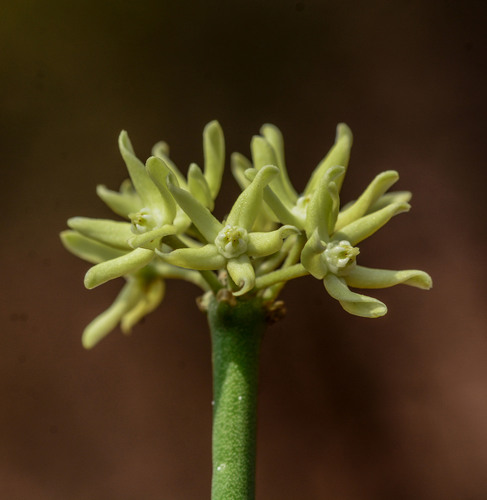
Ceropegia bulbosa
Roxb
Bulbous ceropegia
iNaturalist· cc0
no rights reserved, uploaded by S.MORE
iNaturalist· cc-by-nc
(c) swanand kesari, some rights reserved (CC BY-NC)
iNaturalist· cc-by-nc
(c) swanand kesari, some rights reserved (CC BY-NC)
Description
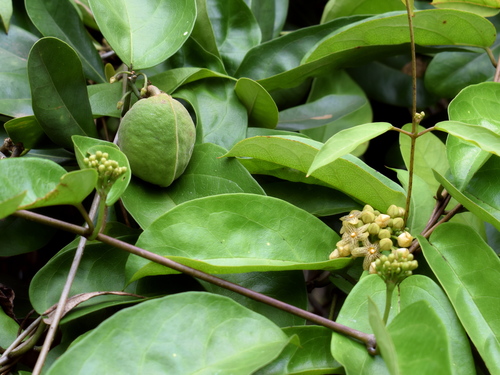
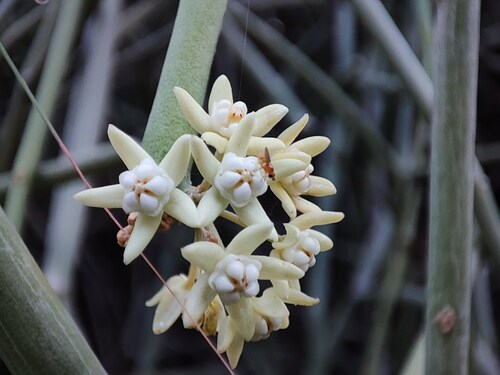
A woody twiner or climber. The tuber is round. It is 7-8 cm long by 3-4 cm wide. The leaves are oval or narrow. They are 3-6 cm long and slightly heart shaped. They are fleshy. The fruit are dry and 10 cm long by 0.5 cm wide. The seeds are 8-9 mm long.
Edible Uses
The tubers can be eaten raw or boiled in water to remove bitterness. The leaves are eaten raw or stewed in curries where they provide a slightly sour flavor. Young leaves and stems are also prepared in curries.
Traditional Uses
The roots are eaten after boiling in water. Otherwise they are bitter. The tubers and leaves are also eaten raw. The young leaves and stems are eaten stewed in curries. They are slightly sour.
Medicinal Uses
The tubers are considered to be digestive and tonic. An alkaloid, ceropegine, is present in the tubers which makes them bitter, somewhat like raw turnips.
Distribution
A tropical plant. It grows near Mumbai. It grows naturally on well drained rocky soils on slopes. It grows in humid areas.
Where It Grows
Africa, Asia, Cameroon, Central Africa, Congo, Ethiopia, India, Middle East, Oman, Pakistan, Saudi Arabia, Yemen,
Cultivation
Plants are grown from seed. It can be grown from cuttings.
Production
Tubers 2-3 cm across are ready after 2 years.
Notes
There are about 150 Ceropegia species.
Synonyms
Also Known As
Alat-khalah, Dadmudale, Dúdha malida kand, Galot, Galya, Hallike, Hedulo, Kendua, Khapparkadu, Kharpudi, Khartundi, Malode, Palatige, Patala tumbari, Roob, Sap okoni, Suparikanda, Thiyamanda
References (28)
- Al-Fatimi, M. A., Wild Edible Plants Traditionally Collected and Used in Southern Yemen. Research Square. University of Aden. p 16
- Ambasta S.P. (Ed.), 2000, The Useful Plants of India. CSIR India. p 117
- Arora, R. K., 2014, Diversity in Underutilized Plant Species - An Asia-Pacific Perspective. Bioversity International. p 38
- Chauhan, S. H., et al, 2018, Consumption patterns of wild edibles by the Vasavas: a case study from Gujarat, India. Journal of Ethnobiology and Ethnomedicine (2018) 14:5
- Datar, M. N. & Upadhye, A. S., 2015, Forest foods of Northern Western Ghats: Mode of Consumption, Nutrition, and Availability. Asian Agri-History Vol. 19, No. 4, 2015 (293–316)
Show all 28 references Hide references
- Facciola, S., 1998, Cornucopia 2: a Source Book of Edible Plants. Kampong Publications, p 32
- GAMMIE;
- GUPTA & KANODIA,
- Hedrick, U.P., 1919, (Ed.), Sturtevant's edible plants of the world. p 182
- Jadhav, R., et al, 2015, Forest Foods of Northern Western Ghats: Mode of Consumption, Nutrition and Availability. Asian Agri-History Vol. 19, No. 4: 293-317
- Jardin, C., 1970, List of Foods Used In Africa, FAO Nutrition Information Document Series No 2.p 12 (As Ceropegia vignaldiana)
- Kala, C. P., 2009, Aboriginal uses and management of ethnobotanical species in deciduous forests of Chhattisgarh state in India. Journal of Ethnobiology and Ethnomedicine. 5:32
- Kiran, K. C., et al, 2019, Diversity and Seasonal Availability of Potential Wild Edible Plants from Vidarbha Region of Maharashtra State, India. Int.J.Curr.Microbiol.App.Sci (2019) 8(2): 1434-1446
- Prabha, Y. P., et al, 2010, Documentation of Wild Edible Plants of Melghat Forest, Dist. Amravati, Maharashtra State, India. Ethnobotanical Leaflets 14: 751-58, 2010.
- Lim, T. K., 2015, Edible Medicinal and Non Medicinal Plants. Volume 9, Modified Stems, Roots, Bulbs. Springer p 23
- Miller, A. G., Morris, M. & Stuart-Smith, S., 1988, Plants of Dhofar. The Southern Region of Oman, Traditional, Economic and Medicinal Uses. Sultanate of Oman. p 58
- Rahangdale, D.R. & Rahangdale, S.S., 2014, Potential Wild Edible Plant Resources from Maharashtra Future Prospects for their Conservation and Improvement. Life Science Leaflets. http://lifesciencesleaflets.ning.com
- Reddy, K. N. et al, 2007, Traditional knowledge on wild food plants in Andhra Pradesh. Indian Journal of Traditional Knowledge. Vol. 6(1): 223-229
- SAXENA,
- Seidemann J., 2005, World Spice Plants. Economic Usage, Botany, Taxonomy. Springer. p 93
- Shah, G.L., 1984, Some economically important plant of Salsette Island near Bombay. J. Econ. Tax. Bot. Vol. 5 No. 4 pp 753-765
- SWARUPANANDAN,
- Tanaka,
- WATT.
- Singh, H.B., Arora R.K.,1978, Wild edible Plants of India. Indian Council of Agricultural Research, New Delhi. p11, 21
- Singh, V. and Singh, P., 1981, Edible Wild Plants of Eastern Rajasthan. J. Econ. Tax. Bot. Vol 2 pp 197-207
- Surveswaran, S., 2007, Molecular phylogenetics and medicinal plants of Asclepiadoideae from India. Ph D thesis University of Hong Kong. p 170
- World Checklist of Useful Plant Species 2020. Royal Botanic Gardens, Kew