Caulanthus crassicaulis
(Torr.) S. Watson
Wild cabbage
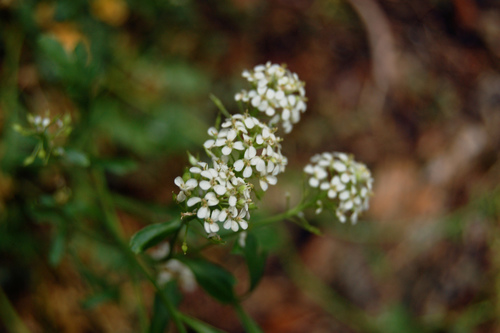
iNaturalist· cc-by-sa
(c) Stan Shebs, some rights reserved (CC BY-SA)
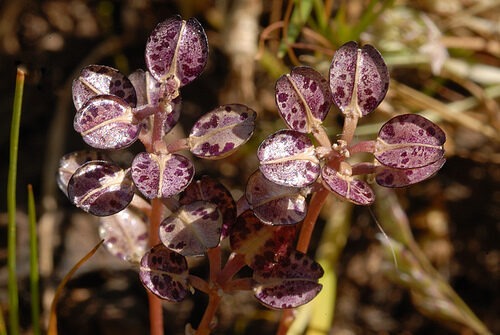
iNaturalist· cc-by
(c) P Holroyd, some rights reserved (CC BY)
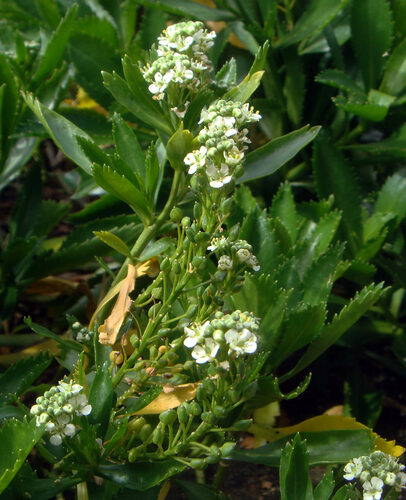
iNaturalist· cc-by-nc
(c) JJ Johnson, some rights reserved (CC BY-NC), uploaded by JJ Johnson
Summary
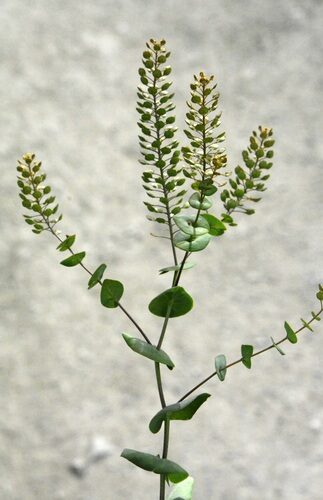
Source: WikipediaCaulanthus crassicaulis is a species of flowering plant in the family Brassicaceae known by the common name thickstem wild cabbage. It is native to the western United States where it is a member of the flora in sagebrush, woodland, and desert scrub habitats. This is a perennial herb producing a stout, inflated stem from a woody caudex base. The leaves form a basal rosette and occur at intervals along the stem. They are broadly lance-shaped on the lower stem and much smaller and linear in shape higher up. They may have smooth, toothed, or deeply cut edges. The rounded flower has a coat of thick, pouched sepals which part at the flower tip to reveal narrow dark purple or brown petals. There are two varieties of this species: var. crassicaulis generally has hairy flowers, while var. glaber has hairless. The fruit is a long, thin silique which may approach 13 centimeters (5.1 in) in length.
Description
A cabbage family herb. The stems are 20-100 cm long and 3 cm wide. The leaves at the base are in a ring. They are 1-2 cm long by 3-45 mm wide. The leaves on the stem are narrow.
Edible Uses
The leaves are occasionally eaten.
Traditional Uses
The leaves are occasionally eaten.
This uses section is brief — help expand it
Distribution
It is a temperate plant.
Where It Grows
North America, USA,
Synonyms
References (3)
- Beckstrom-Sternberg, Stephen M., and James A. Duke. "The Foodplant Database." http://probe.nalusda.gov:8300/cgi-bin/browse/foodplantdb.(ACEDB version 4.0 - data version July 1994)
- Saunders, C.F., 1948, Edible and Useful Wild Plants. Dover. New York. p 126
- World Checklist of Useful Plant Species 2020. Royal Botanic Gardens, Kew