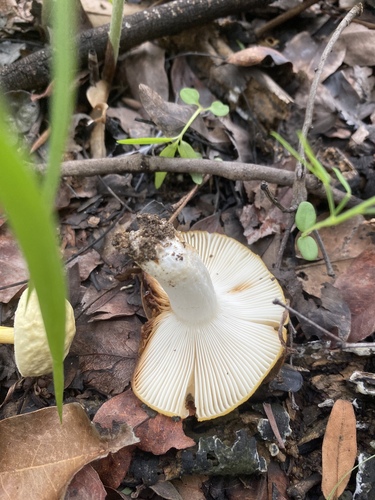
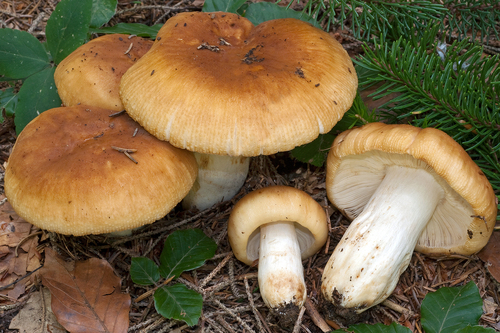
Lactarius badius
Verbeken
gbif· cc-by
Meise Botanic Garden
Description
A tropical fungus in the family Russulaceae.
This description is brief — help expand it
Edible Uses
Often considered a poor relation of the cep (Boletus edulis), the bay bolete is nevertheless highly regarded as a choice edible mushroom by some authors such as Carluccio. In central Mexico, it is collected from Izta-Popo Zoquiapan National Park and sold in neighbouring markets. It may cause an allergic reaction in some people, and the blue discolouration upon bruising can be offputting, although the staining disappears from white flesh when it is cooked. The flavour is milder than its better-known relative. Younger specimens are best for eating, though more mature ones can be suitable for cutting up and drying. The tendency for the pores to absorb water means that wiping rather than washing is recommended before use in the kitchen. Unlike most boletes, I. badia can be eaten raw (though only young mushrooms should be used). Otherwise it can be fried in butter, or used with meat or fish recipes. Mushrooms can also be frozen, dried, or pickled in cider vinegar, wine, or extra virgin olive oil, and later used in sauces or soups. The fruit bodies can be used to make mushroom dyes. Depending on the mordant used, colours ranging from yellow, orange, gold, and green-brown can be obtained. Without mordant, a yellow colour is produced.
Distribution
It is a tropical plant.
Where It Grows
Africa, Central Africa, Congo,
References (1)
- Verbeken, A. and Walleyn, R., 1999, Studies in Tropical African Lactarius species 7 A synopsis of the section edules and a review on the edible species. Belg. Journ. Bot. 132(2): 175-184