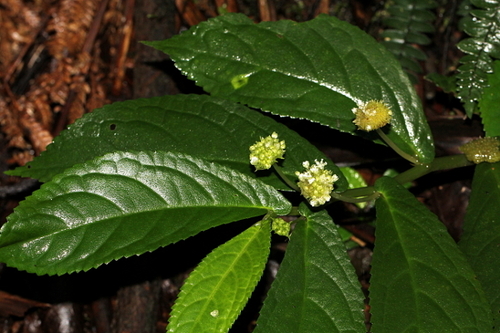
Urera aurantiaca
Wedd.
iNaturalist· cc-by-nc
(c) Lucía B. Correa Campos, some rights reserved (CC BY-NC)
iNaturalist· cc-by-nc
(c) Liu Idárraga Orozco, some rights reserved (CC BY-NC)
iNaturalist· cc-by-nc
(c) Liu Idárraga Orozco, some rights reserved (CC BY-NC)
Description
A perennial shrub in the Urticaceae family native to temperate Argentina, where it grows from sea level to 500 m in elevation.
This description is brief — help expand it
Edible Uses
Both the leaves and fruit are edible.
Medicinal Uses
The plant is diuretic.
Known Hazards
Although no specific mention has been seen for this species, most, if not all, members of this genus have strongly stinging hairs.
Distribution
It is a temperate plant. In Argentina it grows from sea level to 500 m above sea level.
Where It Grows
Argentina, Brazil*, Paraguay, South America*,
Cultivation
A dioecious species, both male and female forms need to be grown if fruit and seed are required.
Other Uses
A fibre obtained from the bark has industrial purposes.
Synonyms
Also Known As
Cacancao, Cansancao, Urtigao-do-rio, Urtiga-de-pacu
References (5)
- Bortolotto, I. M., et al, 2018, Lista preliminar das plantas alimenticias nativas de Mato Grosso do Sul, Brasil. Iheringia, Serie Botanica, Porto Alegre, 73 (supl.):101-116
- Brack, P., et al, 2020, Frutas nativas do Rio Grande do Sul, Brasil: riqueza e potencial alimentício. Native fruits of Rio Grande do Sul, Brazil: richness and potential as food. Rodriguésia 71: e0310201
- INFOODSUpdatedFGU-list.xls
- Kinupp, V. F., 2007, Plantas alimenticias nao-convencionais da regiao metropolitana de Porto Alegre, RS, Brazil p 105
- Kinupp, V. F. & Bergman, I., 2008, Protein and minerals of native species, potential vegetables and fruits. Cienc.Tecnol. Aliment. Vol. 28 No. 4 Campinas Oct/Dec.