Castanea alnifolia
Nutt.
Bush chinkapin, Florida chinkapin, Trailing chinkapin, Downy chinquapin
iNaturalist· cc-by-nc
(c) thesoulflowers, some rights reserved (CC BY-NC)
iNaturalist· cc-by-nc
(c) thesoulflowers, some rights reserved (CC BY-NC)
iNaturalist· cc-by
(c) Alex Abair, some rights reserved (CC BY)
Summary
Source: WikipediaA small deciduous shrub reaching 1 m tall. Monoecious with insects-pollinated flowers blooming in July and seeds ripening in October. Prefers full sun and grows in light to heavy soils with good drainage, including nutritionally poor soil. Tolerates very acidic through neutral pH, and can withstand drought conditions. Hardy to UK zone 7.
Description
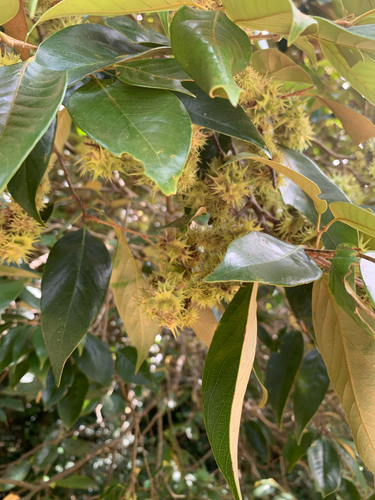
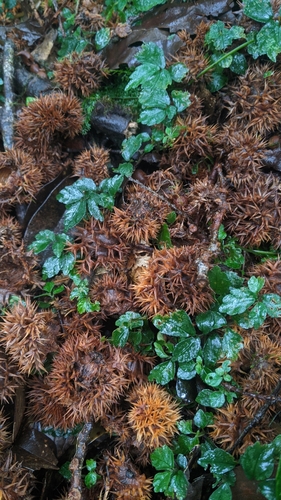
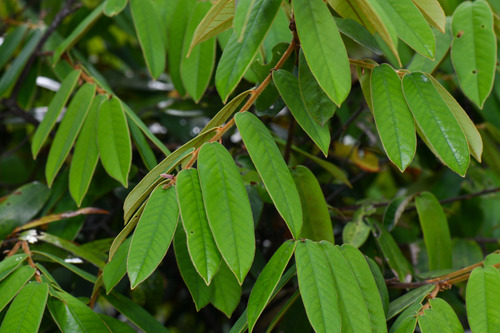
A low spreading shrub. It has an irregular spreading crown. It grows 12 m high. The trunk is 30 cm across. The bark is grey-brown and becomes rough with long furrows. The leaves are 7.5-10 cm long and 2.5-5 cm wide. They are broadly oval with many straight side veins. There are short teeth around the edge. The leaf stalks are short and without hairs. The leaves are dark green above and paler underneath. The flowers are very small and white. The male flowers are in catkins 10-13 cm long at the base of a leaf. There are several very small female flowers at the base of shorter catkins. The fruit are 2-2.5 cm across. They have burs with a few scattered spines. They split open. They contain one nut which is egg shaped. It is shiny brown and edible.
Edible Uses
The seed of Castanea alnifolia is of excellent quality and can be eaten raw or cooked. Though small, the seeds are sweet and larger than those of C. pumila, though produced less abundantly. Eaten raw, there is a distinct astringency, particularly if the fleshy inner skin beneath the outer shell is not removed. When cooked — and especially when baked — the seed becomes much sweeter with a floury texture, making an excellent food that can serve as a staple in much the same way as potatoes or cereals. The burs have fewer prickles than related species, making harvest easier.
Traditional Uses
The nuts are eaten.
This uses section is brief — help expand it
Medicinal Uses
None known.
Distribution
It is a temperate plant. It grows in uplands on sandy soils in oak forests. It grows near sea level.
Where It Grows
North America, USA,
Cultivation
Prefers a good well-drained slightly acid loam but succeeds in dry soils. Once established, it is very drought tolerant. Very tolerant of highly acid, infertile dry sands. Averse to calcareous soils but succeeds on harder limestones. This species only really thrives in areas with hot summers, it may not be hardy in Britain. Another report says that it succeeds in climatic zone 7 and should therefore tolerate temperatures down to at least -10°c. Usually a small shrub, this species occasionally reaches small-tree size (as C. alnifolia floridana. Sarg.) This species is similar to and often confused with C. pumila. An excellent soil-enriching understorey shrub in pine forests. It grows into a clump by means of suckers. Flowers are produced on wood of the current year's growth. Plants are fairly self-sterile. They hybridize freely with other members of this genus. Plants in this genus are notably resistant to honey fungus.
Propagation
Where possible, sow seed as soon as it is ripe in a cold frame or outdoor seedbed. Seed must be protected from mice and squirrels. It has a short viability and must not be allowed to dry out; it can be stored moist in a cool place such as a fridge salad compartment for a few months, but should be checked regularly for signs of germination. Seed should germinate in late winter or early spring. Plants sown in an outdoor seedbed can remain in situ for 1–2 years before being moved to permanent positions. Plants grown in pots can go into permanent positions in summer or autumn, with some cold protection in their first winter. Division of suckers in winter is also possible; these can be planted directly into permanent positions.
Other Uses
The bark, leaves, wood and seed husks all contain tannin.
Notes
All Castanea bear edible nuts. There are about 12 Castanea species.
Dangerous Lookalikes
This plant can be confused with the following toxic species. Always verify identification carefully before consuming any wild plant.
Horse Chestnut (Conker)
Aesculus hippocastanum
Solipsist
Bush chinkapin
Castanea alnifolia
(c) thesoulflowers, some rights reserved (CC BY-NC)
Horse Chestnut (Conker): Round smooth nuts (conkers), bumpy green husk (not very spiny), palmate compound leaves (like a hand).
Bush chinkapin: Nuts with pointed tassel, very spiny bur casing, simple toothed leaves.
References (5)
- Facciola, S., 1998, Cornucopia 2: a Source Book of Edible Plants. Kampong Publications, p 114
- Gen. N. Amer. pl. 2:217. 1818
- Little, E.L., 1980, National Audubon Society Field Guide to North American Trees. Alfred A. Knopf. p 376
- Plants for a Future database, The Field, Penpol, Lostwithiel, Cornwall, PL22 0NG, UK. http://www.scs.leeds.ac.uk/pfaf/
- Tozer, F., 2007, The Uses of Wild Plants. Green Man Publishing. p 59