Cassine aethiopica
Thunb.
Cape cherry, Kooboo-berry
iNaturalist· cc-by-nc
(c) Ann, some rights reserved (CC BY-NC)
iNaturalist· cc-by-nc
(c) Ann, some rights reserved (CC BY-NC)
iNaturalist· cc-by-nc
(c) Ann, some rights reserved (CC BY-NC)
Description
A slender tree. It has many branches. It can be 12-20 m tall. The trunk can be 60 cm across. The bark is rough and dark. The leaves are simple and alternate. They are leathery. They are 1.3-13 cm long by 0.8-6 cm wide. The shape varies. The leaf stalks are often yellow and 6 mm long. The flowers are small and yellow. They are produced in clusters in the axils of leaves. The fruit is fleshy with one stone inside. They are 0.8-2.5 cm long and oval. They are deep pink or red when ripe. There is one seed. The fruit is edible.
Edible Uses
The ripe fruit is eaten and is sweet. In Kenya, the ripened fruit is mixed with porridge or gruel and with white liquor from crushed, cooked maize.
Traditional Uses
The fruit is eaten. It is sweet. In Kenya the ripened fruit is mixed with porridge or gruel and with the white liquor from crushed, cooked maize.
This uses section is brief — help expand it
Distribution
A tropical plant. It can grow under a range of conditions. It can be in arid scrub or swamp forest. It grows in savanna. It also occurs in rainforest. It suits humid locations. In Malawi it grows from 750-2,450 m altitude.
Where It Grows
Africa, Angola, Botswana, Cameroon, Central Africa, Comoros, Congo, East Africa, Eswatini, Ethiopia, Equatorial-Guinea, Kenya, Madagascar, Malawi, Mozambique, Namibia, Seychelles, South Africa, Southern Africa, Sudan, Swaziland, Uganda, Zambia, Zimbabwe,
Cultivation
Plants can be grown from seeds.
Production
Plants grow fairly quickly.
Other Information
The fruit are eaten by children.
Notes
There are 80 Cassine species. Most are in Africa. The Celastraceae are mostly in the tropics and subtropics.
Nutrition
| Part | Moisture | kJ | kcal | Protein | Vit A | Vit C | Iron | Zinc |
|---|---|---|---|---|---|---|---|---|
| Fruit | 75.4 | 342 | 82 | 0.8 | — | — | — | — |
Synonyms
Also Known As
Acnond-rateng, Bushveld cherry, Ethelei, Ingukutane, Inqayi, Kalumekamukuwe, Kigori, Kukadshi, Londongoniyo, Mgungulutane, Mkimgulutane, Mlimbo-limbo, mu-Kawa, Mubendabendi, Mudangwa, Muhundui, Mukongau, Ondiek, Umgxube, Umnqayi, Xikayi
References (22)
- Dale, I. R. and Greenway, P. J., 1961, Kenya Trees and Shrubs. Nairobi. p 132
- Drummond, R. B., 1981, Common Trees of the Central Watershed Woodlands of Zimbabwe, National Herbarium Salisbury. p 126
- Fl. cap. 2(1):227. 1818
- Fox, F. W. & Young, M. E. N., 1982, Food from the Veld. Delta Books. p 148
- Glover et al, 1969,
Show all 22 references Hide references
- INFOODS:FAO/INFOODS Databases
- Jardin, C., 1970, List of Foods Used In Africa, FAO Nutrition Information Document Series No 2.p 149 (As Mystroxylon aethiopicum)
- Johns, T., and Kokwaro, J.O., 1991, Food Plants of the Luo of Siayo District, Kenya. Economic Botany 45(1), pp 103-113 (As Mystroxylon aethiopicum)
- Malaisse, F., 1997, Se nourrir en floret claire africaine. Approche ecologique et nutritionnelle. CTA., p 59
- Malaisse, F., 2010, How to live and survive in Zambezian open forest (Miombo Ecoregion). Les Presses Agronomiques de Gembloux.
- Palgrave, K.C., 1996, Trees of Southern Africa. Struik Publishers. p 509
- Palmer, E and Pitman, N., 1972, Trees of Southern Africa. Vol. 2. A.A. Balkema, Cape Town p 1313
- Peters, C. R., O'Brien, E. M., and Drummond, R.B., 1992, Edible Wild plants of Sub-saharan Africa. Kew. p 80
- RILEY & BROKENSHA,
- Roodt, V., 1998, Trees & Shrubs of the Okavango Delta. Medicinal Uses and Nutritional value. The Shell Field Guide Series: Part 1. Shell Botswana. p 194
- Ruiters-Welcome, A. K., 2019, Food plants of southern Africa. Ph.D. thesis. Univ. of Johannesburg p 43
- Shava, S., 2000, The Use of Indigenous Plants as Food by a Rural Community in the Eastern Cape: an Educational Exploration. Masters Thesis Rhodes University. p 63
- van Wyk, B, van Wyk, P, and van Wyk B., 2000, Photographic guide to Trees of Southern Africa. Briza. p 208 (As Mystroxylon aethiopicum)
- Wehmeyer, A. S, 1986, Edible Wild Plants of Southern Africa. Data on the Nutrient Contents of over 300 species
- Welcome, A. K. & Van Wyk, B.-E., 2019, An inventory and analysis of the food plants of southern Africa. South African Journal of Botany 122 (2019) 136–179 (As Mystroxylon aethiopicum)
- White, F., Dowsett-Lemaire, F. and Chapman, J. D., 2001, Evergreen Forest Flora of Malawi. Kew. p 183
- www.zimbabweflora.co.zw 2011
More from Celastraceae
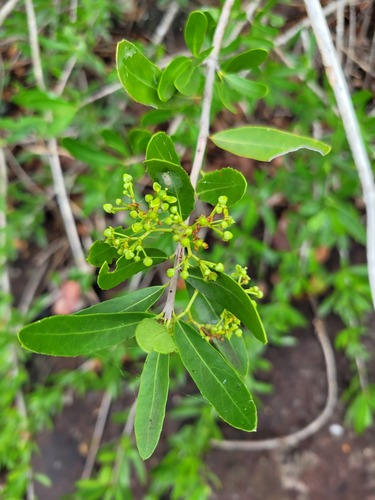
Elaeodendron sphaerophyllum
Elaeodendron transvaalense
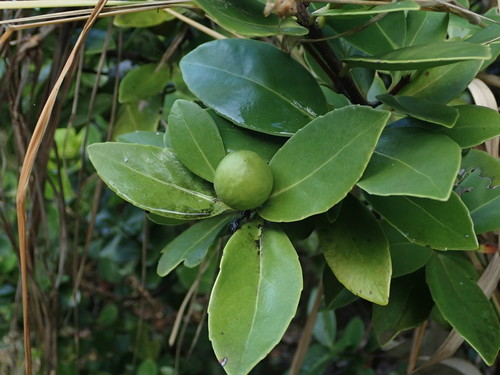
Transvaal saffronwood, Three-petalled cassine
Elaeodendron xylocarpum
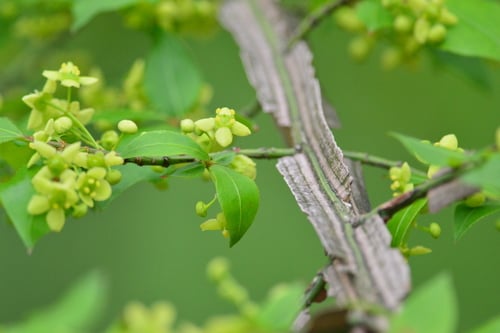
Marble tree, Olive wood
Euonymus alatus
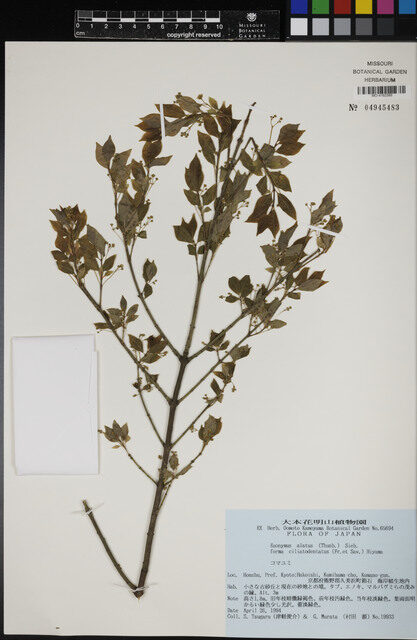
Winged spindle tree, Cork bush, Winged Euonymus, Burning bush
Euonymus alatus apterus
Winged Spindle Tree
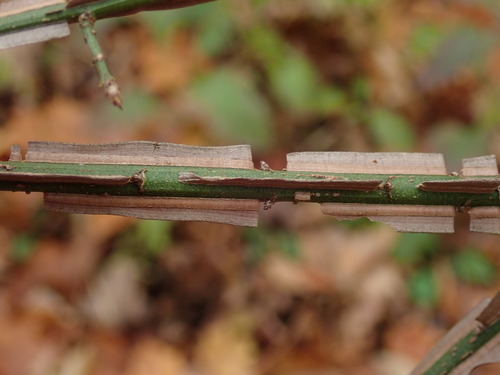
Euonymus alatus subsp. apterus
Winged spindle tree