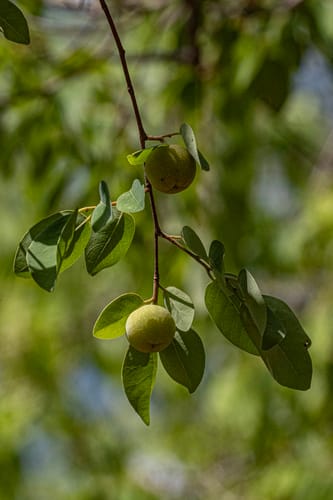
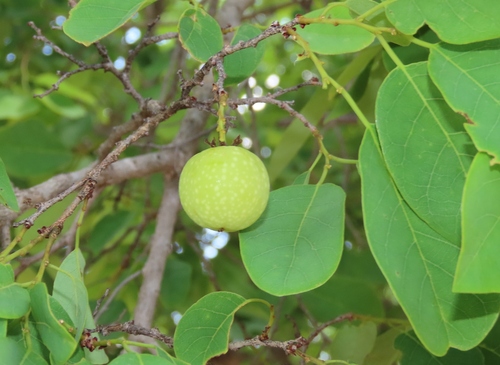
Caryodendron orinocense
H. Karsten
Taccy nut, Tacaynut, Orinoco nut, Baniras nut
iNaturalist· cc-by-sa
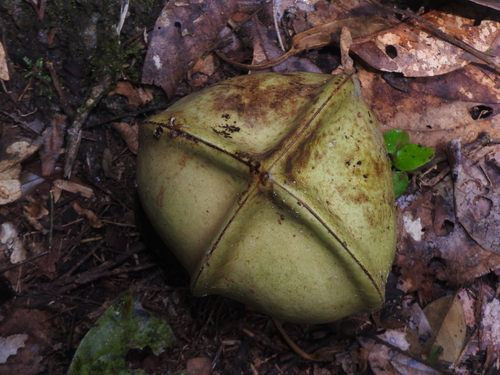
(c) Elkin.paezh, some rights reserved (CC BY-SA)
iNaturalist· cc-by-sa
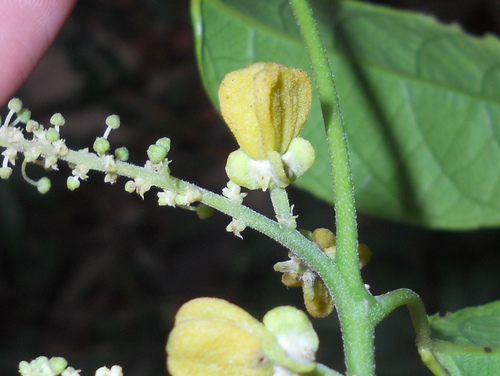
(c) Puyote, some rights reserved (CC BY-SA)
iNaturalist· cc-by-nc
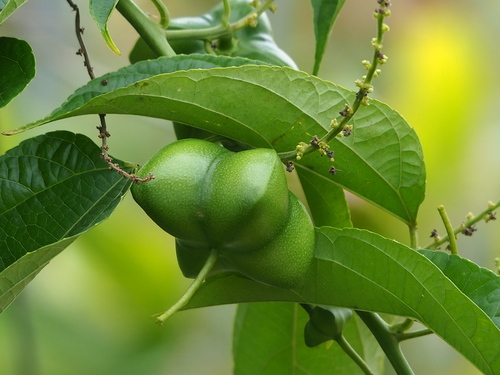
(c) Apipa, some rights reserved (CC BY-NC)
Summary
Source: WikipediaCaryodendron orinocense, commonly known as cacay, inchi or orinoconut, is an evergreen tree belonging to the family Euphorbiaceae. This species of flowering plant is indigenous to the north-west of South America, particularly from the drainage basins of the Orinoco and Amazon rivers located in Colombia, Venezuela, Ecuador, Peru and Brazil. Originally described by Hermann Karsten in 1858, the cacay tree distinguishes itself by its dense and leafy top, as well as its production of fruits, each one containing three edible nuts. Cacay is notable for the oil extracted from its nuts, which is edible and is also used in cosmetics.
Description
A large tree. It grows 25 m high. The trunk is straight and has slight grooves. The leaves are alternate. They are dark green above and pale underneath. They are narrowly oval and 12-15 cm long by 4-10 cm wide. Male and female flowers are separate. The male flowers do not have petals and are in groups at the ends of branches. Female flowers are in round groups. There are 3 large seeds in each fruit. They are 1.5 cm long.
Edible Uses
The seeds of Caryodendron orinocense can be eaten raw, roasted, fried or ground into a powder. After removing the leathery testa, the kernels — each around 25 mm long, enclosed in a thin shell easily broken with the fingers — have a pleasant flavour resembling hazel nuts. They can be eaten raw, roasted, fried, or ground for use in drinks or sweets. Under dry conditions, nuts will keep for around 30 days in the capsule; shell damage or a moist environment can trigger enzyme reactions leading to acidification and rancidity of the oil. When dried and roasted, seeds can be safely stored for a long time in sealed plastic bags. The seeds are a source of an edible oil rich in linoleic acid (34.4%), which can be safely stored for a long time without turning rancid.
Traditional Uses
The seeds are roasted and eaten. They can be fried or ground into a powder. They can be used for a drink or sweets. They also produce cooking oil.
Medicinal Uses
The nuts and oil are regarded as an excellent remedy for pulmonary complaints and dermatitis.
Distribution
A tropical plant. It grows in valleys and on mountains. It grows from sea level to 2,300 m above sea level. It can grow in damp soil. It can grow in poor soils that are acid and have high levels of aluminium. It grows in tropical forests where the annual temperatures are 24°C and rainfall of 2,000-4,000 mm per year. It cannot tolerate fire nor droughts.
Where It Grows
Amazon, Bolivia, Brazil, Colombia, Ecuador, Peru, South America, Venezuela,
Cultivation
Experimental Crop Management: Standard Staple Crop: Protein-oilA plant of the semi-arid to moist tropics, where it is found at elevations up to 2,300 metres. It grows best in areas where annual daytime temperatures are within the range 20 - 29c, but can tolerate 12 - 35c. It prefers a mean annual rainfall in the range 1,200 - 3,000mm, but tolerates 800 - 5,000mm. Prefers a position in full sun. Succeeds on a wide range of soils. Tolerates a few months of mild drought and withstands brief waterlogging. Prefers a pH in the range 5 - 6, tolerating 4.5 - 6.5. Plant growth is rapid, with fruiting usually beginning in the seventh year when trees are around 7 metres tall. Occasional plants will commence fruiting when as young as 4 - 5 years old. The average weight of a nut is 8.5 g, attaining 12.5 g or more in superior selections. A 10 year old tree can yield 100 - 250 kg of nuts per annum, an old specimen has given about 800 kg. There is the potential for an annual production of 3,500 - 5,000 kg of oil per ha from trees bearing nuts with an oil content of 57%. Both monoecious and dioecious trees have been reported - it is important to make sure you are either growing monoecious forms, or have both male and female dioecious forms if seed is required.
Propagation
Seed has a short viability and should ideally be sown within 10 days of harvesting; it is reputed to fail to germinate if more than 35 days old. Shade is required during the first year of growth, followed by full sun exposure on transplanting when the seedling is around 50 cm tall, at the onset of the following rainy season.
Other Uses
The tree is grown as a shade tree in coffee and cacao plantations. Oil extracted from the shells and seeds is used as an illuminant. A latex obtained from the bark also serves as an illuminant. The wood is not considered valuable or durable but is used for furniture. It makes an excellent charcoal.
Production
It is slow growing. There are about 300 seeds in a kg.
Other Information
Nuts are sold in local markets. It is cultivated.
Synonyms
Also Known As
Almendro, Almendro del Peru, Achansu, Cacay, Caqueta, Castano, Caycay, Huachanzo, Inchi, Mani de monte, Meta, Muaemanzo, Sacha inchik, Suni, Naam, Naampi, Nalampi, Nambi, Ninacuru inchi, Nogol, Nuez, Nuez cacai, Putumayo, Sacha inchi, Shimpi, Tacay, Taqui, Tocay taque, Wachansi
References (24)
- Bendezu, Y. F., 2018, Arboles nativos de lad Region Ucayali. Instituto Nacional de Innovacion Agraria. p 110
- Bennett, B. C., 1990, Useful Plants of Amazonian Ecuador. US Agency for International Development. Fifth Progress Report. New York Botanical Gardens. p 40
- Bircher, A. G. & Bircher, W. H., 2000, Encyclopedia of Fruit Trees and Edible Flowering Plants in Egypt and the Subtropics. AUC Press. p 88
- Creed-kanashiro, H., et al, Traditional food system of an Awajun community in Peru. Indigenous Peoples' food systems Chp. 4
- Etkin, N.L. (Ed.), 1994, Eating on the Wild Side, Univ. of Arizona. p 122, 137, 155
Show all 24 references Hide references
- Ferns, Useful Tropical Plants.
- Fl. columb. 1:91, t. 45. 1858 (As Caryodendron orinocense)
- Flores, Y., 2018, Arboles nativos de la Region Ucayili. Estacion Experimental Agragia Pucallpa. Pucallpa Peru, 375 p. p 110
- Fouqué, A. 1972. Espèces fruitières d'Amérique tropicale. Institut français de recherches fruitierès outre-mer
- Gori, B., et al, 2022, Understanding the diversity and biogeography of Colombian edible plants. Scientific Reports 12:7835
- Grandtner, M. M. & Chevrette, J., 2013, Dictionary of Trees, Volume 2: South America: Nomenclature, Taxonomy and Ecology. Academic Press p 104
- Hermandez Bermejo, J.E., and Leon, J. (Eds.), 1994, Neglected Crops. 1492 from a different perspective. FAO Plant Production and Protection Series No 26. FAO, Rome. p18
- Kermath, B. M., et al, 2014, Food Plants in the Americas: A survey of the domesticated, cultivated and wild plants used for Human food in North, Central and South America and the Caribbean. On line draft. p 193
- León, J. 1987. Botánica de los cultivos tropicales. Instituto Interamericano de Cooperación para la Agricultura, Servicio Editorial. San José, Costa Rica.
- Martin, F. W., et al, 1987, Perennial Edible Fruits of the Tropics. USDA Handbook 642 p 95
- Menninger, E.A., 1977, Edible Nuts of the World. Horticultural Books. Florida p 50
- V.M. NIETO, V. M. and RODRIGUEZ, J., Caryodendron orinocense H. Karst. Corporacion Nacional de Investigacion of Forestal Santafé de Bogotá, Colombia
- Padilla, F.C., M. T. Alvarez & M. J. Alfaro, 1996, Functional properties of barinas nut flour (Caryodendron orinocense Karst., Euphorbiaceae) compared to those of soybean Food Chemisrry, Vol. 57. No. 2, pp. 191-196, 1996
- Roa, J. A. G. & Boada, D. S. G., 2018, Fundación para el Fortalecimiento de la Fruticultura y Plantas Alimenticias no Convencionales en Colombia.
- Torre, de la, L., et al, 2008, Enciclopedia de las Plantas Útiles del Ecuador. Herbario QCA. Pontificia Universidad Católica del Ecuador. p 320
- Van den Eynden, V., et al, 2003, Wild Foods from South Ecuador. Economic Botany 57(4): 576-603
- Wickens, G.E., 1995, Edible Nuts. FAO Non-wood forest products. FAO, Rome. p 67, 121
- Wiersema, J. H. & Leon, B., 2013, World Economic Plants. A Standard Reference CRC Press. 2nd Ed. p 148
- World Checklist of Useful Plant Species 2020. Royal Botanic Gardens, Kew