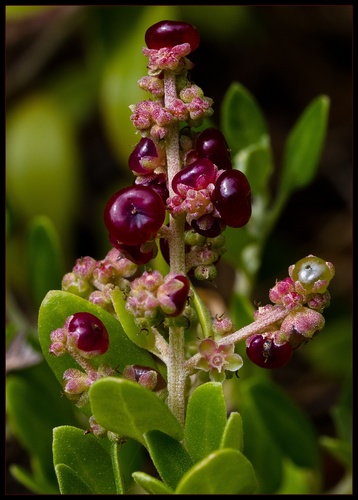
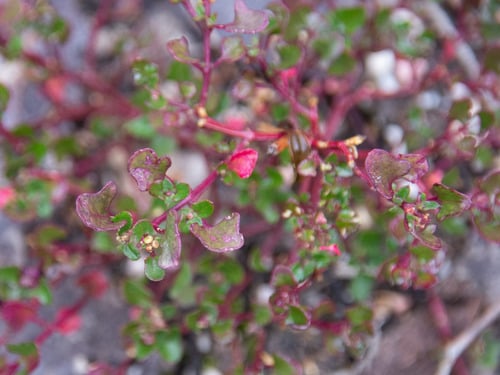
Salicornia pachystachya
Bung ex Ung.-Sternv.
Glasswort, Samphire
iNaturalist· cc-by-nc
(c) Ricky Taylor, some rights reserved (CC BY-NC), uploaded by Ricky Taylor
Description
An erect herb. It grows each year from seeds. It grows 40 cm tall. The stem has several branches. It is almost leafless. It has a series of cup shaped segments along the branches. The fertile segments have spikes at the end. These are 1-2.5 cm long. The flowers are in clusters of 3. The fruit is a nut. The seeds are oval and 1.5 mm long.
Edible Uses
Young shoots - raw or cooked. A distinctive, salty flavour, much liked by some. They can be eaten fresh in salads or as a garnish, pickled in vinegar, or as a cooked vegetable, similar to other Salicornia species outside Africa.
Traditional Uses
The young shoots are eaten fresh in salads. They are also cooked and can be pickled in vinegar.
This uses section is brief — help expand it
Medicinal Uses
It is said that juice of the fresh plant is an excellent diuretic.
Distribution
It is a tropical plant. It grows in salt marshes and mangrove swamps at sea level.
Where It Grows
Africa, Asia, Australia, East Africa, India, Kenya, Madagascar, Mozambique, South Africa, Tanzania,
Other Uses
The plant is rich in salt. Formerly, the ash of Salicornia species was used for washing.
Other Information
A minor vegetable becoming more popular because of its distinctive taste.
Notes
This may be changed to the family Brassicaceae. There are 30-40 Salicornia species.
Synonyms
References (2)
- Grubben, G. J. H. and Denton, O. A. (eds), 2004, Plant Resources of Tropical Africa 2. Vegetables. PROTA, Wageningen, Netherlands. p 452
- Martin, F.W. & Ruberte, R.M., 1979, Edible Leaves of the Tropics. Antillian College Press, Mayaguez, Puerto Rico. p 182 (As Arthrocnemum pachystachyum)