Aglaia chittagonga
Miq.
iNaturalist· cc-by-nc
(c) JODY HSIEH, some rights reserved (CC BY-NC), uploaded by JODY HSIEH
iNaturalist· cc-by-nc
(c) JODY HSIEH, some rights reserved (CC BY-NC), uploaded by JODY HSIEH
iNaturalist· cc-by-nc
(c) JODY HSIEH, some rights reserved (CC BY-NC), uploaded by JODY HSIEH
Summary
Source: WikipediaAglaia chittagonga is a species of plant in the family Meliaceae. It is found in Bangladesh, Taiwan, and Thailand.
Description
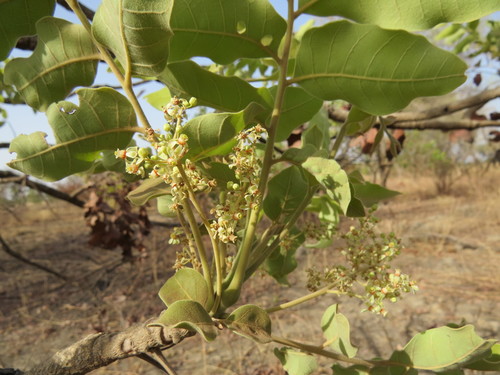
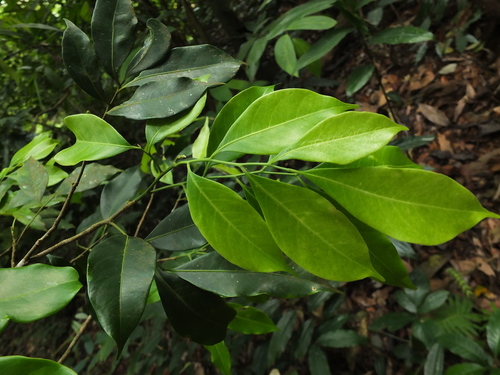
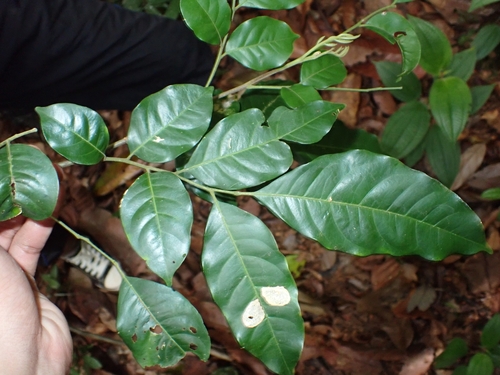
An evergreen tree. It grows 10-14 m tall. The leaves are compound and 30 cm long. The leaflets underneath are covered with small pale brown scales. The flowers are in clusters 10 cm long. The fruit are oval and are in 2 sections but do not split.
Edible Uses
Fruit - raw. The orange-brown, ellipsoid fruit is around 25mm long and 15mm wide; containing up to 2 seeds, each surrounded by a layer of edible flesh.
Medicinal Uses
The genus 'Aglaia' is the only source of the group of about 50 known representatives of compounds that bear a unique cyclopenta[b]tetrahydrobenzofuran skeleton. These compounds are more commonly called rocaglate or rocaglamide derivatives, or flavaglines, and most have been found to have potent insecticidal properties, antifungal, antiviral, antibacterial or anthelmintic bioactivity. Several of them exhibit pronounced cytotoxic activity against a range of human cancers. Since the first representative in this group was only discovered in 1982, this is one of the few recent examples of a completely new class of plant secondary metabolites of biological promise (see B. G. Wang et al., Biochem. Syst. Ecol. 32: 1223-1226. 2004; L.W. Chaidir et al., J. Nat. Prod. 64: 1216-1220. 2001).
Distribution
It is a tropical plant. It grows in forests between 25-1,600 m above sea level. It can be over limestone.
Where It Grows
Asia, Bangladesh, Bhutan, India, Indochina, Myanmar, SE Asia, Taiwan, Thailand,
Cultivation
A dioecious species, both male and female forms need to be grown if fruit and seed are required.
Other Uses
The genus 'Aglaia' is the only source of the group of about 50 known representatives of compounds that bear a unique cyclopenta[b]tetrahydrobenzofuran skeleton. These compounds are more commonly called rocaglate or rocaglamide derivatives, or flavaglines, and most have been found to have potent insecticidal properties, antifungal, antiviral, antibacterial or anthelmintic bioactivity. Several of them exhibit pronounced cytotoxic activity against a range of human cancers. Since the first representative in this group was only discovered in 1982, this is one of the few recent examples of a completely new class of plant secondary metabolites of biological promise (see B. G. Wang et al., Biochem. Syst. Ecol. 32: 1223-1226. 2004; L.W. Chaidir et al., J. Nat. Prod. 64: 1216-1220. 2001).
Production
In Thailand flowering and fruiting can be February to December, but is more common mid year.
Synonyms
Also Known As
Khang klao nu, Sa ka tong, Ta suea, Tang kiat
References (2)
- Gardner, S., et al, 2000, A Field Guide to Forest Trees of Northern Thailand, Kobfai Publishing Project. p 119
- Wongprasert, T. et al, 2011, A Synoptic Account of the Meliaceae of Thailand. Thai For. Bull. 39:210-266